Getting Around Italy by Train
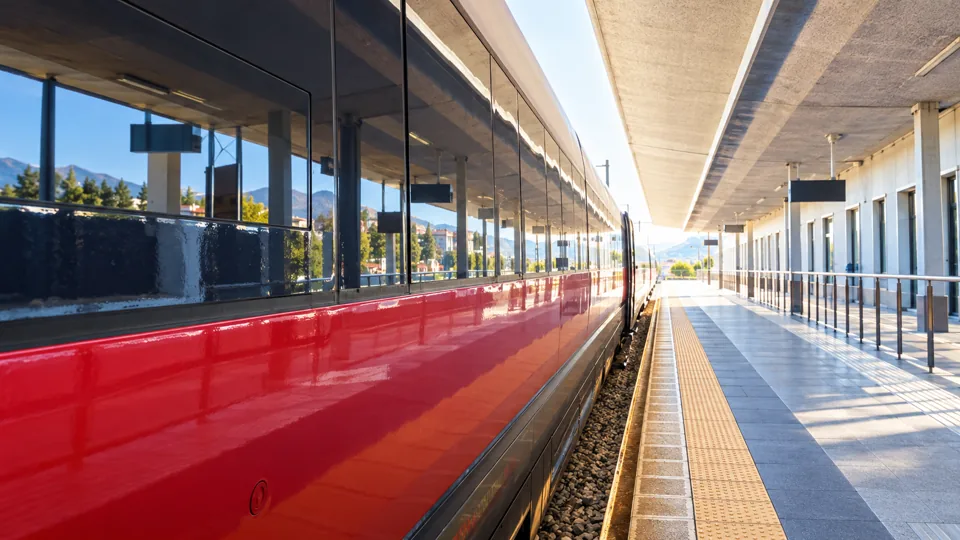
Italy has two kinds of passenger trains that matter to visitors: fast, reserved trains between major cities, and slower regional trains that stop at most stations. Two competing companies run the high-speed network. Trenitalia is the passenger arm of the state railway, and Italo is a private operator. Each sells its own tickets through its own website and app, and a ticket from one company is not valid on the other’s trains. Trenitalia also runs the regional trains, which follow different rules for seats, prices, and ticket stamping.
Rome to Milan takes under three hours on the fastest services. Rome to Naples or Florence takes a little over an hour to an hour and a half. First-time riders most often run into three problems: regional paper tickets that must be stamped before boarding, stations with similar names in the same city, and rail strikes that cluster on a few dates each month. Each one is covered below.
The Two Operators and Their Trains
Trenitalia’s top service is Frecciarossa, which runs at speeds up to 300 km/h and links Rome, Florence, Milan, Venice, Naples, Bologna and Turin. Frecciargento and Frecciabianca are the other reserved long-distance trains in the Frecce family, and Intercity trains cover longer, slower routes. Italo operates a similar high-speed corridor, roughly Turin, Milan, Bologna, Florence, Rome and Naples. For most city-to-city trips on that spine, both companies are options, so compare prices and departure times on each.
Regional trains are subsidized by regional governments under service contracts and stop at many more stations than long-distance trains. They have no seat reservations, so buying a regional ticket weeks ahead gives no price advantage, and non-residents get no discount. Regional trains suit short hops, such as Florence to a nearby Tuscan town, or the last leg to a place the fast trains skip.
Typical Routes and Travel Times
Trenitalia publishes journey times and daily frequencies for its main Frecciarossa corridors. These are marketing-level figures, and actual running times change with the stops a particular train makes.
| Route | Trenitalia figure | Daily frequency |
|---|---|---|
| Rome to Milan | Non-stop in 2h 50′ | Over 100 connections |
| Rome to Florence | A little over 1h 30′ | Over 100 |
| Rome to Naples | A little over 1h | Over 100 |
| Milan to Naples | A little over 4h | 70 |
| Milan to Venice | No time given | 44 |
| Milan to Florence | No time given | Up to 80, stopping at Reggio Emilia AV and Bologna Centrale |
| Rome to Venice | No time given | Over 30 |
Trenitalia’s Frecciarossa overview lists the Milan to Venice, Milan to Florence and Rome to Venice frequencies. For Italo, no official timetable is available here, so use its website or app for its departure times.
The published service windows show how early and late you can travel. From Rome, Florence-bound departures run from 5:10 to 21:48, and from Florence to Rome from 6:00 to 22:14. Naples departures from Rome run from 7:00 to 22:35, and from Naples from 5:09 to 20:30. The Rome to Milan page gives a sample day: Rome Termini 5:38 to Milano Centrale 8:30, and Milano Centrale 20:35 back to Roma Termini 23:25.
Rome to Milan times depend on which stations you use. An earlier Trenitalia announcement gave 2h 45′ for Roma Tiburtina to Milano Rogoredo and 2h 59′ for Roma Termini to Milano Centrale, with about 90 daily connections. Plan around about three hours for central station to central station, and check the exact train before booking.
Engineering works change those numbers sharply. During works near Orvieto and Chiusi one August, a Milan to Rome Frecciarossa with the same 9:58 departure took 4h 55′ as train 9623, while the week before it had run in the usual 3h 12′ as train 9619. The longer run came from intermediate stops added to that train number. In August, a connection to a flight or a dinner reservation needs more margin than the timetable average suggests.
Which Station You Need
Both operators serve several stations in Rome, Milan and Venice, and the stations have different names and locations. Roma Termini and Roma Tiburtina are separate stations, and the same applies to Milano Centrale and Milano Rogoredo. Look at the station names on your ticket before leaving your hotel, especially when you switch operators between outbound and return trips.
Buying Tickets
Tickets are sold on the Trenitalia and Italo websites and apps, at station counters and machines, and through authorized agencies. Third-party retailers such as Trainline sell both operators’ tickets side by side, which makes price comparison easy. Italo tickets are not sold through Italiarail. Cards and PayPal work online, and e-tickets arrive by email or in the app. Trenitalia’s own site is reported to limit one transaction to five passengers, so larger groups should split the booking.
High-speed fares are reportedly released 90 to 120 days ahead, and Italo follows a similar window. If your date does not appear, the fares have not opened yet, so check again closer to the date. Booking early matters most on the cheapest fares, which have limited availability.
Fares and Flexibility
Trenitalia’s cheapest advance fares are Economy and Super Economy. Both are valid only on the booked train and carry no refund. Economy can be changed before departure by paying any difference, and Super Economy cannot be changed at all. The Base fare is sold on all channels until departure and covers Frecce, Intercity, Intercity Notte and FrecciaLink in all classes. It is the fare to choose when your plans are not fixed.
Italo sells Low Cost, Economy and Flex fares. Low Cost is the cheapest and the most restricted. Italo’s Economy fare includes a paid "Extra Tempo" service, which gives you one hour to find a seat on the next suitable train, subject to availability. The names overlap with Trenitalia’s, but the products are separate, so Italo’s Economy rules do not apply to Trenitalia’s Economy, and Trenitalia’s do not apply to Italo’s. On either operator, missing your train on a Super Economy or Economy ticket normally means losing the ticket, unless you bought a rebooking add-on such as "tiRimborso" at booking.
Changes and Refunds
Trenitalia’s official ticket guide sets out the change rules. Before departure, you can change a ticket by paying any price difference. If the new ticket costs less, the difference is refunded minus a deduction, provided the original train has not left. After departure, a change is possible only up to one hour afterward, only at the ticket office of the departure station, and never at a self-service machine. The new travel must fall within six months of the first change request. Passengers can also ask for a refund before departure if they give up the trip, and can claim delay compensation after traveling. The official page confirms both options, but the compensation thresholds are in Trenitalia’s own conditions, so read them on the day you need them.
Italo’s transport contract allows a refund for personal reasons up to three minutes before scheduled departure, if the fare permits it, and the refund follows that fare’s terms and deductions. A combined ticket can be refunded only as a whole, up to three minutes before the first leg departs. If Italo fails to provide transport through its own fault, the passenger is refunded the full price of transport and ancillary services, subject to exceptions listed in the contract.
International tickets follow different terms. Trenitalia’s conditions for trains such as the night train between Italy, Austria and Germany say some of those tickets cannot be changed at all. Do not assume the domestic change rules apply to them.
Validating Tickets
High-speed and Intercity tickets, including Italo, do not need stamping. They are reserved with a date, time and seat, and you show a QR code or booking reference on your phone or a printout. A conductor scans the e-ticket on board. Download or print the ticket before you travel, since a confirmation receipt sent by email may not be the ticket itself.
Regional tickets are the exception. A paper regional ticket bought at a station or machine must be validated at a validator machine before you board. Validators sit near platform entrances, in colors that vary from station to station, and validation cannot be done online. Validate before the train leaves the origin station, because an unstamped paper ticket is treated as no ticket. If the machine is broken, tell the conductor as soon as you board and be ready to show that you got on at a station where it was not working.
Online regional tickets with a chosen departure time arrive already validated and need no stamping. Whether the Trenitalia app also asks for a check-in tap before boarding has changed over time. Read the instructions on your ticket in the app and follow them. Regional validity is commonly four hours from the selected departure, and some tickets use different periods, so check the validity printed on the ticket instead of assuming. Digital regional tickets remain valid until the scheduled arrival of the booked trains, and a delayed train does not invalidate them.
Fines for Invalid Tickets
Riding without a valid ticket, including an unstamped regional ticket, brings fines that are far larger than the fare. On long-distance trains, the penalty is the full fare plus a €200 surcharge, reduced to €100 if paid within 15 days. An unvalidated or irregularly validated ticket found on board is treated the same way. Fines on regional paper tickets are reported at €50 or more. Check Trenitalia’s conditions of carriage for the amounts currently in force.
The usual causes are easy to avoid: a bus ticket used on a train, a forgotten stamp, or a pass that does not cover the route. If you have no ticket at all, find a conductor as you board, since the rules for on-board regularization vary by region and the amounts are lower when you speak up first.
Rail Strikes
Strikes are frequent in Italy but rarely stop all trains. The official list is the Commissione di garanzia’s strike search, which gives date, company, union, region and hours for each rail strike. The Ministry of Infrastructure and Transport also publishes a strike overview at scioperi.mit.gov.it.
Strikes are limited by law in essential services such as transport. On weekdays, regional trains are reported to be guaranteed from 6:00 to 9:00 and from 18:00 to 21:00, and the same bands were repeated for an October 2026 strike. For Frecce and Intercity trains, guaranteed trains are published as a list of specific services instead of a band. A strike notice for a multi-sector stoppage may use different guaranteed hours, so read the specific notice.
Strike entries listed for October 2026 show the pattern:
- 2 October: a multi-sector stoppage by CSLE hits rail from 11:00 to 14:00.
- 13 and 14 October: a Tuscany regional general strike stops trains from 9:01 to 17:00.
- 28 and 29 October: Trenitalia customer operations staff in Emilia-Romagna (at Bologna, Reggio Emilia, AV Mediopadana and Rimini) strike from 21:00 to 21:00 the next day.
- 29 and 30 October: a USB general strike stops rail from 21:00 on 29 October to 20:59 on 30 October.
Coverage differs by union: the 30 October USI-CIT strike is reported to exclude rail, while the USB strike on the same date covers it, so check which union is behind a given strike. Several calendars, such as the PMI.it list and the Virgilio city-by-city list, summarize these, but the Commissione listing is the one to rely on.
To protect a trip, avoid scheduling a flight or a ferry on a strike date. If you must travel, book a morning train that falls inside the guaranteed band, and look at the operator’s website the evening before. Refund rules for strike cancellations are not set out in the operator pages consulted for this guide. Keep your ticket, ask the operator for its rebooking or refund options as soon as a cancellation appears, and do not rely on a refund promise you have not seen in writing. Italo’s contract promises a full refund when Italo itself fails to provide transport, subject to exceptions, but whether a particular strike falls under those exceptions is a question for Italo.
Rules to Check Before You Travel
- Match the ticket to the operator: A Trenitalia ticket does not work on Italo, and the reverse is also true, so compare both on the same route and keep the booking in one app.
- Plan about three hours for Rome to Milan: Trenitalia lists 2h 50′ non-stop. Engineering works can stretch the same departure to nearly five hours.
- Stamp paper regional tickets before boarding: A paper regional ticket must be stamped before you board, or you risk a fine of €50 or more. High-speed and Intercity tickets need no stamping.
- Check the station name: Roma Termini and Roma Tiburtina are different stations, and so are Milano Centrale and Milano Rogoredo.
- Check the Commissione di garanzia strike calendar before booking: Strikes follow listed dates and hours. On weekdays, regional trains are guaranteed from 6:00 to 9:00 and from 18:00 to 21:00.