Is Australia Safe for Travelers? Official Advice, Scams, Health Costs and Natural Hazards
Australia is a safe destination for most visitors. The U.S. State Department rates it Level 1, "Exercise normal precautions," in an advisory issued August 18, 2026, which is the lowest level on its four-level scale. The summary there calls Australia generally a safe destination. Violent crime against tourists is uncommon. The problems visitors run into most are petty theft, online and phone scams, alcohol-fueled trouble in late-night entertainment districts, hospital bills that insurance would have covered, and natural hazards such as bushfires, floods, cyclones, marine stingers and extreme heat in remote country.
Most of these risks have simple defenses. Australia has a national warning system for natural disasters, one emergency number for police, fire and ambulance, and clear public guidance on swimming, driving in remote areas and medical costs. First-time visitors who know these in advance rarely have a serious problem. Check the details below against official pages shortly before departure, because warnings, fees and rules change.
What official travel advice says
The U.S. advisory places Australia at Level 1 and names no specific neighborhood or region as a higher risk. Its practical warnings fall into familiar groups: petty crime in tourist areas, nightlife assaults and drink spiking, scams, and the dangers of the Outback.
The advisory also covers legal traps for visitors. Overstaying a visa, even by a few days, can lead to detention, deportation and a ban on returning. Drug offenses carry strict penalties. Biosecurity rules restrict certain food, plant and animal products, so declare anything questionable on arrival. Cash over AUD 10,000 must be declared when entering or leaving. Parents traveling alone with children should know that Australia enforces strict child-abduction laws, and minors without proper consent documentation have sometimes been delayed or blocked.
Australia’s own government publishes Smartraveller, and its four-level system shows what the scale means. Smartraveller’s guidance for Level 1, "Exercise normal safety precautions," says to use common sense and watch for suspicious behavior as you would at home. Level 2 means "Exercise a high degree of caution," Level 3 means "Reconsider your need to travel," and Level 4 means "Do not travel." The levels matter for money as well as safety. Smartraveller says most travel insurance policies exclude travel to Level 4 countries, some exclude Level 3 depending on the reasons, and most do not cover safety-related cancellation if the level has not changed. Australia sits at the low end of this scale, so an insurance exclusion is unlikely to apply, though the policy wording is worth reading.
Levels can also differ inside a country. The same Smartraveller page says some regions carry a higher or lower level than the country as a whole. For Australia, the practical equivalent is the state-by-state emergency information covered in the natural hazards section.
Use official channels for visas, which affects safety indirectly. Travelers from eligible countries apply for an Electronic Travel Authority (ETA) or, for eligible European passport holders, a free eVisitor. VisaMind’s summary of the eVisitor says it is valid for 12 months, allows multiple entries and stays of up to three months per visit, and covers tourism and short business only. The Home Affairs website is the place to confirm the current ETA fee and the correct application route. Entrypolicies warns that third-party sites charge $50 to $100 for applications that cost far less through official channels.
Scams are the largest financial risk
Scams cost Australians far more than street crime. The National Anti-Scam Centre’s Targeting Scams report for 2025, published March 30, 2026, puts combined reported losses at $2.18 billion for the year, up 7.8% on 2024, across 481,523 reports. These numbers cover all Australians, not visitors specifically, and the report says individual loss amounts are not verified. About 30% of people who experience a scam do not report it, according to an Australian Bureau of Statistics estimate cited there, so the true total is higher.
Investment scams caused the largest losses. Payment redirection, romance, phishing and remote access scams followed. For a visitor, the scams most likely to matter are different from these headline categories.
Online shopping and classified-ad scams are common for travelers who book rentals, buy used gear or purchase tickets from strangers. In 2025, 12,248 people reported losing money to them. Pay through platforms with buyer protection and avoid sellers who push you off the platform.
Phishing (fake messages that try to get you to give up passwords or card details) was the most reported scam type, with 65,361 reports, although only 2.3% of those who reported it said they lost money. A text or email that claims to be from your bank, a government agency or a delivery company deserves a call to the organization using a number you look up yourself.
Phone scams fell in total losses by 32.0%, but the median individual loss was still $3,800. Text-message scam reports fell 62.4%, though text-related losses rose. A mandatory SMS Sender ID Register is scheduled to launch on July 1, 2026, which is intended to make fake sender names harder to use. Telcos blocked more than 492.7 million scam calls and 153.5 million scam texts in 2025.
Cryptocurrency payments now draw the largest share of Scamwatch losses by payment method, $121.3 million or 36.2% of overall losses, with the report describing a significant shift away from bank transfers. Investment remains the highest scam category by loss, at $172.2 million. Crypto ATMs are a particular concern. AUSTRAC, the financial intelligence agency, says transfers through these machines are almost instant and cannot be reversed, which attracts criminals. Its Crypto Taskforce has set a $5,000 limit on cash deposits and withdrawals and required scam warnings on the machines. AUSTRAC estimates that 85% of the top crypto ATM users were coerced into transactions by scammers or were money mules. Anyone who tells you to buy cryptocurrency at a machine to pay a fine, fee or "safe account" is running a scam.
Two patterns target people from overseas. Job scams rose 102.4% in reports, and the report says they target international students and non-resident visa holders. Anyone planning a working holiday should be wary of employers who ask for money upfront. Impersonation of overseas law enforcement drives threat-based scams with a median loss of around $55,000 for CALD-identified Scamwatch reporters, mainly Chinese authority scams, where callers threaten imprisonment or deportation. No genuine police or immigration agency demands payment by phone or transfer.
The U.S. advisory adds romance scams and a physical-safety angle: criminals may use dating apps to set up robberies or assaults, so meet matches in public places and avoid isolated locations. If you lose money, the report says Scamwatch reporters can opt in to referral to IDCARE, a recovery support service. It also lists Lifeline (13 11 14) and Beyond Blue (1300 22 4636) for crisis support.
Street crime, nightlife and where to be careful
Crime against visitors is mostly opportunistic. The U.S. advisory says robbery, burglary, assault and auto theft can occur anywhere, including larger cities, and that visitors in popular tourist areas are targets for pickpockets, purse-snatchers and petty thieves. Most of this can be avoided with ordinary habits: keep bags zipped and in front of you, never leave valuables visible in a parked car, and keep phones off café tables.

Nightlife is where the risk rises. The advisory says "bar brawls" and other assaults sometimes occur in bars and clubs in major-city entertainment areas. It also warns of drink spiking and advises never leaving food or drinks unattended and refusing drinks from strangers. Plan the trip home before you go out, and stay with the group you arrived with.
Areas to avoid. No current official list of no-go neighborhoods for tourists exists in the advisories. The U.S. advisory names no higher-risk areas, and Australia’s cities, including the central business districts (CBDs), are generally fine to walk in during the day. The risk concentrates in late-night entertainment strips, mostly after midnight on weekends.
Older government and police material points to the same places. Queensland’s June 2014 Safe Night Out Strategy proposed "Safe Night Precincts" for key late-night areas: the CBDs of Cairns, Townsville, Airlie Beach and Mackay; Broadbeach and Surfers Paradise on the Gold Coast; and Caxton Street, the CBD and Fortitude Valley in Brisbane. That document is a 2014 proposal, not current policy, so treat it as a list of busy nightlife districts rather than danger zones. A 2013 submission from the Police Association of NSW to a parliamentary inquiry said violence in late-night entertainment areas peaks between midnight and 3am, most often on Friday, Saturday and Sunday nights, and named Byron Bay, Kings Cross and the Newcastle CBD as hotspots using data from 2011 and earlier. The submission is union advocacy and its figures are old, but the pattern of late hours on weekend nights matches what the U.S. advisory describes today.
In practice, a first-time visitor can enjoy a night out in any Australian city by leaving entertainment districts before the late-night rush, using licensed taxis or ride-share apps, and avoiding dark, empty streets. Remote areas carry a different kind of risk, covered below.
Health costs: the largest bill most visitors face
Australia’s public health system is excellent, but visitors do not get it for free. According to the Department of Home Affairs’ page on adequate health insurance, most visitors are not eligible for Medicare, the national public health insurance scheme, and are responsible for all costs during their stay, including treatment in public hospitals. A non-eligible patient is treated as a private patient and must pay any costs not covered by private health insurance at the time of treatment.
Medicare covers Australian citizens and permanent residents, lawfully present New Zealand citizens, certain temporary visa holders under a Ministerial Order, and people from countries with a Reciprocal Health Care Agreement (RHCA). Queensland Health lists the RHCA countries as the UK, Republic of Ireland, New Zealand, Sweden, the Netherlands, Finland, Belgium, Norway, Slovenia, Malta and Italy. The United States is not on that list, so American travelers pay in full. Even for RHCA visitors, Queensland Health says cover is limited to medically essential treatment, meaning emergency care for an illness or injury that arises in Australia and must be treated before returning home, and it is not a substitute for travel insurance.
Home Affairs says it "strongly recommends" private health insurance for all visitors who are not Medicare-eligible, whether or not their visa requires it. Some visas do require it: Condition 8501 requires holders to maintain adequate health insurance while in Australia. Tourist visas generally do not carry that requirement, so travel insurance is a recommendation rather than a legal obligation for most tourists. Care prices vary by state. In Western Australia, Sir Charles Gairdner Hospital says fees for non-Medicare patients are set by the WA Department of Health and are not subsidized by the Australian government.
The recommended minimum cover includes GP visits, in-hospital treatment, surgery, tests, prescription medicines and ambulance services, including emergency treatment. Overseas Visitor Health Cover (OVHC) products commonly provide this minimum. Check the waiting periods: up to two months for most treatments, 12 months for pre-existing conditions, and 12 months for pregnancy and birth-related care (no waiting period for policies of two years or more). A standard travel policy from your home country may handle these differently, so confirm that it covers emergency hospital care, ambulance transport and medical evacuation from remote areas.
Before any non-emergency treatment, ask for a cost estimate, what your insurance covers and any gap fees, which are the amounts insurance does not pay. Home Affairs says a GP appointment is normally the cheapest option for routine problems. Queensland Health notes that private clinics are sometimes cheaper than public hospitals for non-emergencies, so it recommends calling both. Anyone traveling specifically to receive medical treatment needs a medical treatment visa.
Natural hazards and remote travel
Australia’s hazards vary by season and region, and a national system warns people about them. Check conditions daily when you travel, especially in summer and in the tropical north.
The Australian Warning System and how alerts reach you
The Australian Warning System uses the same three alert levels, icons and messages for bushfires, extreme heat, floods, cyclones and storms. According to the Northern Territory government, the Bureau of Meteorology (BoM) advises on the levels:
- Advice (yellow): stay informed.
- Watch and act (orange): conditions are changing and you should start taking action.
- Emergency warning (red): act immediately.
A siren-style tone called the Standard Emergency Warning Signal may sound on radio, TV and social media with an emergency warning.
Alerts also arrive by phone. The same NT page says the text-based Emergency Alert is being replaced with AusAlert in October 2026. AusAlert uses cell broadcast, which sends messages to every compatible phone, tablet and smartwatch in an area, with 160-meter accuracy. Until AusAlert is operational, text-based Emergency Alert continues. Current phone alert messages come from +61 444 444 444, and the page advises following all instructions in them.
For official information, use your state’s site. Western Australia has Emergency WA, Victoria has VicEmergency, Tasmania has TasALERT, and New South Wales has Hazard Watch NSW. Queensland has Get Ready Queensland, South Australia has its advice and warnings page, and the ACT has the ACT Emergency Services Agency. In the Northern Territory, use SecureNT for incidents.
Cyclones, floods and fire
Tropical cyclone season in the north is officially November to April, according to a caravanning guide at Get Caravan Ready. The same guide puts bushfire season at roughly October to March in the southern states, starting earlier further north. A BoM website release dated late October 2026 put tropical cyclone information on one page with "Today" and "Days ahead" tabs, including forecast warnings and track maps. BoM flood warnings now target sub-catchments, the smaller drainage areas within a river basin, rather than whole catchments, and a warning is issued when riverine flooding is likely or occurring at a location.
Fire danger ratings follow the Australian Fire Danger Rating System, and fire bans are issued for specific areas. If you are camping, hiking or driving through bushland on a day with a high fire danger rating or a total fire ban, change the plan.
The Outback
The Outback, the vast dry interior, needs the most preparation. The U.S. advisory calls driving, camping or hiking there "very dangerous" if you are unprepared. It notes summer temperatures often exceed 104°F, and says mobile phone service is unavailable outside major towns. It advises never leaving a broken-down vehicle to walk for help, and recommends traveling with a 4WD, extra fuel, water reserves and an emergency satellite device. Rural medical help takes longer to arrive, and the advisory strongly encourages U.S. citizens to carry medical evacuation insurance. Tell someone your route and expected arrival time before you leave a town.
Beaches, stingers, sharks and crocodiles
Most beach deaths and injuries involve swimming where lifesavers are not on duty. The simplest rule is to swim between the red-and-yellow flags at a patrolled beach. The Queensland government’s dangerous marine life page, last updated October 2, 2019, is the main official reference in the tropical north. Confirm the current season dates locally before you swim.
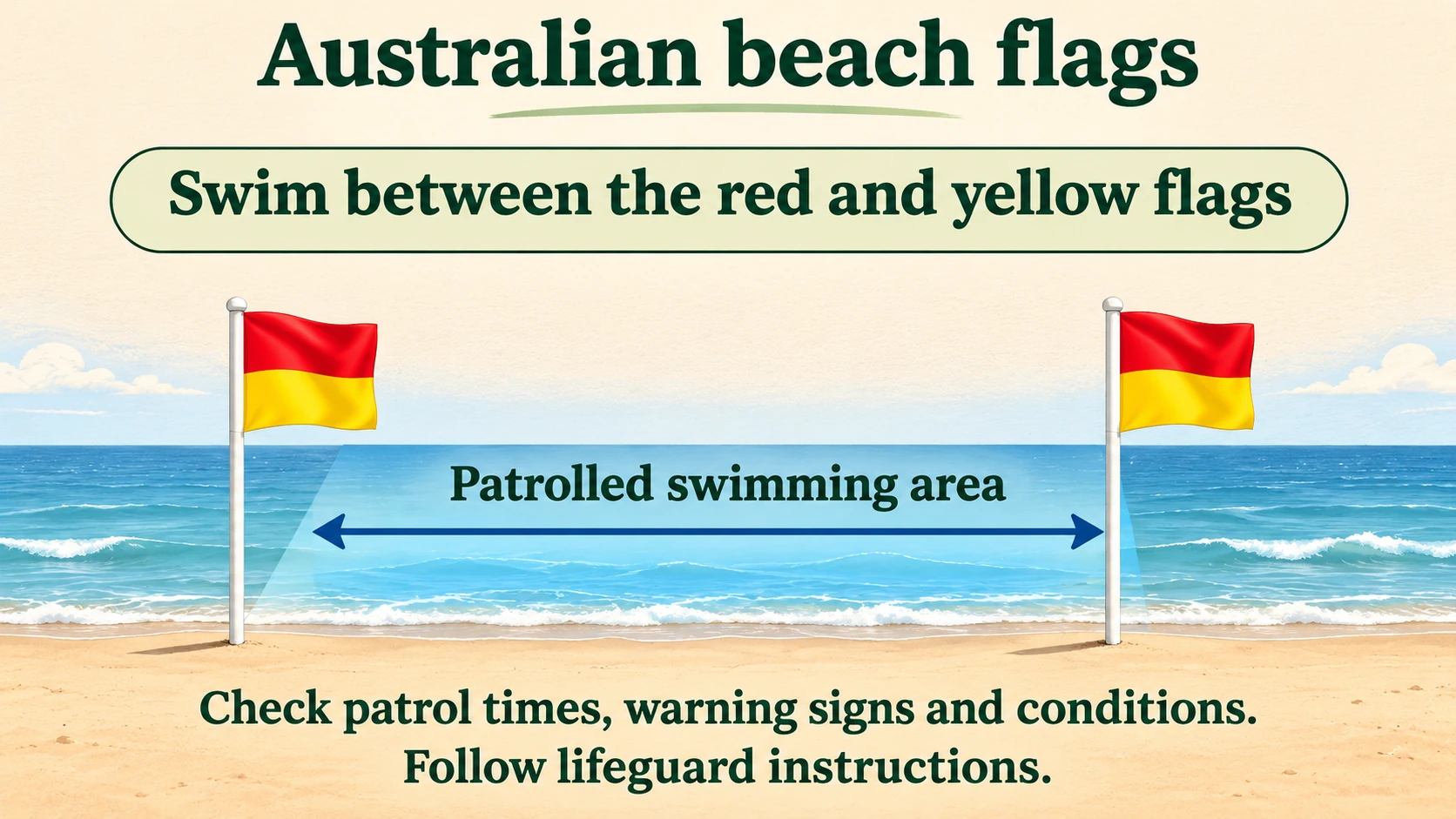
Marine stingers. Tropical Queensland has several dangerous stinger species, including box jellyfish and Irukandji. The marine stinger season runs from November to May, although stingers are present all year. Swim only at patrolled beaches between the flags, use stinger nets where provided, and never touch stingers washed ashore. If someone is stung, call Triple Zero (000) and ask for an ambulance, then pour vinegar on the sting while waiting. Irukandji symptoms may take 20 to 40 minutes to develop, so feeling fine right after contact does not clear someone. Surf Life Saving Australia’s marine stinger guidance is another place to check.
Sharks. Swim at patrolled beaches, ideally those with shark-control equipment. If a shark is spotted, lifesavers sound a siren or ring a bell, raise a red-and-white flag and tell swimmers to leave the water. Avoid swimming at dawn or dusk, in murky water, or near fish-cleaning areas.
Crocodiles. In northern Queensland, crocodiles live in both fresh and salt water. Swim only in designated safe areas, even where there is no warning sign. Never feed crocodiles, and take extra care near water at night and during the breeding season, September to April.
Blue-ringed octopus. Its bite can be fatal and may be painless at first. If bitten, call Triple Zero (000), apply a pressure immobilization bandage and start CPR if the person stops breathing.
Surf Life Saving’s Beachsafe website and app show patrolled beaches, patrol times, hazards and weather. A red flag means the beach is closed, according to the Discover Australia guide. Check the beach’s current conditions before getting in, and ask a lifesaver if the signs are unclear.
Emergency numbers and how to reach them
The number to remember is 000, called Triple Zero. The official Triple Zero site says to call when someone is seriously injured or needs urgent medical help, when life or property is threatened, or when you witness a serious accident or crime. Calls are free. Tell the operator whether you need police, fire or ambulance, and give your address or location. The U.S. emergency number does not work in Australia, as an emergency-number guide for visitors explains.
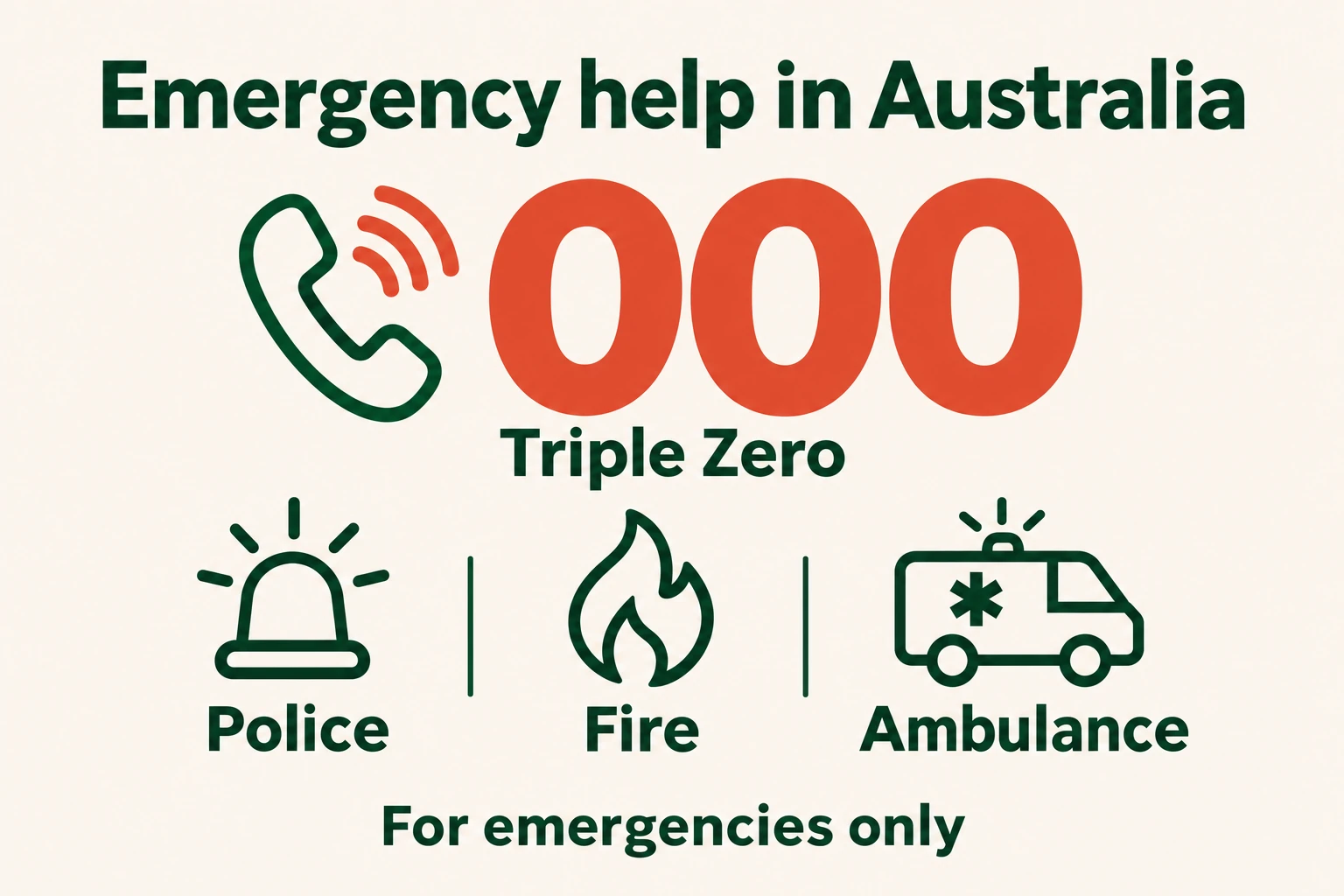
| Number | Use |
|---|---|
| 000 (Triple Zero) | Life-threatening emergencies, crimes in progress, serious accidents, and fire, police or ambulance |
| 106 | Text Emergency Call for people who are deaf, hard of hearing or speech-impaired; it is not SMS and can be used from teletypewriters |
| 131 444 | Police, non-emergency |
| 132 500 | State Emergency Service, for storm and flood assistance |
| 1800 333 000 | Crime Stoppers, to help solve a crime |
| 13 11 14 | Lifeline, crisis support |
| 1300 22 4636 | Beyond Blue, crisis support |
Mobile coverage can limit emergency calls. The Triple Zero site warns that if there is no mobile coverage on any network, you cannot reach the Emergency Call Service from a mobile phone. That matters in the Outback and in remote coastal and mountain areas, which is why the U.S. advisory recommends a satellite emergency device for remote trips. Your phone also needs to be compatible. The evisitor-online guide says 3G phones and some older 4G phones, especially those bought overseas, may be unable to call 000, so ask your mobile provider before you travel.
For non-emergency fire matters, contact the fire service of the state or territory you are in. In a state with active fire or flood warnings, follow the instructions from the warning messages and your state’s emergency site rather than waiting for a call or text.
Key Takeaways
- Plan for scams and theft before crime. The most common financial threats are phishing, fake online sales, job offers that ask for upfront money, and callers impersonating police. Pickpocketing is the main street risk in tourist areas.
- Buy health or travel insurance before you fly. Most visitors are not covered by Medicare and pay all treatment costs, including in public hospitals, and the Department of Home Affairs "strongly recommends" private health insurance.
- Use the red-and-yellow flags and the warning system. Swim only at patrolled beaches in stinger season (November to May in tropical Queensland), and check BoM and your state emergency site for the three-level Australian Warning System alerts.
- Prepare seriously for the Outback. Carry extra fuel and water, stay with a broken-down vehicle, tell someone your route and bring a satellite emergency device because mobile coverage is absent outside major towns.
- Save 000 and know its limits. Triple Zero is free and handles police, fire and ambulance, but it does not work without mobile coverage on any network, and the U.S. emergency number does not work in Australia.