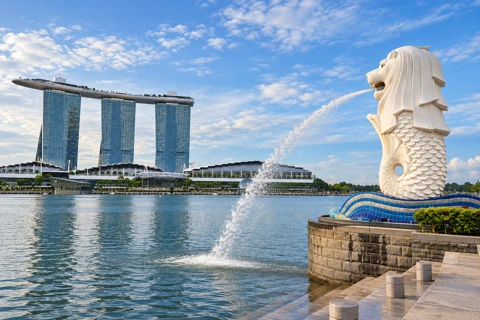
Singapore
Singapore Entry Requirements for US Travelers
US citizens traveling to Singapore for tourism or a short business trip do not need a visa. Singapore allows a visa-free stay of up to 90 days if the passport remains valid for at least six months beyond the planned departure date. As of October 2026, Singapore does not require an electronic travel authorization (ETA), an online pre-approval that some countries require before arrival. The only mandatory online step is the SG Arrival Card, a free electronic form you submit within three days before you land.
Rules and fees change, so check the Immigration and Checkpoints Authority (ICA) website before you book. Passport validity, the arrival card, questions border officers may ask, grounds for refusal, and customs limits follow, and the Canadian rules at the end show how another common passport compares.
Passport and Visa Rules
Your passport must be valid for at least six months beyond the date you plan to leave Singapore. Canada’s official travel advisory for Singapore, last updated 15 October 2026, sets this rule for Canadian passports, and the six-month guidance applies to US passports too. Airlines often apply their own validity rules, and the Canadian advisory warns that carriers’ rules may be more stringent than the entry rules. Airlines check passports at check-in and can refuse to let you board, so count six months from your return date and treat it as the minimum.
Carry a passport with at least one blank page for the entry stamp and in good condition. A damaged passport can be rejected at check-in or at the border.
For visa status, US citizens do not need a visa for tourism or business visits. The exemption applies at air, sea, and land checkpoints. The maximum visa-free stay is 90 days. That allowance covers tourism, business, transit, and visits to family or friends. The 90 days can be used within any 180-day period. Days already spent in Singapore during that window, including on an earlier trip, reduce what is left for a second trip. Confirm the current visa-free terms on ICA’s visa requirements page before you travel.
The number of days you receive is set at the border, not by the visa-free maximum. The immigration officer records your permitted stay on the electronic Visit Pass, called the e-Pass, and the end date is printed on it. Officers can grant a shorter stay than you request. If you need more time, you can apply to extend your short stay through ICA. Extensions are possible but not guaranteed, so do not plan a trip that depends on one.
Visa-free entry covers tourism and short business visits only. Paid work requires a work pass, study requires a Student’s Pass, and stays longer than the visa-free period need a Long-Term Visit Pass applied for in advance. Working or studying on a visitor entry can lead to refusal or removal.
Electronic Travel Authorization and Fees
Singapore does not require an ETA for US citizens. ICA’s most direct statement on the subject is its response of 2 October 2024 to a Straits Times letter, which said that "An additional process like Electronic Travel Authorisation (ETA) may not be necessary, for now." That wording describes a policy that could change, so check ICA’s entry pages before each trip.
Because no ETA is required, no Singapore ETA fee applies. You will see ETA fees in search results, but those belong to other countries. For example, the United Kingdom charges its own ETA fee. A US traveler should not pay for an ETA to enter Singapore unless the official ICA pages state that one applies.
ICA screens foreign visitors before they reach the checkpoint. It uses arrival card data, airline advance passenger information, and other sources to assess visitors. Anyone who poses an immigration or security risk, or who does not meet the entry requirements, will not be allowed in. This is one reason to answer the arrival card accurately and to arrive with the documents listed in the next sections.
Filling Out the SG Arrival Card
The SG Arrival Card (SGAC) is the form that every traveler, including US citizens, submits before arrival. It combines the entry declaration with an electronic health declaration. The official SGAC page lists two exceptions. The first covers people transiting without immigration clearance. The second is residents, such as citizens, permanent residents, and Long-Term Pass holders, who cross at Woodlands or Tuas. US visitors fall under neither exception.
Submission opens within three days before arrival, counting the day you arrive. ICA’s example uses an arrival on 30 June 2023, when submission opens on 28 June 2023. ICA says the window is meant to reduce delays at immigration clearance. Submit the form within that window, not weeks earlier, unless you want a record in your MyICA account for later trips.
The card is free. ICA does not endorse commercial services that charge a fee to submit it. Use the official e-Service or the free MyICA app, which can save your details for future trips. Paper cards ended on 27 March 2020.
The form collects personal details, arrival and stay information, and a health declaration. Also have ready the address where you will stay in Singapore and your recent travel history. The health declaration is not a formality. False declarations can be prosecuted under the Infectious Diseases Act, according to ICA’s SGAC page. The SGAC is not a visa, and submitting it does not grant entry. The border officer still decides whether you enter.
What Border Officers May Ask
Canada’s advisory says customs officials can ask travelers to show a return or onward ticket and proof of sufficient funds for the stay. US visitors should expect to show the same two documents. Keep a printed or downloaded copy of your return flight, along with bank statements or a credit card, so you can answer quickly if asked.
Officers may also ask the purpose of your visit, how long you plan to stay, and where you will stay. Give the hotel name and address you entered on the arrival card. A clear answer about the trip, such as tourism or a meeting with a named business contact, matches what the form says and reduces follow-up questions.
Singapore records biometric data on entry and exit. The Canadian advisory notes that officers scan the iris, face, and fingerprints. Plan for this step in the immigration queue, especially at Changi Airport during busy arrival periods.
ICA states that it protects Singapore’s borders against undesirable persons, cargo, and conveyances at land, air, and sea checkpoints. Officers can refuse entry to anyone they judge to be a risk, which connects to the screening described above.
Grounds for Refusal
Canada’s advisory describes a No-Boarding Directive, effective 30 January 2026, that Singapore applies to travelers who pose health, security, or immigration threats. The directive is applied before boarding, so a traveler who meets its criteria can be stopped at the departure airport. The directive covers several kinds of problems. It lists a past entry refusal or a criminal record. It also covers an invalid visa or a passport with less than six months of validity. Travelers who fail to follow health protocols or who lack required vaccine documents also fall under the directive. Other categories include links to fraud and listing on a watchlist.
The passport rule is the one most US travelers can control. A passport that expires within six months of the return date fits the directive’s category for invalid documents, so renew early if your passport is close to that date.
Customs Limits
Singapore’s customs rules divide travelers into two channels. The Green Channel is for travelers with nothing to declare who stay within all allowances. The Red Channel is for goods above allowances, tobacco, controlled items, and cash of S$20,000 or more. Goods can be declared and duty and GST (the goods and services tax) paid online through Customs@SG up to three days before arrival, as described in this customs guide. Declaring online can save time in the Red Channel.
The table below lists the allowances as the research reports them, with the current figures from ICA’s What You Can Bring page as the authority to check. Confirm the figures there before you pack.
| Item | Allowance or rule | Reported by |
|---|---|---|
| Liquor | Up to 2 litres in total, for travelers 18 and older who have spent a minimum period outside Singapore and are not arriving from Malaysia | Canibringto guide |
| Tobacco | No duty-free allowance; cigarettes, cigars, and loose tobacco go in the Red Channel with duty and GST paid | Customs guide |
| Other goods, longer stays abroad | Up to S$500 duty- and GST-free; goods above the threshold attract 9% GST | Goods Across Borders |
| Other goods, shorter stays abroad | Up to S$100 duty- and GST-free | Goods Across Borders |
| Cash and bearer negotiable instruments | Declare S$20,000 or more, or the equivalent in any currency | CustomsLimit guide |
The liquor rule has several conditions, so read each one. The minimum time-abroad requirement means that a short weekend trip from elsewhere in Asia may not qualify. Travelers who arrive from Malaysia do not qualify for the duty-free liquor allowance, even if they have been outside Singapore for longer than the minimum period. A traveler who arrives from Malaysia and carries alcohol should declare it and pay the duty.
Singapore gives no duty-free cigarette allowance, which differs most from what many travelers expect. Undeclared cigarettes draw a fine of S$200 per packet, so declare any tobacco you carry.
Vapes and heated tobacco products are prohibited, including e-cigarettes, vaporizers, and products such as IQOS, glo, and Ploom, which are illegal to import, sell, or possess. The customs guide lists first-offense fines of up to S$10,000 and repeat-offense fines of up to S$20,000, with a possible jail term of six months. X-ray screening at Changi routinely detects these devices. Leave them at home or dispose of them before you fly.
For cash, you must declare S$20,000 or more on arrival or departure, using Form NP727. You can file through the ICA website, the MyICA app, or the SG Arrival Card. The declaration can be made up to 72 hours before arrival. Failing to declare can bring a fine of up to S$50,000, up to three years in prison, or both. Officers can also seize the cash. An incorrect declaration of goods above allowances can draw a fine of up to S$10,000, as the customs guidance explains.
Singapore enforces strict drug laws. Controlled drugs and psychotropic substances are banned. The customs rules state that Singapore applies a mandatory death penalty for drug trafficking. Carry only prescription medicine in its original packaging with a copy of the prescription, and check ICA’s pages for the specific rules before you travel with any medication.
Canadian Passport Differences
Canadian travelers face the same six-month passport validity rule as US travelers. Canada’s advisory states that a regular Canadian passport must be valid for at least six months beyond the date of entry, and that the rule applies to transit passengers as well.
The visa-free stay is shorter for Canadians. Canadians do not need a tourist visa for stays of up to 30 days, and the same 30-day exemption covers business visits. Canadians who plan to study need a student visa. ICA may approve an extension of the 30-day stay in certain circumstances, according to Canada’s advisory. Canadians also submit the SG Arrival Card within the same three-day window as US travelers.
In short, US citizens get a 90-day visa-free stay under the travel guides cited above, and Canadians get 30 days under Canada’s official advisory. A US traveler who plans a longer trip has more room in the visa-free period than a Canadian traveler. Both passports face the same six-month validity guidance and the same arrival card.
Key Takeaways
- Renew early: Make sure your passport is valid for at least six months beyond your planned departure, because airlines can refuse to board a passport that fails their own validity checks.
- Submit the arrival card in the window: Fill out the free SG Arrival Card through ICA’s official e-Service or MyICA app within three days before arrival, and answer the health declaration accurately.
- Carry proof of onward travel and funds: Bring a return ticket and bank or card statements, and give the hotel address you entered on the arrival card.
- Leave vapes and heated tobacco at home: These products are prohibited, and first-offense fines can reach S$10,000.
- Declare cash of S$20,000 or more: File Form NP727 before arrival, because undeclared cash can lead to a fine of up to S$50,000, a prison term, and seizure.
- Check the liquor and goods limits before you pack: Duty-free liquor requires a minimum time outside Singapore and does not apply to travelers arriving from Malaysia, so check the current figures on ICA’s What You Can Bring page.