Getting Around Sweden
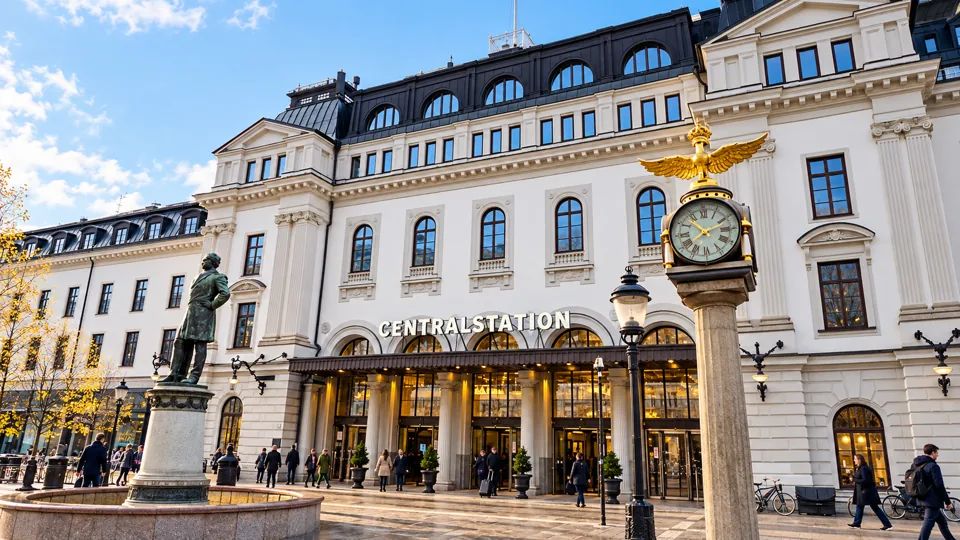
Sweden’s main cities are far apart. Stockholm and Gothenburg are about 397 km apart, and Malmö is at the southern tip. Your choice of train, bus, plane, ferry, or car determines how much of the trip you spend in transit. Trains are the most practical option between Stockholm, Gothenburg, and Malmö. Buses cost less but take roughly twice as long. Flights make the most sense for the far north and tight schedules. Ferries matter for Gotland, the island off the east coast, and a car is most useful outside the cities.
Operators change timetables and prices by date, season, and demand. The durations and fares here are typical figures. Check the operator’s page for your travel date before you book.
Trains Between Stockholm, Gothenburg and Malmö
SJ is the national rail operator, and sj.se is its booking site. SJ’s most popular routes are Stockholm–Gothenburg, Stockholm–Malmö and Stockholm–Uppsala. On Stockholm–Gothenburg, other companies such as VR and Tågab also run services, so the fastest or cheapest departure on a given day may not be an SJ train.
Day-train times between Stockholm and Gothenburg fall between about 3h18m and 4h14m, depending on the train and the stops it makes. Plan on that range and read the duration on the specific departure you book. Stockholm–Malmö by day takes about 5h06m, and Gothenburg–Malmö takes about 2h57m. A trip that links all three cities therefore adds up to a long day of rail travel, which is why many travelers take the Stockholm–Malmö leg overnight.
Book at sj.se by choosing cities and a date. Some overseas payment cards are rejected at checkout, so keep a second card ready. Fares behave like airline fares, with prices varying by departure and how far ahead you buy, so buying early on busy routes saves money.
Night Trains and Sleepers
SJ lists these night-train routes for 2026:
- Stockholm–Östersund/Åre/Duved
- Stockholm–Malmö
- Stockholm–Umeå
- Stockholm–Luleå
The northern trains are the main rail link to ski country around Åre and to the Norrland coast. SJ night trains offer seats, couchettes, beds in sleeping compartments, or a private first-class sleeper with an en-suite shower and WC, though not every level is available on every train. SJ’s booking pages show which routes carry which accommodation.
The Stockholm–Malmö sleeper is the one most visitors use. Train 1 leaves Stockholm Central at 23:17 and reaches Malmö Central at 06:59, a trip of 7h42m, with stops at Norrköping, Hässleholm, Helsingborg and Lund. The return, train 2, leaves Malmö at 22:17 and reaches Stockholm at 06:00. Exact times can shift from season to season. The sleeper does not run on Saturday nights, so confirm your date on sj.se, where the direct evening departure appears as a normal search result.
Snälltåget is a separate private company that runs seasonal night trains from Stockholm through Malmö and Copenhagen to Hamburg and Berlin. Its 2024 schedule ran daily except Saturday from 31 March to 1 November, with Friday extensions to Dresden and extra trips in late November and December. These are 2024 dates, so check the operator for the current season. In winter, Snälltåget has run one train per week from Malmö to Innsbruck via Salzburg and Zell am See. A separate EuroNight from Stockholm Central to Berlin Lichtenberg averages 15 hours and is operated by BahnTouristikExpress (RDC) together with SJ.
Long-Distance Buses
FlixBus dominates intercity buses in Sweden. Its network links Stockholm, Gothenburg, Malmö, Jönköping, Linköping, Västerås, Örebro and other towns. Swebus, the older national coach brand, was bought by FlixBus on 2 May 2018 and stopped being used in September 2018, so any Swebus timetable you find online is out of date. Vy Bus4You and Infobus also serve Gothenburg–Malmö.
Typical times show why buses suit budgets more than schedules:
- Gothenburg–Malmö (about 273 km): roughly 3h05m to 3h22m, with at least 6 direct buses a day.
- Stockholm–Gothenburg: about 6 to 7.5 hours. The range comes from direction and traffic: one listing shows 7h35m northbound and 7h05m southbound.
- Stockholm–Malmö: about 7 to 8 hours, with FlixBus listing 8h05m on its three daily rides.
Indicative adult fares in SEK, which move with booking time, occupancy and discounts:
- Stockholm–Gothenburg: 129 to 349 kr
- Stockholm–Malmö: 149 to 399 kr
- Gothenburg–Malmö: 99 to 299 kr
- Malmö–Copenhagen: 79 to 199 kr
Fares rise with demand and short notice, and early and midweek off-peak departures tend to be cheaper. On Gothenburg–Malmö, an advance booking can cost 198 kr, while same-period fares run 265 to 277 kr.
Booking runs through the FlixBus website or app. You choose cities and a date, and payment options include credit card, PayPal, Google Pay and Apple Pay. The ticket arrives as a PDF with a QR code, and app bookings are stored in the app. Printing is not required, and drivers accept the digital ticket. The app also shows delays and the bus’s live position.
Stops are in central locations. In Malmö, FlixBus’s main stop is Norra Vallgatan at Malmö central station, platform K, and Kristianiagatan is used by a FlixBus marketplace partner. Gothenburg departures leave from Nils Ericson Terminal, except between 00:30 and 04:00, when buses use Åkareplatsen. Airport links exist in two cities: Stockholm to Arlanda takes about 40 minutes and Gothenburg to Landvetter about 30 minutes. No FlixBus line serves Malmö airport.
Domestic Flights
Flying is the fastest option over long distances. SAS flies within Sweden to Gothenburg, Kiruna, Luleå, Malmö, Skellefteå, Stockholm, Sundsvall, Umeå, Visby and Åre/Östersund, with connections via Stockholm, Oslo or Copenhagen. Norwegian also flies domestic routes, including Stockholm–Arlanda to Kiruna. Check Norwegian’s schedule for its current Swedish network.
Most domestic routes take 1h to 1h30m. Stockholm–Gothenburg is about 55 minutes and Stockholm–Malmö about 1h05m, but airport transfers and security make the door-to-door gap against the train smaller than those numbers suggest. The strongest case for flying is the north:
- Stockholm–Kiruna (about 919 km): about 1h40m to 1h45m.
- Stockholm–Umeå (509 km): about 1h07m, and Umeå–Stockholm about 1h06m. Arlanda is the most common airport pairing.
Kiruna Airport is Sweden’s northernmost, about 10 km from the old town and 4 km from the new one. In summer, Kallax Flyg runs twice-daily helicopter flights to the Nikkaluokta–Kebnekaise area, so confirm the current schedule with the operator.
Fares are generally lowest one to three months ahead and rise sharply in the final two weeks. Stockholm–Umeå starts at 706 kr on SAS. Check SAS for current Stockholm–Kiruna fares. When booked ahead, Norwegian often undercuts SAS on Stockholm–Malmö and Stockholm–Gothenburg, so compare both carriers.
SAS has listed online or app check-in opening up to 30 hours before departure, and one 8 kg carry-on included on European flights. Look at the fare conditions in your booking for checked-bag allowances and change and refund terms on a domestic ticket.
Ferries to Gotland
Ferries matter mainly for Gotland, where Visby is the main port. Destination Gotland operates the two principal routes, and both run year-round:
- Nynäshamn–Visby: about 3h15m.
- Oskarshamn–Visby: a similar crossing time.
Västervik–Visby takes about 2h30m. Frequency varies by season, with roughly two to four departures per day on Nynäshamn–Visby, and the first sailing from Nynäshamn is around 01:30 with the last around 23:55. Summer is the busiest period, and the Destination Gotland timetable lists the sailings for the date you want.
Stockholm–Visby is a summer-only Viking Line mini-cruise that runs from June to August and calls at Mariehamn on Åland. The trip takes much longer than the direct sailings, and the ship has no vehicle deck. Viking Line also sails Visby–Mariehamn as an international route. Rostock and Riga are international destinations served from Visby.
Nynäshamn is about 60 km south of Stockholm, with the terminal about 400 m from the station. The commuter train (pendeltåg) from Stockholm Central takes around an hour. Destination Gotland takes cars, campervans, motorbikes and foot passengers, and dogs are accepted. The MS Gotland has room for 1,730 passengers and 500 cars, so in July bring a vehicle only if you have reserved well ahead. Operators announce short-notice changes first, so check your booking again on the day you travel.
Driving in Sweden
A driving licence from another EEA country is valid in Sweden if it is valid at home and has not been exchanged for a Swedish one, as Transportstyrelsen (the Swedish Transport Agency) states. A non-EEA licence is valid under three conditions: it is valid in the issuing country, it has not been exchanged for a Swedish licence, and the holder has not been registered as a Swedish resident for more than one year. The one-year rule does not apply to UK or Faroese licences.
A licence that follows none of the international road-traffic conventions and is not in English, German or French needs a certified translation into English, German, French, Swedish, Danish or Norwegian. An international driving permit counts as a translation but cannot be issued in Sweden, so get it before you leave. A licence without a photo is valid only with a photo identity document, and you must carry your licence while driving. The minimum driving age is 18, and alcohol and narcotics bans apply. Visitors who become residents can exchange a foreign licence for a Swedish one only if it was issued in an EEA country, Switzerland or Japan.
Congestion tax applies in Stockholm and Gothenburg. Cameras photograph front and rear plates at toll stations, and the bill goes to the registered owner. It has applied to foreign-registered cars, lorries and buses since 1 January 2015, so a rental-car customer is billed through the rental company. Avis lists 75 SEK per day in Stockholm including VAT. Tariffs and time windows change, so read the live Transportstyrelsen page. The taxpayer must pay on time even if no payment slip arrives, and a late payment adds a 500 SEK surcharge. Before a winter trip, check Transportstyrelsen or Trafikverket for winter-tire and equipment rules.
Journey Times at a Glance
| Route | Day train | Bus | Flight | Ferry |
|---|---|---|---|---|
| Stockholm–Gothenburg | About 3h18m to 4h14m | About 6h to 7h35m | About 55 min | n/a |
| Stockholm–Malmö | About 5h06m (night train: 7h42m) | About 7h to 8h05m | About 1h05m | n/a |
| Gothenburg–Malmö | About 2h57m | About 3h05m to 3h22m | n/a | n/a |
| Stockholm–Umeå | Night train | n/a | About 1h05m to 1h07m | n/a |
| Stockholm–Kiruna | n/a | n/a | About 1h40m to 1h45m | n/a |
| Nynäshamn–Visby | n/a | n/a | n/a | About 3h15m |
| Oskarshamn–Visby | n/a | n/a | n/a | Similar to Nynäshamn–Visby |
Key Takeaways
- Take trains for the main triangle: Stockholm–Gothenburg runs about 3h18m to 4h14m by day, and Gothenburg–Malmö is about 2h57m. Book at sj.se and carry a second payment card.
- Use the night train for Stockholm–Malmö or the north: The sleeper takes 7h42m, and SJ also runs night trains to Åre, Umeå and Luleå. Confirm your date on sj.se, since the sleeper does not run on Saturday nights.
- Choose buses for price: FlixBus fares are generally lower on the main routes, but the trips take about twice as long as the train. Swebus no longer exists.
- Fly to the far north: Stockholm–Kiruna takes about 1h40m to 1h45m and Stockholm–Umeå about 1h07m. Book one to three months ahead and compare SAS with Norwegian.
- Reserve early for Gotland: Nynäshamn–Visby takes about 3h15m and Oskarshamn–Visby is similar. In summer, reserve a vehicle space well ahead.
- Plan for congestion tax if you drive: Stockholm and Gothenburg bill the registered owner, which means the rental company for visitors. Check licence validity with Transportstyrelsen before you go.