Morocco
What to Eat in Morocco: Dishes, Drinks, Regional Specialties and Prices
Moroccan food centers on slow-cooked stews, steamed grains, flaky pastries and sweet mint tea. Most first-time visitors see the same handful of dishes on nearly every menu. The tagine (a stew named after the conical clay pot it cooks in), couscous, pastilla (a savory-sweet meat pie) and harira (a thick soup) cover most of what travelers order. Each region also has its own dishes: fish on the Atlantic coast, tanjia in Marrakech and pastilla in Fes.
The timing of meals matters as much as the menu. Lunch is the main meal, Friday is couscous day, and during Ramadan, the Muslim month of daytime fasting, restaurant hours change completely. Food is halal by default, so pork and alcohol are limited. Vegetarians have an easier time than vegans. Prices below are in Moroccan dirhams (MAD, also written DH) and range from a few dirhams for street snacks to several hundred for a fine-dining table.
The dishes to order first
Start with the tagine. The word names both the stew and the cooking vessel: the cone-shaped lid returns condensation to the food, so the stew cooks in almost no added liquid. Moroccan cooking leans on cumin, sweet paprika, ginger, turmeric, cinnamon, saffron and the spice blend ras el hanout. Chili appears mainly as harissa, a hot pepper paste served on the side, so the food is fragrant rather than spicy-hot. Tagine is also the most widely eaten dish in the country, which makes it easy to find and compare from one restaurant to the next.
Three versions cover most menus. Chicken with preserved lemon and green olives is the everyday Friday-night order, while lamb with prunes, almonds and cinnamon is the wedding-banquet version. Kefta mkaouara, spiced meatballs poached in tomato sauce with eggs, is a quick lunch from medina grills. Tagines also follow the seasons: spring brings artichokes and peas, autumn quince, and winter cardoons, so a vegetable tagine tells you what is being harvested.
Couscous is the Friday dish. It is traditionally eaten after midday prayers on Friday, usually as a family lunch, and the knowledge and practices around it joined UNESCO’s Intangible Cultural Heritage list in 2020 through a joint nomination by Algeria, Mauritania, Morocco and Tunisia. Cooks steam hand-rolled semolina three times over the stew broth and pile it under vegetables and meat. A seven-vegetable version with meat is the full celebratory plate. Restaurants that serve couscous every day, especially in tourist areas, often cook it quickly from precooked grains. A local restaurant on Friday gives the best chance of the long-cooked version.
Pastilla, also spelled bastilla, wraps shredded meat, eggs, almonds and cinnamon in warqa, a paper-thin pastry, then dusts the top with icing sugar. Pigeon is the traditional filling, chicken is the most common today, and coastal towns make seafood versions with shrimp, fish or squid. Some menus also list a sweet milk pastilla, a custard-style dessert. The sweet and savory combination surprises many first-timers, so order a small portion to share if you are unsure. The same guide lists rfissa, shredded bread with lentils and chicken, a hearty dish worth ordering when it appears.
Harira is the soup to know. It is thick with tomatoes, lentils, chickpeas, herbs and warming spices, and recipes vary by region and family, with some versions containing meat and others vegetarian. For cheap vegetarian plates, look for zaalouk and taktouka, cooked vegetable salads served with bread, typically built on eggplant, tomato and peppers. Many travelers make a meal of these salads, bread and a bowl of harira.
Mint tea and other drinks
Mint tea, called atay, combines gunpowder green tea, fresh spearmint (nana) and white sugar, and it is typically served in three rounds in small glasses. The base changes by region: wormwood (shiba) appears in the south, lemon verbena (lwiza) in coastal areas, and rose petals occasionally turn up in Marrakech.
Tea accompanies every meal, business meeting and home visit, so expect to be offered it in carpet shops, riads and homes. Accepting the first glass is polite, since refusing is awkward. A health reason such as "I don’t drink tea for health reasons" is understood and respected. On a trip longer than a few days you will drink it dozens of times, so learn the basic etiquette.
Some customs are worth knowing. Use your right hand, because the left is considered unclean for eating and drinking. Hold the small glass by the rim with your thumb and two fingers, because the glass is intentionally hot, and sip over 10 to 20 minutes. Finishing quickly signals you want a refill. If you want less sweetness, ask for "shwiya sukkar," meaning a little sugar. Hosts may find the request unusual, though cafés and restaurants accommodate it readily. Do not stir, since the pour has already mixed the tea, and do not ask for milk, because mint tea is never served with it. Complimenting the tea is expected, and the ceremony ends when the host stops refilling glasses or clears the tray.
Many hosts repeat a saying about the three glasses: the first is as gentle as life, the second as strong as love, and the third as bitter as death. The tea is also sugary and contains green-tea caffeine, so travelers sensitive to either should pace themselves across a day of invitations.
Fresh orange juice is the other everyday drink, sold from stalls and handcarts in every city. At breakfast, tea competes with milky coffee, and cafés open as early as 6 to 7 am. Alcohol is sold only in licensed venues (see the dietary section below).
When and where Moroccans eat
Lunch is the main meal of the day, and tagine or couscous is the typical order. Restaurants generally serve lunch from about noon to 3 pm and dinner in the evening. Tourist restaurants serve dinner later and charge more than neighborhood spots, which is why a heavy tagine at 9 pm is a concession to visitors rather than a local habit. If you plan one big meal a day, make it lunch and keep dinner light, as many locals do.
Breakfast is bread-based. A typical table includes msemen (a layered, pan-fried flatbread) and baghrir (a spongy semolina pancake with tiny holes), served with honey, butter or amlou, plus mint tea or milky coffee. The holes in baghrir soak up honey-butter, the most common way to eat it, and it also serves as a snack and as part of iftar, the sunset meal during Ramadan. Amlou is a spread of almonds, argan oil and honey. A hotel breakfast often includes these, but street vendors and small cafés sell them for a few dirhams.
Friday brings couscous at midday, the usual time for family lunches. If you want to eat it the traditional way, ask at a neighborhood restaurant on Friday what is on offer rather than ordering it on another day. When dishes arrive in the center of the table, eat from the portion in front of you.
Ramadan changes the rhythm of the day. Many restaurants close during fasting hours and reopen after sunset, though small takeaway windows sell harira by the liter as sunset approaches. Iftar begins with a date, then most households move to harira, and chebakia follows: a flower-shaped, fried pastry soaked in honey and coated in sesame seeds. Streets empty quickly when the fast ends, and visitors are advised not to plan dinner around 7 to 8 pm. Tourist restaurants serve dinner after the iftar rush, so eating around 8 pm works. Iftar tables also hold boiled eggs, dates, msemen, yoghurt and milk. Eid al-Fitr, the holiday that ends Ramadan, brings a special breakfast of baghrir or melwi.
Where you eat sets both the food and the price:
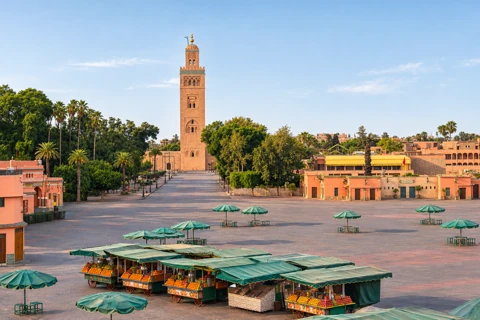
- Evening stalls in Marrakech’s Jemaa el-Fnaa square serve grilled meat, snail soup, fried fish, harira and fresh juice.
- Gargotes, small neighborhood eateries, serve the everyday tagine and couscous at the lowest restaurant prices.
- Tourist restaurants in the medinas, the old walled city quarters, charge more and serve dinner later.
Regional specialties
Fes. Fes is the classic home of pastilla. Bastela is served here at weddings and on ceremonial occasions, and Fassi cooking is ceremonial in character, with elaborate tagines. Breakfast in Fes can include eggs fried in khlii, a preserved spiced beef cooked in its own fat, served in a small tagine. Order a pastilla in Fes for the pastry alone.
Marrakech. Jemaa el-Fnaa turns into an open-air restaurant every evening, and mechoui, whole lamb roasted in a pit oven or on a spit and eaten by hand with cumin and coarse salt, anchors weddings and feasts. Tanjia is the city’s signature dish. Beef or lamb cooks with preserved lemon, saffron, cumin, smen (aged, preserved butter) and garlic in a tall clay urn, which the keeper of a bathhouse furnace buries in the hot ashes for many hours, often overnight. It sounds like a tagine, but the urn and the ashes make it a different dish. Snail soup and mrouzia are also Marrakech dishes, and the Rahba Kedima spice square sells ras el hanout, saffron, dried herbs and argan oil if you want to bring flavors home.
Essaouira and the Atlantic coast. Coastal cities focus on fish. Grilled fish, sardine tagine and fish with chermoula, a marinade of coriander, cumin, paprika, garlic and lemon, are the signatures here. Essaouira and Safi serve whatever sardines came in that morning, and the local tagine fish are sea bream in Safi and sole in Tangier. At the Essaouira port, stalls grill fish to order. Argan oil comes from the surrounding region, and amlou makes a good souvenir or breakfast.
Tangier and the north. Tangier’s food is Spanish-influenced seafood, bocadillos (sandwiches on crusty bread) and cafés where Moroccan, Andalusian and European habits mix. Try karantika, a baked chickpea-flour snack with Spanish roots, and fried fish. Chefchaouen, in the Rif mountains, is known for fresh goat cheese, mountain honey, herbs and hearty bread. Bissara, a fava bean soup eaten at breakfast, is the comfort food of Chefchaouen, Tangier, Tetouan and the Rif.
Rabat and Casablanca. Rabat serves fish pastilla, fish tagine with chermoula and sardine meatballs in tomato sauce. Casablanca is known for seven-vegetable couscous and seafood, from fried fish cones at the port to full seafood restaurants. In both cities the Atlantic shapes the menu, so order fish when you would otherwise default to lamb.
Halal food, alcohol, and vegetarian, vegan and gluten-free eating
Morocco is predominantly Muslim, so halal food is the norm. Meat is typically slaughtered per Islamic guidelines, and pork is rare outside certain supermarkets and international restaurants. Street food, souk food, riad meals and local restaurants are all halal. Muslim travelers can eat nearly anywhere without asking questions.
Alcohol is limited to licensed places. It is available in licensed bars, hotels and some restaurants, especially in Casablanca and Rabat, and it is not usually served with street food or at simpler local eateries. In Marrakech, licensed restaurants in Gueliz and Hivernage and some riad rooftop bars serve wine, beer and cocktails, while traditional restaurants, medina dining spots and street stalls do not. Drinking in public is prohibited, and recent guides give the legal age as 18. Travelers who want an alcohol-free table can pick from Naranj, Nomad, Dar Chef and Le Jardin in Marrakech, and it is wise to confirm the policy when booking. Chefchaouen riads and guesthouses are almost all alcohol-free. Most bars and shops stop selling alcohol during Ramadan.
Vegetarians eat well. Restaurants accommodate vegetarians easily, and asking for "végétarien" or "sans viande" works in a country where French is widely understood. Vegetable tagine, vegetable couscous, harira, lentil dishes, bissara, zaalouk and taktouka all fill the plate. The same source lists tagines, grilled meats, salads and rice dishes as gluten-free, though gluten-free and allergy needs take more explanation. Seitan, a wheat-gluten meat substitute, is common on vegan menus, so check that dishes marked gluten-free do not rely on it. The same guide names dedicated gluten-free venues in Tangier and Casablanca.
Vegans need to plan ahead more. Vegetable-only tagines and bean or lentil dishes are often available if you ask for no butter or animal fat, and the phrase "balâa l-haywânî" means "without animal products." Restaurant versions of loubia, a white bean stew, may include meat bones, although home versions are usually vegan. Olives are always vegan, and plain or honey sfenj, a fried doughnut, is typically vegan too. Breakfast olives, jams, bread and fruit rarely contain animal products. Larger cities have vegan-aware restaurants, including World Storytelling Cafe in Marrakech and Shyadma’s Vegan Food in Essaouira.
What meals and drinks cost
Published prices are estimates. Prices vary by city and neighborhood, and they are highest around the big medinas. At gargotes, a vegetable tagine runs 25 to 35 MAD, a meat tagine 40 to 70 MAD and couscous 45 to 70 MAD. The same range lists tagine, couscous or pastilla in tourist medinas, such as around Jemaa el-Fnaa or the Fes medina, at 70 to 150 MAD. A mid-range restaurant meal with starter, main and dessert costs 120 to 200 MAD, and high-end restaurants run 300 to 800 MAD. Kefta sandwiches cost 15 to 25 MAD, while sfenj, msemen and bissara cost a few dirhams each.
Prices show the same pattern in a French regional survey of Moroccan restaurants. A simple restaurant charges 40 to 70 MAD for tagine or couscous, a traditional restaurant 80 to 100 MAD for a tagine, and a traditional full menu with starter, main and tea 80 to 150 MAD. Neighborhood sandwiches, skewers or tagines cost 20 to 50 MAD, and a kefta sandwich or skewer plate at Jemaa el-Fnaa costs 20 to 30 MAD. Upscale riad restaurants and gastronomic tables start around 250 MAD. Morocco’s Law 80-14 on tourist establishments requires operators to display prices and the services offered, so ask to see the menu with prices before ordering at tourist-facing places.
Drinks are cheap in cafés and add up on terraces. Mint tea costs a few dirhams in a neighborhood café and about 20 MAD on a tourist terrace. Fresh orange juice is 10 to 25 MAD, and a 1.5-liter bottle of water is 5 to 7 MAD. Alcohol costs more: a local beer in a restaurant is 35 to 60 MAD, and a bottle of Moroccan wine is 150 to 300 MAD.
For budgeting, split meals by type. Breakfast from a stall or café, a gargote lunch and a street-food dinner keeps a day in the range of tens to low hundreds of dirhams. A tagine at a tourist-medina restaurant roughly doubles a gargote price. Ordering the same dish at a riad or fine-dining table multiplies it several times.
Key Takeaways
- Order tagine, couscous, pastilla and harira first: they cover the core of Moroccan menus, and each has a clear best time or place, such as couscous on Friday and pastilla in Fes.
- Eat your big meal at lunch: restaurants serve lunch from about noon to 3 pm and dinner in the evening. During Ramadan most close in the daytime and reopen after sunset.
- Accept the first glass of mint tea: use your right hand, hold the glass by the rim and sip slowly, because tea comes with nearly every meal, shop visit and home invitation.
- Match the dish to the region: choose fish on the Atlantic coast, tanjia and mechoui in Marrakech, bissara in the north and pastilla in Fes.
- Plan ahead for alcohol-free, vegan and gluten-free needs: pork is rare, and alcohol is restricted to licensed venues. Vegetarians eat easily; vegans should ask for no butter, animal fat or meat stock.