Thailand
Etiquette and Customs in Thailand: What First-Time Visitors Should Know
Thai etiquette for visitors comes down to a few habits. Greet people with a smile, and avoid pointing your feet at people or touching anyone’s head. Cover your shoulders and knees at temples, and take your shoes off before entering sacred buildings. Share the food at the table, and treat anything connected to the monarchy with care. Thailand is forgiving of tourists who get small things wrong. Most mistakes get a patient smile, and residents do not expect visitors to know every custom.
Two areas are less forgiving. Temples and palaces enforce dress codes at the gate and turn away people who break them. The monarchy is protected by a criminal law, Section 112 of the Criminal Code, that applies to foreigners as well as Thai citizens.
Greetings and the wai
The traditional Thai greeting is the wai, in which a person presses their palms together in front of the chest and bows slightly. The only rule for visitors is to return a wai when someone offers one and not to start one yourself. Visit Thailand Today advises against waiing children or service staff, such as hotel porters, shop assistants, and waiters. Those workers may wai you as part of their job, and a smile with a nod is the correct reply.
A smile and a nod works in almost every situation. Go2 Thailand says visitors do not need to master every level of the gesture. If your hands are full, skip the wai and smile. A spoken "sawatdee" works as a greeting for anyone. "Khop khun khrap" (said by men) and "khop khun kha" (said by women) mean thank you. Even high-end restaurants tell guests that a smile and a slight nod is a suitable reply to a wai from staff.
The wai has levels, and the height of the hands signals respect. Department of Cultural Promotion guidance, as summarized in Thai etiquette material, describes three. The highest, used toward the Buddha, the Dhamma (the Buddha’s teachings), and the Sangha (the monastic community), places the thumbs between the eyebrows and adds a low bow. Men stand and bow low, and women kneel and step back. Visitors rarely perform this level except at a temple, and nobody expects a tourist to get the form exactly right.
Monks receive a different treatment. Explore advises greeting a monk with a wai, palms pressed together, and never offering a handshake. If a monk speaks to you first, the same wai and smile apply.
Two physical rules apply to everyone you greet. Go2 explains that in Thai cultural symbolism the head is the highest part of the body and the feet are the lowest. Don’t touch anyone’s head without permission, and that includes patting a child on the head, which many visitors do out of affection. Visit Thailand Today lists head-touching among the most common mistakes for the same reason. The rule on feet applies inside temples too, and the next section covers it.
Dress and conduct at temples and palaces
Cover your shoulders and knees at every Buddhist temple, whatever your gender. Out Thailand says individual venues set their own policies, so check the signs at the entrance. Covered shoulders and knees work at almost every temple. Go2 takes the same approach and notes that each temple or palace can set its own entry rules.
Your Thai Guide lists the clothing that gets people stopped: shorts above the knee, sleeveless or crop tops, leggings or yoga pants, ripped clothing, see-through fabric, and heavy denim. It recommends light, breathable fabrics and slip-on shoes, which suit both the heat and the shoe-removal rule. A violation means denial of entry or a request to rent a sarong or robe on the spot. Heat makes conservative dress uncomfortable, as Explore acknowledges, so loose long trousers, a long skirt, or a lightweight linen shirt with sleeves are easier to wear in the heat.
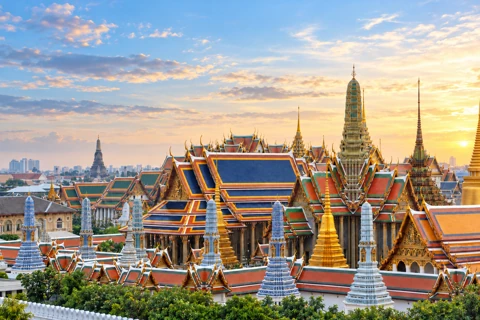
The Grand Palace in Bangkok has the strictest rules. The official visitor page excludes sleeveless, short, see-through, and torn clothing, very tight clothing, bike trousers, and miniskirts. Your Thai Guide says a scarf over bare shoulders does not satisfy the rule and that leggings are prohibited. At Wat Phra Kaew, the temple inside the palace grounds, Visit Thailand Today reports that visitors in shorts or sleeveless tops are turned away. Out Thailand advises dressing correctly at your hotel rather than relying on a cover-up at the gate.
Do not count on renting a sarong on site. Where rentals exist, some require a deposit, and availability is not guaranteed. A rental also does not solve every problem, because the Grand Palace rules on scarves and tight clothing still apply. A lightweight sarong or long cover-up in your daypack costs little, weighs almost nothing, and covers an unplanned temple stop. Explore recommends exactly this. Go2 adds that modest dress also suits government buildings such as district offices and police stations.
Once you are dressed correctly, a few habits cover most situations inside temple grounds. Remove your shoes before entering prayer halls, building interiors, and anywhere the site marks a boundary. Go2 and Out Thailand both say shoes can stay on in open outdoor areas, so watch what other visitors do and look for shoe racks or a row of sandals near a doorway. Explore reports that shoes are usually left at the bottom of temple steps, and that at busy Bangkok sites carrying sandals in a bag is acceptable because shoe theft is common. Slip-on shoes make removing them quick.
Take off hats and sunglasses in sacred areas, as Your Thai Guide advises. Explore adds that you should keep your voice low and skip phone calls and music inside a temple.
Feet need the most attention. Go2 and Your Thai Guide both say never to point your feet at a Buddha image or a monk. When you sit on the floor of a prayer hall, tuck your feet behind you or angle them to the side. Don’t use your foot to move an object, and don’t point your soles at people anywhere else, since Go2 treats this as the same rule. TAGTHAi adds that you should not rise above a monk or an elder in a religious or traditional setting, so avoid standing over a seated monk or leaning across someone who sits lower than you.
Touch sacred objects only when a host invites you to, according to Go2. Do not climb chedis (the tall bell-shaped or spired monuments found in temple compounds), statues, or platforms to get a better view. These steps cost nothing, and worshippers and staff notice when visitors take them without being asked.
Eating and paying
Thai meals are shared. According to Visit Thailand Today, you order dishes for the table rather than one plate per person, and rice comes in a shared pot that everyone serves from during the meal. TAGTHAi advises ordering a variety of dishes. It also says to use the serving spoon rather than your own and to take small portions so that dishes last until everyone has tried them.
The usual set is a spoon and a fork. Hold the spoon in your right hand and the fork in your left. The fork pushes food onto the spoon, and the spoon goes into your mouth. Visit Thailand Today and Forbes & Partners both say chopsticks belong with noodle soups and Chinese-style dishes. Using them for rice dishes or pad Thai looks out of place. In some countryside areas, TAGTHAi notes, people eat with their hands, especially sticky rice and nam phrik, a chili dip. If a village table serves those dishes, watch your hosts and follow their lead.
TAGTHAi says the host or the oldest person usually invites others to begin, so wait for that signal. Avoid wasting food, especially rice, and try at least a small bite of anything offered, because refusing food can seem impolite. Keep your feet off chairs and away from the table. Visit Thailand Today and Go2 both warn that stepping over someone’s food is very disrespectful, even by accident. This matters on the floor of a home or a low-seated restaurant, where dishes sit near walking paths.
If a Thai friend invites you home, TAGTHAi says fruit or dessert is a popular gift, and saying "aroi" (delicious) about the food is well received.
Tips are appreciated but optional. Visit Thailand Today says nobody expects a tip at 7-Eleven, markets, or government offices. At upscale restaurants, check the bill first. Forbes & Partners advises looking for a 10% service charge. If it is included, no extra tip is needed; if not, a 10% tip is appropriate for good service. The same source describes the dress code as smart casual: a collared shirt, smart trousers, and closed shoes for men, and an elegant dress, skirt, or trousers for women. Skip shorts, T-shirts, flip-flops, and athletic wear, and arrive on time.
Photos and Buddha images
Photography is allowed at most sights. The rules concern how you pose and behave rather than the camera itself. Bangkok Spirit says visitors may photograph the Grand Palace and the public royal portraits that hang in shops, stations, intersections, and on large billboards. The line falls at mockery. Don’t pose with a portrait in a joking way, don’t alter or deface an image, and don’t attach a disrespectful caption when you post it. Inside royal and religious buildings, follow the posted photography restrictions and keep your dress modest.
Buddha images get the same care. Go2 says not to climb on statues, chedis, or platforms for a picture. Posing with your back to a Buddha image, or sitting on a platform to get closer, breaks the rules on height and feet described earlier. Bangkok Spirit reports that Thai authorities have detained and deported foreigners over tattoos and images judged to disrespect the Buddha. A religious tattoo that Thais read as respectful is different from using a Buddha image as a doormat, a bar decoration, or the subject of a joking tattoo. The second kind can lead to serious trouble. A souvenir shop selling such items does not show what local authorities accept.
Some sites set specific rules for photographers. At Wat Arun, a riverside temple in Bangkok, photographers linked to traditional Thai costume rental shops must complete etiquette and conduct training under temple regulations before offering services on the premises. If you rent a costume for photos at a temple, the conduct rules apply to the shoot as well as to the setting.
In practice, the same care you use everywhere else at a temple applies here. Take your picture, then move aside so worshippers and monks can use the space. Put your phone away during any moment of prayer or ceremony, and don’t post anything that treats a sacred object or a royal image as a joke.
The monarchy, money, and the anthem
Section 112 of the Criminal Code, usually called lèse-majesté, covers defaming, insulting, or threatening the King, Queen, heir apparent, or regent. It carries 3 to 15 years in prison per count, and Bangkok Spirit says penalties can accumulate across multiple statements. Visit Thailand Today gives the same range and reports that prosecutions occur regularly, including against foreigners.
The law applies to everyone in Thailand, with no exemption for tourists. Bangkok Spirit says an embassy has limited ability to intervene in a domestic criminal case, that the law is broadly interpreted and actively enforced, and that any person in Thailand can file a complaint. Social media posts have led to arrests. The Thai Holiday Guide advises avoiding jokes, memes, and careless posts about the royal family, and not wearing or displaying anything that mocks the monarchy. A visitor who avoids the subject in public and online faces no risk from this law.
Money carries the same weight. Every Thai banknote and coin bears the King’s image. Bangkok Spirit says not to step on a banknote, tear it, deface it, or handle it carelessly, and to pick it up if it drops. Visit Thailand Today also advises against stopping a rolling coin or a banknote with your foot, a reflex worth unlearning in a windy market. Counting out change with some care is enough.
The royal anthem is the third daily encounter. Bangkok Spirit and the Thai Holiday Guide say it is broadcast in many public spaces, including BTS Skytrain and MRT stations and some parks, at 08:00 and 18:00. It also plays in cinemas before the film. When it starts, stop, stand still, and stay quiet until it ends. Walking on, or sitting and chatting, reads as disrespect. If you are on a station platform at 6 p.m., pause your conversation and your phone and wait it out. It takes about a minute, and the locals around you will do the same.
Key Takeaways
- Return a wai, smile, and nod: Don’t initiate a wai, and skip it with children and service staff. Keep your hands off anyone’s head.
- Cover shoulders and knees at every temple: The Grand Palace is strictest, with bans on sleeveless tops, shorts, tight or torn clothes, and miniskirts, and a scarf does not count as cover. Pack a sarong because rental is not guaranteed.
- Take shoes off at building entrances and keep feet low: Never point your soles at monks, people, or Buddha images, and don’t climb statues or platforms for photos.
- Share dishes and use spoon and fork: Chopsticks are for noodle soups, wait for the oldest person to start, and check the bill for a 10% service charge before tipping.
- Treat the monarchy as a legal matter: Insulting the royal family carries 3 to 15 years per count, applies to foreigners, and covers social media posts. Stand still for the royal anthem and never step on a banknote.