Thailand
Thailand Itinerary for 10 Days: Bangkok, Chiang Mai, and Phuket
Ten days in Thailand covers three places well: Bangkok for the Grand Palace and the capital’s temples, Chiang Mai in the north, and Phuket in the south with a boat day to Maya Bay. One overland leg (a day train from Bangkok to Chiang Mai) and one domestic flight (Chiang Mai to Phuket) connect them, so you spend only a few hours in transit.
Thailand’s entry rules changed on September 15, 2026, when the 60-day visa-free stay ended. A visa exemption lets you enter as a tourist without applying for a visa in advance. Before you book anything, check which entry category your passport falls into. You must also fill out the Thailand Digital Arrival Card (TDAC), a free online form that replaced the paper arrival slip.
Entry rules to settle before you book
The 60-day visa exemption that began in July 2024 ended on the evening of September 14, 2026, and four Royal Gazette orders dated August 31, 2026 took effect the next day. Siam Legal reports that the 93 countries and territories under the old scheme were each assigned to one entry category. Nationals of 60 countries and territories get a 30-day exemption, including citizens of the United States, United Kingdom, Australia, and Canada. Passport holders from Mauritius and Seychelles get 15 days. Nationals of 21 countries must obtain a visa before traveling. The exemptions and Visa on Arrival apply to tourism only, per a September 3, 2026 clarification from Thailand’s Ministry of Foreign Affairs.
A 30-day exemption covers this 10-day route and a two-week version of it. The 15-day tier also fits both, but it leaves little room if a flight is delayed or you add days. The 30-day exemption limits land-border entries to two per calendar year, so a trip that includes a land crossing from a neighboring country needs a count of earlier entries. This itinerary flies in and out, so the limit does not affect it.
The TDAC applies to every non-Thai traveler. The Thai embassy in Buenos Aires says non-Thai nationals entering by air, land, or sea must complete the TDAC online from May 1, 2025. Children and infants need their own card, and each entry requires a new one. Visit Thailand, citing the official FAQ, says submissions open three days before arrival, counting the arrival day, and the window counts from your arrival in Thailand rather than your departure from home.
Use only the Thai Immigration Bureau’s site at tdac.immigration.go.th. The Thailand Toolkit says the official form is free and that lookalike sites charge fees and collect passport data. The form asks for flight details, your arrival date, and accommodation in Thailand, and you receive a confirmation email with the card as a QR code. Because the form asks for a Thai address, book your first night before you submit it. Tisland Travel notes that flight number, arrival date, and hotel can be edited with "Update Arrival Card," while name, date of birth, and nationality are locked and require a new submission. The TDAC only collects information and does not grant entry or change your visa status.
A proposed 300-baht "foot-on-land" tourist fee is still under study. ThaiPublica reported in June 2026 that the Tourism Ministry is considering a fee of no more than 300 baht, paid into the Thailand Tourism Promotion Fund and including insurance for foreign visitors, with a target of the fourth quarter of 2026. Thansettakij reported that it would apply only to foreign tourists arriving by air. It is a national plan. Check for an announcement before you fly, and keep a little room in the budget in case it starts.
Bangkok and the train north
| Day | Stop | Transport and notes |
|---|---|---|
| 1 | Arrive Bangkok | Submit the TDAC within three days of arrival |
| 2 | Bangkok: Grand Palace | Arrive at 8:30 opening |
| 3 | Bangkok to Chiang Mai | Day train, about 10.5 hours |
| 4–5 | Chiang Mai | Two full days |
| 6 | Chiang Mai to Phuket | Direct flight, 1.5 to 2 hours |
| 7 | Phuket | Rest or local exploring |
| 8 | Phi Phi and Maya Bay | Boat day trip |
| 9 | Phuket | Buffer day for weather and departure prep |
| 10 | Depart Phuket | Leave with time to spare |
Day 1 is for arrival only. Submit the TDAC before you leave home, clear immigration, and go to the lodging address you entered on the form. Most long-haul flights land in Bangkok at odd hours, so a day with no plans leaves room for jet lag and delays.
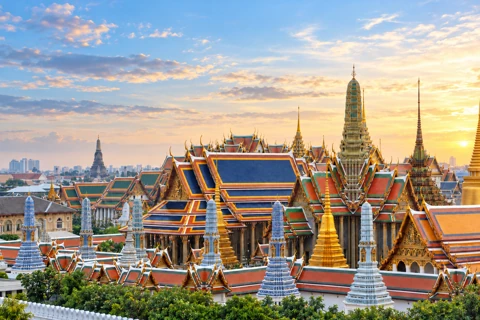
Day 2 is for the Grand Palace, the most visited site in the city. According to Planet Whitley’s September 2026 guide, foreign visitors pay 500 baht, the gates open at 8:30, ticket sales and last entry close at 15:30, and the grounds close at 16:30. A visit takes two to three hours. The nearest stop is Tha Chang pier on the Chao Phraya Express Boat (stop N9), and there is no parking on site. Some other sites list slightly different hours, so confirm them on the Grand Palace’s official schedule. The 500-baht ticket also covers Wat Phra Kaew and the Queen Sirikit Museum of Textiles, according to MyTravelGENO. Children under 120 cm enter free.
The dress code is enforced at the gate. Beliholiday says upper arms must be covered with full or capped sleeves, legs must be covered below the knee, torn or sheer fabric is refused, and flip-flops and open-back sandals are generally turned away. Dress fully covered before you leave your hotel instead of relying on rentals. Buy tickets only at the official office inside the main gate on Na Phra Lan Road. Bangkok Spirit advises ignoring street sellers who claim the palace is closed today. Payment is generally in cash, though some counters accept cards.
Check for closures when you pick your dates. The palace and Wat Phra Kaew closed in June 2026 for a royal funeral, and Planet Whitley expects temporary closures around the royal cremation of Queen Mother Sirikit at Sanam Luang. If your trip overlaps those closures, swap the palace to another day or confirm the schedule first.
Day 3 is the train. The State Railway of Thailand timetable lists Special Express No. 7 from Krung Thep Aphiwat station in Bangkok at 09:05, arriving in Chiang Mai at 19:30. That is 744 km in 10 hours 25 minutes for about 558 baht. The page is labeled Version 2025, so verify the times on the SRT site before you buy. A day train lets you watch the landscape change, but it takes most of the day, and you reach Chiang Mai after dark. Book a hotel you can reach easily at night, since you will arrive around 19:30.
Chiang Mai and the flight south
Chiang Mai gets two full days (days 4 and 5): one for the city and one for a day trip beyond it. Which comes first depends on your interests and the weather. Day 3 ends after dark, so day 4 is the first morning to start fresh. If you want more than two days here, take them from Bangkok rather than from Phuket, since the beach days double as your buffer.
Day 6 moves you south. A direct Chiang Mai to Phuket flight takes about 1.5 hours according to Pickyourtrail, or about 2 hours according to Thailand Guide. Thailand Guide describes it as a regional direct flight with limited daily frequencies. Book early. The route has few departures, so a missed or cancelled flight is hard to replace. The indicative one-way fare that guide lists is 2,000 baht, higher than the 900 to 1,500 baht it lists for major trunk routes from Bangkok, and it recommends booking four to six weeks ahead because fares rise as departure nears.
The alternative is to connect through Bangkok. Bangkok to Phuket takes about an hour in the air, but two flights and a possible airport change take more time than the direct flight. They also add a second chance of delay. The direct flight is the better choice unless the schedule on your dates leaves you no workable departure.
If you fly a budget airline, mind the bag limits. Thailand Guide says budget carriers (AirAsia, Nok Air, Thai Lion Air, and Thai VietJet) typically set a 7 kg cabin allowance, with checked bags sold separately. Bangkok Airways advertises a 20 kg allowance on domestic and international flights. Thai Airways charges excess baggage on domestic routes per kilogram: 125 baht on Chiang Mai to Phuket, 60 on Bangkok to Chiang Mai, and 70 on both Bangkok to Krabi and Bangkok to Phuket. A pack under 20 kg, with a carry-on that fits the 7 kg limit, avoids most of those fees. Check each carrier’s site before you pay.
Arrive in Phuket with the afternoon free. Phuket International Airport sits in Mai Khao, about 32 km north of Phuket city, and Terminal 3 handles domestic flights. If you land in the afternoon, there is time to reach your lodging and settle in before the beach days.
Phuket, Maya Bay, and the way out
Day 7 is a rest day or a local exploring day in Phuket. After a train day, a flight day, and five days of city sightseeing, a slow day on the island makes the boat day easier to enjoy.
Day 8 is the Phi Phi day trip. Koh Phi Phi has no airport or bridge, and boats from Phuket, Krabi, Ao Nang, Railay, and Koh Lanta take 45 minutes to 2 hours depending on route and vessel. A typical tour covers Bamboo Island, Viking Cave, Pileh Lagoon, Maya Bay, and Phi Phi Don for lunch and Monkey Beach. Tour operators set pricing and schedules. Tisland Travel lists Krabi-departing tours from 2,200 baht per person in 2026. That is an operator price rather than an official fare, and Phuket departures are priced separately.
Maya Bay is on Ko Phi Phi Leh inside Hat Noppharat Thara–Mu Ko Phi Phi National Park. It closes every year from August 1 to September 30. It reopened on October 1, 2026. Boats do not enter the bay. They dock at a pier in Loh Samah Bay, and visitors walk about 5 to 10 minutes along a wooden boardwalk. Swimming in the bay is prohibited, though wading knee-deep is allowed. Visitor numbers are capped at about 375 per time slot, so a late booking can lose its slot. The park fee is about 400 baht for foreigners and 200 baht for Thai visitors, per Railay Eco Tour, which also reports that reef-unsafe sunscreen and littering are banned.
Rules across the Phi Phi stops include no feeding wildlife, no drones, no alcohol, no smoking, no littering, and no collecting shells. Trip Thai Tour reports fines of 5,000 to 100,000 baht. Wear reef-safe sunscreen (or none) and carry your trash back to the boat. Ask the operator about sea conditions when you book. One August 2026 review on Phuket Boat Tours reports that Maya Bay was skipped that day because of high waves while the rest of the itinerary ran. A cancelled stop is possible, which is why day 9 stays empty.
Day 9 in Phuket is a buffer. If weather cancelled the Phi Phi trip, rebook it here. If the trip went ahead, use the day for the beach, a late morning, and packing. Do not schedule anything on day 9 that you would regret skipping.
Day 10 is departure. Where you fly next determines the plan. If your flight home leaves from Bangkok, book a morning Phuket to Bangkok flight (about an hour) with several hours of margin before the international departure. Note which Bangkok airport your domestic flight uses. Thailand Starter Kit says most budget airlines fly from Don Mueang, while Thai Airways, Bangkok Airways, and VietJet use Suvarnabhumi. Buying a budget fare into one airport and an international ticket out of the other creates a cross-city transfer. If your return flight leaves from Phuket itself, the buffer day gives you more room.
Transport, costs, and where to sleep
Rail and air fares on this route are modest by international standards, but they change by date and carrier. Treat every figure as a starting point. The Bangkok to Chiang Mai train costs about 558 baht on Special Express No. 7. The slower Rapid No. 109 takes 13 hours 50 minutes and runs about 230 to 758 baht, according to the same SRT timetable. Trip.com’s rail guide puts the trip at roughly 11 to 13 hours, with a second-class sleeper from 900 baht. Flights are quicker. Thailand Guide lists indicative budget one-way fares of 900 baht from Bangkok to Chiang Mai and 900 baht from Bangkok to Phuket. Bangkok Airways’ homepage advertises start-from fares of 1,500 baht to Phuket and 1,200 baht to Krabi, but those are promotional prices without travel dates.
The Chiang Mai to Phuket leg is the pricey one, so book it first and plan the rest around it. Add the Grand Palace ticket at 500 baht, the Maya Bay park fee at 400 baht, and the Phi Phi tour, and you can total the fixed costs before you leave.
For lodging, the most useful choices are logistical. The only hard requirement is that you book your first night in Bangkok before you submit the TDAC, since the form asks for a Thai address. In Bangkok, a stay near the Chao Phraya Express Boat piers keeps the Grand Palace trip short, since Tha Chang is the stop for the palace. For the night before the train, stay near Krung Thep Aphiwat station or somewhere with an easy route to it, since the 09:05 departure leaves little margin. In Chiang Mai, you arrive at 19:30, so a hotel close to the station or a pre-arranged ride counts for more than the neighborhood. In Phuket, the airport is 32 km north of the city, so the last night works best near the airport or with a transfer booked in advance. The Phi Phi tours depart from various piers, so confirm your pickup location with the operator before choosing your Phuket base.
Adapting the route to a week or two weeks
A seven-day version drops one Bangkok night and one Chiang Mai night. Arrive in Bangkok on day 1 and visit the Grand Palace on day 2, then take an overnight train to Chiang Mai. The SRT Northern Line page lists Special Express Nos. 13 and 14 as sleeper services, including an air-conditioned first-class sleeper. Check departure times on the SRT site before you book. Spend days 3 and 4 in Chiang Mai, fly to Phuket on day 5, take the Phi Phi trip on day 6, and depart on day 7. This version has no weather buffer, so if sea conditions cancel the boat trip there is no spare day. Consider keeping the Phi Phi trip on day 5 and leaving day 6 free if your flight home allows it.
A fourteen-day version adds Krabi as a second beach base. Bangkok to Krabi takes about 1 hour by air, up to 1 hour 25 minutes depending on the source, and Krabi departures to Phi Phi are priced from 2,200 baht. Give the extra four days to a mix of extra Bangkok nights at the start or end, extra Chiang Mai nights, and two or three nights in Krabi. Leave one day empty near the end for weather.
Two entry rules matter for the longer trip. A 30-day exemption covers a two-week trip with plenty of margin. The 15-day tier covers a two-week trip with a day to spare, so keep your return flight booked and the dates exact. And if you plan to cross a land border at any point, remember the two-entry-per-calendar-year limit on land entries under the 30-day exemption.
Key Takeaways
- Check your passport category first: Since September 15, 2026, Thailand assigns each nationality to a 30-day exemption, a 15-day exemption, or a required visa. The 10-day route fits both exemption tiers.
- File the TDAC on the official site only: Submit it at tdac.immigration.go.th within three days before arrival, counting the arrival day. It is free, and it needs a first-night address.
- Use two transport legs, not six: The day train to Chiang Mai (about 10.5 hours) and one direct flight to Phuket (1.5 to 2 hours) link the stops. Book the flight early, because frequencies are limited.
- Plan Maya Bay around the rules: Swimming is banned and visitor slots are capped. The park fee is about 400 baht, and rough seas can cancel the stop. Keep day 9 free as a buffer.
- Arrive at the Grand Palace at 8:30 with shoulders and knees covered: Entry costs 500 baht, last entry is 15:30, and royal ceremonies may close the palace temporarily.