Meal Times in Spain and the Menú del Día
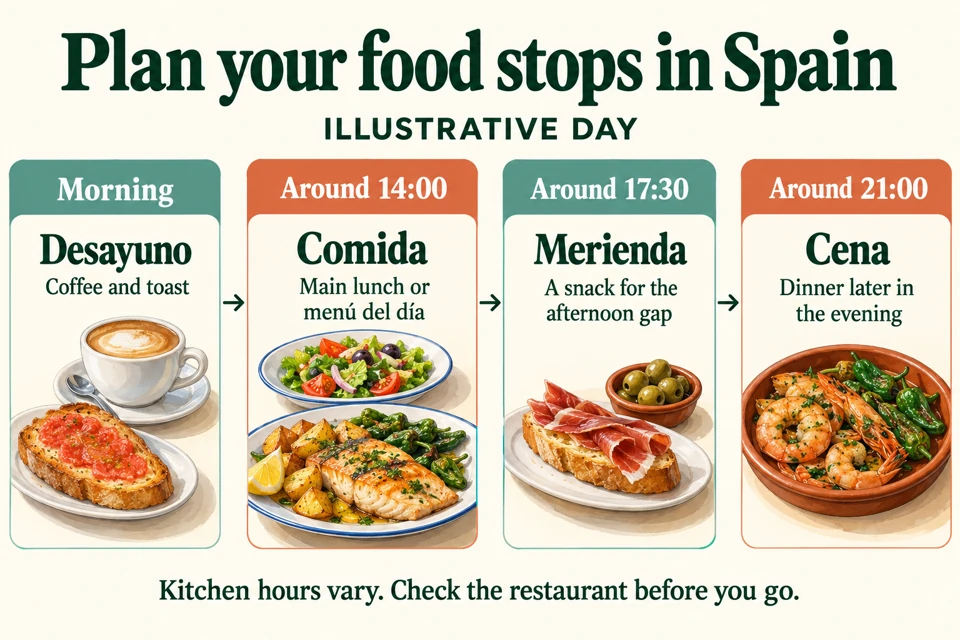
Spaniards eat their main meal in the early afternoon and dinner late in the evening. A typical day starts with a small breakfast, a main lunch around 2 p.m., a light snack in the late afternoon, and dinner at 9 or 10 p.m. The menú del día, meaning "menu of the day," is a fixed-price lunch with several courses. Most restaurants serve it on weekdays, and the dishes change daily.
Travelers should plan lunch around 2 p.m. on a weekday, eat a snack in the afternoon gap when most kitchens are closed, and expect dinner to start around 8 or 9 p.m.
When Spaniards Eat Each Meal
Clock times vary, but the overall pattern is consistent. The table below shows the usual windows.
| Meal | Typical time | What it usually involves |
|---|---|---|
| Breakfast (desayuno) | Early morning | Coffee with toast, a croissant, or a pastry |
| Mid-morning (almuerzo) | 10 a.m. to noon | A light snack, such as cocas with cured meats and cheese in Valencia |
| Lunch (comida) | 2 to 3 p.m., sometimes to 4 p.m. | The main meal, often the menú del día |
| Merienda | 5 to 6:30 p.m. | A light snack between lunch and dinner |
| Dinner (cena) | 9 to 10:30 p.m. | Lighter than lunch, though it can have several courses |
Breakfast is the smallest meal of the day. Locals usually order a café con leche (coffee with milk), a cortado (a small coffee with a little milk), or a café solo (black espresso) and eat it standing at a bar. Spain Food Guide describes it as a short bar stop rather than a sit-down meal. Some diners sit for 15 to 20 minutes instead.
The mid-morning meal has no fixed name across Spain. In Valencia, an early almuerzo at 10 a.m. to noon is a light snack, and people with physical jobs in the morning often eat it. Eatseerv reports that in parts of Andalucía, almuerzo refers to the midday meal instead. Travelers should expect the word to mean different things depending on the region.
Lunch is the main event. Restaurant kitchens typically open around 1:30 or 2 p.m. and stop serving lunch between 3:30 and 4 p.m. Weekday dining rooms fill between 2 and 3:30 p.m. Lunch length depends on the setting. Foreverbarcelona puts it at about an hour, while Spain Food Guide describes a workplace break of 1.5 to 2 hours.
The merienda is a light snack that falls between lunch and dinner. Children eat it routinely. Spanish Sabores and Interlink describe it as a snack for children, and adults eat it less consistently. A café merienda in the 5 to 6:30 p.m. window is an easy way to bridge the afternoon gap.
Between lunch and dinner, most restaurant kitchens are closed. Khalijia Restaurante reports that drinks and cold snacks may be available during this gap, but full meals usually are not. Plan a snack or a coffee for this window rather than hoping for a full lunch.
Dinner starts around 8 or 9 p.m. Restaurants are busiest between 9:30 and 10:30 p.m., and kitchens close late at night. Dinner is lighter than lunch, but a multi-course dinner is common enough that a traveler should not assume a small plate is the only option.
Customs Behind the Late Schedule
Meals run long because people linger at the table. The Spanish term for this is sobremesa, the time spent talking after the meal. On weekends, tables can stay full well past 4:30 p.m. Spanish Sabores describes this custom, and it explains why a weekend lunch can run into the afternoon.
The siesta, a midday rest, has largely faded from big cities. Spain Food Guide describes it as rare in large cities outside August, though small villages may still observe it. Business hours follow a similar split. In smaller towns and villages, shops often close for two to three hours in the afternoon. In Madrid, Barcelona, and Seville, most businesses keep continuous hours.
Heat is one explanation offered for the late lunch in Andalucía, Extremadura, and the central plateau, where outdoor work was impractical during the hottest afternoon hours.
Survey data on meal length covers one region. A time-use analysis of the Basque Country, which reports average times for people over 16. Lunch averaged 44 minutes, dinner 36 minutes, and breakfast 21 minutes. These numbers describe one region, not Spain as a whole.
Dinner Is Getting Earlier
Older guides list 9 to 10:30 p.m. as the usual dinner window, and that remains the common picture. Newer restaurant data points to a shift. A report from El Correo Gallego on 9 October 2026 cites CoverManager booking data showing that late bookings from 10 p.m. onward fell from 30% to 15%. About half of dinner reservations now start before 9 p.m. The report says the shift began around 2021.
The same data gives regional averages. Madrid’s average dinner reservation falls at 9 p.m., 12 minutes earlier than in 2024. Barcelona’s average is 8:45 p.m., 15 minutes earlier over two years, with 52.2% of tables booked before 9 p.m. Cádiz averages about 9:30 p.m. These figures cover restaurant reservations only, and the report does not state a sample size or time period. Use them as a guide to what to expect, then confirm the hours of the restaurant you plan to visit.
What the Menú del Día Includes
The menú del día is a fixed-price set meal served mainly at weekday lunch. Wikipedia’s entry on the menú del día describes it as a lunch offer with a set price, and most restaurants post it outside or on a chalkboard. A standard menú includes a first course, a second course, dessert or coffee, bread, and a drink.
Restaurants usually offer two groups of choice, one for first courses and one for second courses. Madrid listings show typical first courses such as salad, soup, gazpacho, or pasta, and second courses such as meat or fish with a side garnish. The "de día" in the name means the offer changes each day. A Spanish dictionary entry makes this point, and the menu you see on Tuesday may not appear on Wednesday.
The drink is the detail that varies most. The drink is usually included. Madrid menus list water, house wine, a soft drink, or beer, depending on the venue. A bar owner in Granada, featured in a television report on the cheapest menú in Spain, said the drink is not included in his €4 menu. Check the posted menu for the drink before you order.
Restaurants also serve an à la carte menu, called the carta. Ordering from the carta costs more, because each dish carries its own price and the total adds up beyond the set-menu price. Some restaurants offer a higher-priced executive menu, or menú ejecutivo. A Time Out Madrid guide reports executive menus at €28 and €36, well above the usual range.
The menú is rarely a dinner option. Spain Food Guide says it is generally not offered in the evening. Some restaurants run an evening version called the menú de noche, which is less common and usually costs more.
What the Menú Costs
Each restaurant sets its own price for the menú. The figures below come from guides, listings, and media reports, and each one carries a different date and method, so treat them as estimates rather than official data.
| Figure | Source | Caveat |
|---|---|---|
| About €14.20 average | Television report, 2 April 2026 | The report does not explain how it reached the average |
| From €14 in neighborhood bars; €15 to €18 in central Madrid restaurants; up to €20 for executive menus | Madrid listing | Commercial listing, not a price survey |
| €10 to €14 outside major cities; €12 to €18 in Madrid and Barcelona | Spanish food guide | Guide estimate |
| €8 to €14 | Encyclopedia entry | Undated |
A reasonable working range for a weekday menú in a Spanish city, based on these figures, runs from about €10 to €18. Prices in central Madrid and Barcelona sit at the upper end. The lowest figure, a €4 menú in Granada, comes from one bar and is an outlier. Neighborhood bars in Madrid, according to one listing, start at €14. Read the posted menu outside the restaurant before you sit down, since it carries the price that applies on that day.
Which Days the Menú Is Served
Most restaurants serve the menú at weekday lunch. Spain Food Guide reports that some restaurants also serve it on Saturday. On Sunday, many restaurants close, and the weekend menú varies by restaurant. Ask before you sit down whether the menú runs that day.
Serving hours differ by restaurant, so check the posted hours before you go. An early lunch gives you the best selection, while a late arrival may leave the restaurant with fewer dishes left to choose from.
Planning a Weekday Around the Menú
The following schedule is a planning sketch built from the typical windows above, not a published itinerary. It works for a weekday in a Spanish city.
Start with breakfast between 8 and 10 a.m., such as a coffee and a pastry at a bar. If you get hungry in the late morning, a light almuerzo in late morning fills the gap. Arrive at the restaurant around 1:30 or 2 p.m. for lunch. The first-course choices can sell out after about 3 p.m., and dining rooms fill between 2 and 3:30 p.m. Arriving early gives you more choice and a quieter room. Arriving at 3 p.m. in a busy city usually means a crowded dining room with a thinner menu.
After lunch, plan for the gap before dinner. A café merienda between 5 and 6:30 p.m. suits this slot. If you plan to walk or visit sites during the afternoon, carry a snack for the late afternoon, because kitchens are usually closed. Dinner works best at 9 p.m. or later, and a dinner after a full lunch can be light. If you want a table at a popular restaurant, book ahead, since dinner reservations in busy cities fill quickly.
Smaller towns often close shops for two to three hours in the afternoon, so plan errands before lunch or after the evening reopening. Service is generally not included in the menú price, so look at the bill for a service charge before you tip.
Rules and Tax to Confirm
The menú’s rules come from regional governments, according to a restaurant guide on the menú’s legal requirements. Some zones require restaurants to offer a menú. Confirm this rule through the regional government’s official bulletin before you rely on it.
The tax rate on the menú is another point to confirm. Food and drink eaten in a restaurant fall under the 10% reduced rate, including alcohol. Takeaway alcohol falls under the 21% rate. Confirm the reduced rate for the menú with the Agencia Tributaria before quoting it as fact. The governing law is Law 37/1992 on value-added tax, which the tax agency publishes alongside its rate guidance.
Quick Rules for Meal Times
- Plan lunch for about 2 p.m. on a weekday: Most kitchens serve lunch from about 1:30 to 4:30 p.m., and dining rooms fill between 2 and 3:30 p.m.
- Plan a snack for the afternoon gap: Most kitchens close during this gap, so a merienda at 5 to 6:30 p.m. fills it.
- Check the posted menú before sitting down: The menú changes daily, and the drink is not always included.
- Plan dinner for 9 p.m. or later: Older guides list 9 to 10:30 p.m., and 2026 restaurant data shows that about half of reservations start before 9 p.m.
- Confirm prices and tax with official sources: Guide estimates run from about €10 to €18, and the menú’s tax rate and regional rules need checking with the Agencia Tributaria and the regional bulletin.