Carry-On Liquid Rules for the US, EU and UK
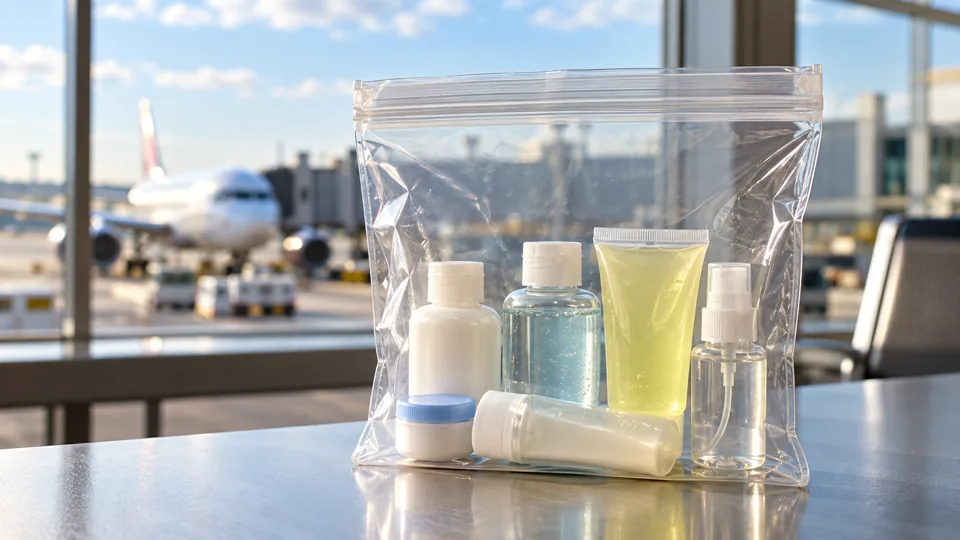
If you pack a carry-on bag for a flight from the United States, the European Union or the United Kingdom, the liquid rules determine how much shampoo, sunscreen, medicine and baby formula you can take through security. Carry-on liquids include anything pourable or spreadable, such as gels, creams, aerosols and pastes. All three places use the same basic rule: small containers packed in one clear bag. The limits differ in the details, and some airports run newer scanners that change the rule.
In the US, each liquid container must hold 3.4 fluid ounces (100 ml) or less, and all containers must fit in one quart-size bag. In the EU, the limit is 100 ml per container inside one bag of no more than one liter. In the UK, 100 ml applies at most airports, but some airports with newer CT scanners allow containers up to 2 liters. All three places have exceptions for formula, breast milk, medicine and baby food.
The US 3-1-1 rule
The US rule is commonly called 3-1-1, a name for three limits. Each container is limited to 3.4 ounces. Each traveler gets one quart-size bag. The 3-1-1 rule explained explains the limits in more detail. The Transportation Security Administration (TSA) runs the checkpoints, and its rules apply to every departure from a US airport. The limit applies to the size printed on the container, not to how full it is, so a 4-ounce bottle that is half empty still exceeds the limit. Empty containers pass through.
At the checkpoint, take the quart bag out of your carry-on and place it in a bin by itself. Keep the bag clear and resealable, because officers need to see its contents. The rule has applied since 2006, and the start month was September 2006. The limit applies to carry-on bags only. Checked luggage has no TSA size limit on liquids, but airlines set their own rules for some items, so check your airline before you pack large bottles or aerosols in a checked bag.
How CT scanners change US screening
Older checkpoints use two-dimensional X-ray machines, which means you remove the quart bag and your electronics before screening. Newer CT (computed tomography) scanners build a three-dimensional image of the bag’s contents. The technology reached the public in 2017, when Phoenix Sky Harbor became the first airport to receive it. A 2018 report described a pilot at 15 airports and named Boston Logan and JFK as later sites. A 2018 report said TSA viewed letting small liquid amounts stay in bags as the next step. That remark described a future step, and the rule did not change.
The current position is that CT lanes keep the 3.4-ounce limit. A 2026 travel report says the limit still applies at CT lanes, and that travelers may leave their liquids in the bag while officers review the 3D images. Another 2026 analysis says the 3-1-1 rule appears to be staying in place for now. Treat the scanner as a change in how screening happens. It does not change how much liquid you can carry.
The number of CT-equipped airports is harder to pin down. As of July 2025, one tally counted 255 airports with CT lanes. Check the current airport list on tsa.gov before you assume your airport has CT lanes, and remember that an airport may run both CT and X-ray lanes at different times. Where the lane is X-ray, you still take the bag out of the carry-on. At CT lanes, every carry-on item goes into a bin, and one report says narrower CT tunnels can push oversized carry-ons to be checked at the gate. If your bag is large, keep that possibility in mind.
Liquid rules in the EU
The European Commission sets the EU baseline in its air-traveler guidance. It states that liquids in hand luggage must sit in individual containers of no more than 100 ml, inside one transparent, resealable plastic bag of no more than one liter. The rule covers gels, aerosols, pastes, lotions, drinks, toothpaste, soup, syrups, perfume and shaving foam. The Commission says the rule applies at all EU airports and at airports in Norway, Iceland and Switzerland, and that it applies to every departing passenger. It covers hand luggage only, and liquids bought after security are not limited. The rule rests on Commission Implementing Regulation (EU) 2015/1998, which sets the aviation security standards that airports follow.
The EU baseline changed in 2024. The Commission announced on 31 July 2024 that the 100 ml limit would return temporarily from 1 September 2024 at airports that run Explosive Detection Systems for Cabin Baggage (EDSCB), a type of scanner that had allowed larger containers at some airports. Airports already at 100 ml, or without EDSCB equipment, were not affected. The Commission described the step as precautionary and tied to a technical issue rather than a new threat.
Claims that up to 2 liters applies at CT-equipped EU airports are undated and ignore the 2024 change, so the Commission’s 100 ml position is the better starting point. Ask your departure airport which scanner it uses, and check the European Commission’s air-travel pages for the current status of the temporary measure before you fly.
Liquid rules in the UK
The UK standard is 100 ml per container in one transparent, resealable bag of about one liter, with one bag per passenger. Most UK airports still apply this rule. Airports with approved CT scanners change that rule. A CT scanner gives security staff a 3D image, so you do not remove liquids or electronics from your bag at a CT lane. Where CT scanners are installed and approved, containers up to 2 liters each are allowed, with no stated cap on the number of containers and no separate clear bag. The allowance applies only at the departure airport. If you fly home from an airport that still uses the 100 ml rule, you follow that airport’s rule at its checkpoint.
Airport status changes often, so check each airport’s security page before you pack. Heathrow reportedly dropped the 100 ml limit at the end of January 2026, following a scanner upgrade. Birmingham and Edinburgh are listed as 2-liter airports. Manchester, Stansted, Luton and East Midlands use 100 ml, although Luton and Manchester let liquids stay in cabin bags even under 100 ml. Confirm Gatwick’s status on its own security page.
Vacuum flasks need attention at CT lanes. Liquid inside a vacuum flask must be poured out, because the scanner cannot see through the double insulation layer. UK medication rules are less settled than the US and EU rules, so confirm them on gov.uk before you pack.
Medicine and baby food rules
Every one of the three regions makes room for medicine, infant food and milk. The details differ, as the table below shows.
| Item | US | EU | UK |
|---|---|---|---|
| Formula, breast milk, juice | Allowed above 3.4 oz, outside the quart bag | Essential baby food and milk allowed above 100 ml for use during the trip | Baby milk and baby food allowed above 100 ml when an infant travels |
| Pumping gear and cooling packs | Allowed, whether or not milk is present | Not addressed in the official guidance | Partially thawed packs may be refused under standard rules |
| Medicines | Prescription and OTC liquid medicines allowed above 3.4 oz; declaration advised | Essential medicines allowed above 100 ml for use during the trip; proof of authenticity may be requested | Rules not settled; check gov.uk |
| Duty-free liquids | Listed on some exemption lists | Listed on some exemption lists | Not confirmed |
The US has the most detailed official text for infant items. The TSA’s FAQ on breast milk, formula and juice says formula, breast milk and juice above 3.4 ounces may go in a carry-on without fitting in the quart bag. Officers remove them for separate screening. A child does not need to be on the flight for breast milk to qualify. Breast milk, formula and pumping equipment count as medically necessary liquids, and ice packs and cooling accessories for these items are allowed. The FAQ does not state a cap on quantity, so do not plan on unlimited quantities.
For medicine in the US, prescription and over-the-counter liquid medicines above 3.4 ounces are allowed, and you should declare them to the officer before screening. The TSA FAQ linked above covers formula and breast milk, so check the medication wording on tsa.gov before you travel. Carry the labeled packaging with the prescription name, which helps when an officer asks questions. Confirm on tsa.gov how TSA PreCheck membership applies to medicine before you reach the checkpoint.
Officers do not always apply the rules the same way. In June 2022, Senators Tammy Duckworth and Mazie Hirono wrote to TSA about travelers who lost breast milk or cooling accessories at checkpoints, and about pumps that were damaged during screening. The letter asked TSA to clarify its rules on ice packs. The current FAQ addresses ice packs, which suggests the clarification happened, but carry-on documentation still helps if an officer questions your supplies.
For EU travel, the Commission says essential medicines, baby food and milk may exceed 100 ml when they are needed during the trip, and you may be asked to prove that they are authentic. Keep the medicine in its labeled container and carry the prescription if you have one. For UK travel, baby milk, sterilized water and baby food can exceed 100 ml when an infant travels. Nursing parents may bring up to 2 liters of breast milk but must taste some at customs. Check gov.uk for the official text.
Packing steps before you fly
Check your departure airport first, since that airport sets which rule applies at its checkpoint. For US trips, check whether your airport runs CT lanes, and plan on removing the quart bag from your carry-on at any lane that still uses X-ray. For EU trips, check the scanner type with your airport, and remember that a temporary 100 ml rule applies at airports with EDSCB equipment. For UK trips, confirm the status of your departure airport on its website, and remember that the 2-liter allowance applies only at departure.
Pack every container under the limit for the region you are leaving, and place them in one clear, resealable bag. Put medicine and infant food in their labeled containers, in a separate bag if you can, so you can show them at the checkpoint without unpacking the rest. Carry the prescriptions, and declare the medicine and infant items to the officer before screening. Buy shampoo, sunscreen and other liquids after security if you want to avoid the limits entirely. Duty-free purchases are a separate case. Check with the shop and the airport before you buy.
Summary of the rules
- Pack one quart-size bag: In the US, each container holds 3.4 fluid ounces (100 ml) or less, and all containers fit in one quart-size bag.
- Check your scanner before you pack: CT lanes change how you screen, not how much liquid you can carry in the US, while UK and EU airports with CT or EDSCB scanners follow different rules.
- Plan for the 2-liter allowance only at departure: Where a UK airport allows 2-liter containers, the allowance covers only that airport’s departure checkpoint and does not extend to your return trip.
- Declare medicine and infant food: Keep prescriptions and labeled containers with you and tell the officer before screening.
- Confirm the current rule on the official site: Airport status and temporary measures change, so check tsa.gov, the European Commission’s pages and gov.uk within a few days of departure.