Packing List for a Two-Week Trip
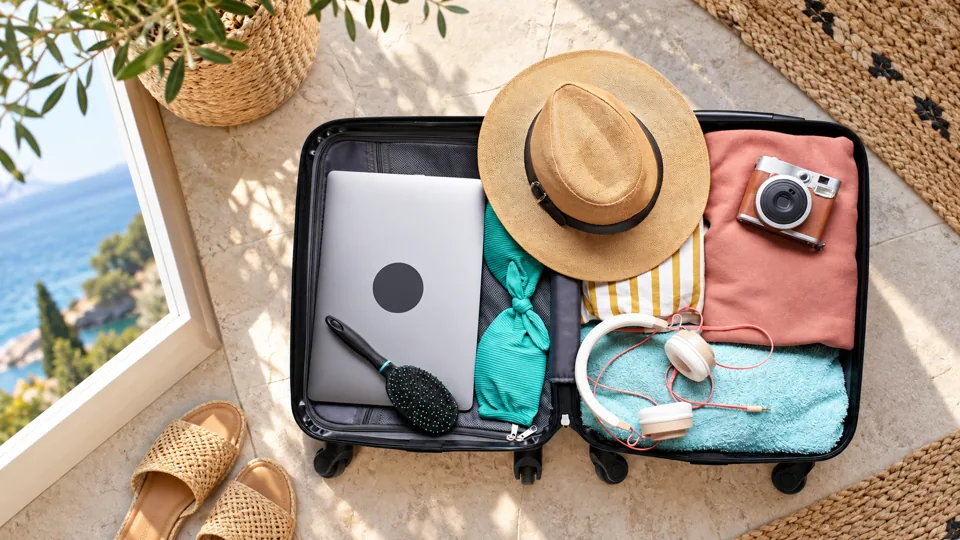
Planning a two-week trip means settling three packing questions early: what goes through the security checkpoint, what goes in the checked bag, and which clothes suit the climate. Security rules limit liquids and lithium batteries. Airline size and weight limits determine which bags you can bring. The weather at your destination drives most of your clothing choices.
Most of this guidance follows U.S. rules, because the checkpoint and airline details apply to flights departing the United States. Fees, carrier policies, and checkpoint rules change, so check each one on the official site before you pay for a bag or pack a bottle. Figures that change often are listed with their dates.
Liquids and toiletries at security
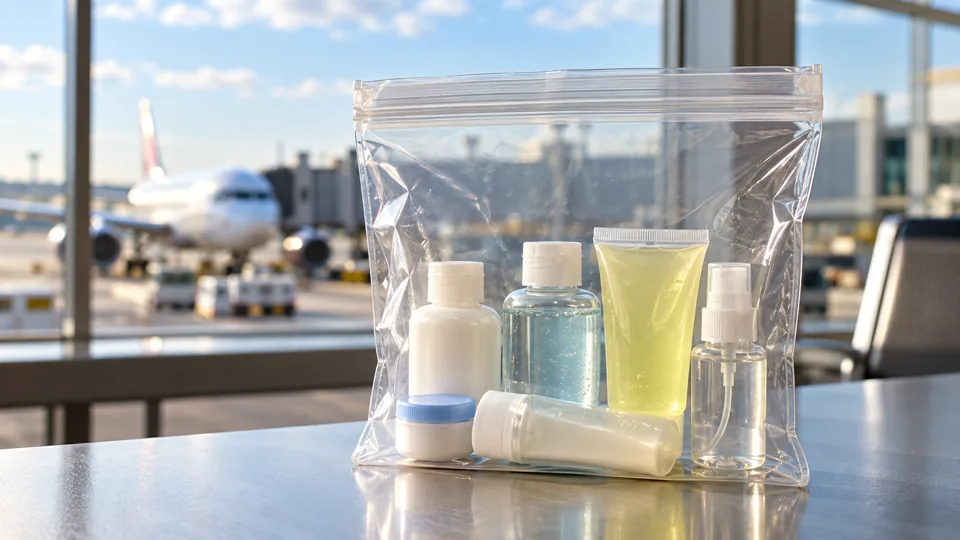
The U.S. checkpoint rule limits each liquid, gel, cream, aerosol, or paste to a container of 3.4 ounces (100 ml) or less. You put all of those containers in one clear, quart-size, resealable bag, and each passenger brings one bag. Whether it passes depends on the size printed on the container. A partly used container counts at its full labeled size. A nearly empty 6-ounce bottle of shampoo still cannot go in the carry-on.
Containers larger than 3.4 ounces belong in the checked bag. Checking them is the only way to bring a full-size bottle of shampoo, sunscreen, or lotion on a flight that also has a carry-on. For the carry-on, buy travel-size bottles or decant into smaller containers. The rule’s wording covers creams, gels, and aerosols, so sunscreen lotion and spray fall under it. Confirm this on tsa.gov before you fly, because the TSA page is the authority for checkpoint rules.
Several everyday items are handled differently. Infant formula, breast milk, and juice can be carried above 3.4 ounces. They do not have to fit in the quart bag, and they should be declared to the officer. Medically necessary liquids are also allowed in larger amounts. That includes prescription and over-the-counter medicines. It also covers gel ice packs and liquid supplements. Tell the officer about them and keep them separate from your other items so they are easy to inspect. Food falls under separate rules. Consumables such as salsa, honey, and peanut butter count toward the 3.4-ounce limit in the carry-on, and honey and hot sauce are permitted in checked bags.
Batteries and power banks
Lithium batteries and power banks go in the carry-on, and the Federal Aviation Administration (FAA) requires this for spare batteries. A device with a battery installed can be checked only when it is powered off and protected from accidental activation. Bags with built-in batteries must stay in the cabin unless you take the batteries out.
Your battery’s watt-hour rating (abbreviated Wh) decides which rules apply. Manufacturers print this figure on the battery or device, and the checkpoint uses that number. The FAA sets no federal quantity limit for personal batteries rated under 100 Wh. Batteries rated 101 to 160 Wh require airline approval, and each person can carry no more than two of them as spares. Batteries over 160 Wh are not allowed on passenger flights. Damaged, defective, or recalled batteries cannot be carried at all.
Power bank labels often list milliamp-hours (mAh) instead of watt-hours, so the conversion helps. Watt-hours equal milliamp-hours multiplied by the battery’s volts, after changing milliamps to amps, so use the voltage printed on the label. A bank rated under 100 Wh is the easiest to fly with, and a bank rated 101 to 160 Wh needs airline approval.
Delta’s battery policy adds a cap of 20 spare batteries per person. The FAA does not list that number, so treat it as Delta’s own rule and check delta.com before you fly on Delta. If a bag is checked at the gate or planeside, the batteries and power banks come out and stay with you. If a battery overheats, swells, smokes, or burns, report it immediately.
Carry-on and checked bag limits
Carry-on size is consistent across the largest U.S. carriers, though the details differ. The table below lists the carry-on size and notes for four large U.S. carriers. Measure your bag at home and confirm the current size on each airline’s site before you buy a ticket.
| Carrier | Carry-on size | Notes |
|---|---|---|
| Delta | 22 × 14 × 9 in | No weight limit; personal item must fit under the seat |
| United | 22 × 14 × 9 in, including handles and wheels | No weight limit; personal item 17 × 10 × 9 in; Basic Economy loses the overhead bag |
| American | 22 × 14 × 9 in, including handles and wheels | No weight limit; the bag must fit the airport sizer |
| Southwest | 24 × 16 × 10 in, including wheels and handles | No weight limit; one personal item allowed |
For the checked bag, the common limit is 62 linear inches (length plus width plus height, counting handles and wheels) and 50 pounds for economy passengers. Southwest uses 50 pounds (23 kg) and allows 30 × 20 × 12 in or 62 linear inches. American accepts bags larger than 62 inches but charges oversize fees for them. Frontier’s 40-pound limit is the strictest of the carriers covered in this guide, so a bag that is fine on one airline can be overweight on another.
The most recent fee changes matter for a two-week trip. Delta’s first checked bag on domestic flights costs $45 and its second costs $55, after a rise from $35 and $45 in April 2026. Southwest raised its fees to $45 for the first bag and $55 for the second in April 2026, after ending its free checked bags on May 28, 2025. Southwest’s Choice Extra and Business Select fares include two free checked bags. American’s first bag costs $50 at the airport or $45 online, and its second costs $60 or $55 online. United has no single published fee. Its charge depends on the purchase date and route. Check the bag fee, the third-bag fee, and any overweight fee on each airline’s own baggage page before you book, because these fees change often.
Pack the clothes, shoes, and any long-term toiletries in the checked bag, and keep the carry-on for the 3.4-ounce liquids, batteries, medicines, a change of clothes, and anything you cannot replace quickly. If you are flying with one carry-on and a personal item, a fold-flat tote that fits under the seat is a better second bag than a full-size duffel that may exceed a personal-item limit.
Clothing for hot weather
Hot-weather packing starts with loose, lightweight, light-colored clothing that lets air move across the skin. The Centers for Disease Control and Prevention (CDC) lists the same basic items for heat and cold travel: layers that breathe, a hat, and protection for the skin. For hot weather, that means a wide-brimmed hat, wraparound sunglasses that block both UVA and UVB rays, and sunscreen labeled broad spectrum with an SPF of 15 or higher. The CDC’s heat guidance says to apply sunscreen 30 minutes before going outside and to reapply it according to the package directions.
Sunscreen strength and timing differ from one guidance source to another. The CDC gives SPF 15 as the minimum, and Colorado’s public health guidance recommends SPF 30 applied 20 minutes before going outside. SPF 30 is the more conservative choice, especially for fair skin or a long day outdoors, and it fits in the same 3.4-ounce container that the checkpoint rule allows.
Heat changes the schedule as much as the wardrobe. The CDC advises planning outdoor activity for the cooler hours of morning and evening and resting in shade during the middle of the day. Fans do not prevent heat illness once temperatures reach the high 90s °F, so an air-conditioned room or a cool shower is the better break. The CDC gives no hydration volume, so drink steadily through the day instead of counting a target.
Sun exposure depends on how close you are to the equator, your altitude, the time of day, and cloud cover. The CDC says UV exposure is highest near the equator, at high altitude, and between 10 a.m. and 4 p.m., and it persists on cool, overcast days. A traveler who is heading to a high-altitude trail on a cloudy morning still needs sunscreen. The same CDC guidance notes that travelers who are not used to heat should limit how long and how hard they exercise during the first week, and the older CDC summer travel guidance suggests about one hour of heat exposure per day before the trip to build tolerance.
Clothing for cold weather
Cold-weather packing relies on layers. The CDC recommends several loose layers, a tightly woven outer coat or jacket that blocks wind, light and warm inner layers, and mittens, a hat, and a scarf. In wet conditions, the CDC recommends waterproof shoes with good traction. Staying dry matters because wet clothing speeds heat loss, and the CDC notes that shivering is an early sign of heat loss. Remove a layer when you start sweating so that you do not soak your base layer.
The Federal Emergency Management Agency (FEMA) adds a few practical details. Its winter risk advice says mittens keep hands warmer than gloves, and it recommends sturdy, non-slip soles for ice and snow. Cover the nose, ears, fingers, and toes, and change into dry layers as soon as you get wet. The National Weather Service (NWS) gives the same basic advice, including covering the mouth in extreme cold.
Layers work because each one traps air, and you can add or remove any of them. The Princeton Outdoor Action Guide explains that the trapped air is the insulation, and that the outer layer should block wind. For the outer shell, the REI winter camping guide prefers a fully waterproof jacket and pants in winter, provided they are breathable. Fabrics matter too. REI’s guidance favors polyester or wool because they move perspiration away from the body. Cotton holds moisture, so a winter gear guide advises against it in cold-weather layers.
Extra layers for cold weather have no fixed temperature threshold. Official guidance gives no packing thresholds in degrees or wind-chill values. Wind chill warning criteria vary by state and by NWS office, so pull the chart for your destination from the local NWS office before you finalize the bag.
Packing for mixed and wet climates
Some trips cross several climates, and layering covers most of them. The CDC Yellow Book, the reference guide for international travel health, warns that mountains and deserts bring both heat and cold risks because temperatures swing widely between day and night. A hiking trip in a desert can start at midday heat and end at a near-freezing night. Pack a light long-sleeve layer for sun and cold alike, and a warm midlayer for nights.
Rain is the main variable. A waterproof shell belongs in the carry-on or on the body, not the checked bag, because it is the item you need when weather changes mid-day. A cold-weather packing guide recommends carrying cold-weather accessories such as gloves, a hat, and a scarf in a coat or carry-on so you can reach them quickly. That advice applies to any trip with a chance of cold mornings, including a summer trip to a mountain town.
Medicine, health items, and documents
Medicines belong in the carry-on, with enough for the full trip plus extra in case of a delay. The CDC’s travel health guidance also recommends carrying your health insurance card and, depending on the destination, a mask, insect repellent, aloe, alcohol-based hand sanitizer, and water disinfection tablets. Keep prescriptions in their labeled containers, and declare liquid medicines to the security officer as described above.
Entry documents depend on the destination, not on the packing rules in this article. Check the official government entry page for each country on your route before you buy tickets. Passport validity, visa requirements, and customs limits change, and the entry page for each country sets those rules.
How many clothes and shoes to pack
The list above covers the categories a two-week trip needs, but the number of items is a judgment call. A packing guide advises packing no more than about a week’s worth of clothing regardless of trip length, which is a sensible starting point. Plan on one week of clothes and one laundry stop, which keeps the checked bag under the 50-pound limit for most travelers.
Footwear needs the same discipline. Wear your heaviest pair on the plane, because that pair takes up the least bag space and it is the pair you will need first. Choose one pair of walking shoes that fits both city streets and light trails. If the forecast includes rain or snow, add a pair of waterproof shoes with good traction, as the CDC recommends for wet cold. A pair of sandals fits in a side pocket and works for showers and warm evenings. Adjust these counts to your route and the forecast.
Finally, weigh the bag before you leave home. A bathroom scale is accurate enough to catch a bag over 50 pounds, and it costs less than an overweight fee at the counter.
Packing rules at a glance
- Pack liquids in one quart bag: Keep each carry-on container at 3.4 ounces (100 ml) or less, and put every container in one clear, resealable quart bag per passenger. Move anything larger to the checked bag.
- Keep batteries in the cabin: Carry spare lithium batteries and power banks in the carry-on, check the watt-hour rating printed on each one, and confirm the Delta limit on delta.com if you fly Delta.
- Measure the bag before checkout: Confirm each carrier’s size and weight limits on its own site, because the common checked limit of 62 linear inches and 50 pounds is not universal, and fees rose in 2026 for several carriers.
- Layer for every climate: For heat, bring loose, light-colored clothes and SPF 15 or higher sunscreen. For cold, bring several wind-resistant layers, mittens, and a hat. For a two-week trip, plan one week of clothes plus laundry.