Belgium Entry Requirements for US Travelers
American travelers can visit Belgium for short stays without a visa, but passport validity, stay length, and entry paperwork still need planning. Belgium is one of the 29 countries in the Schengen area, which apply the same entry rules to visitors. Entering any Schengen country counts as entering the whole group, so the same rules apply whether you arrive in Brussels, Antwerp, or Ghent.
A US passport issued within the previous 10 years and valid for at least three months after you leave the Schengen area allows a stay of up to 90 days in any 180-day period. Visa-exempt visitors, including Americans, will need ETIAS, an online travel authorization that costs €20 for most adults. The launch date has changed, so check the official source before you book.
Passport validity and blank pages
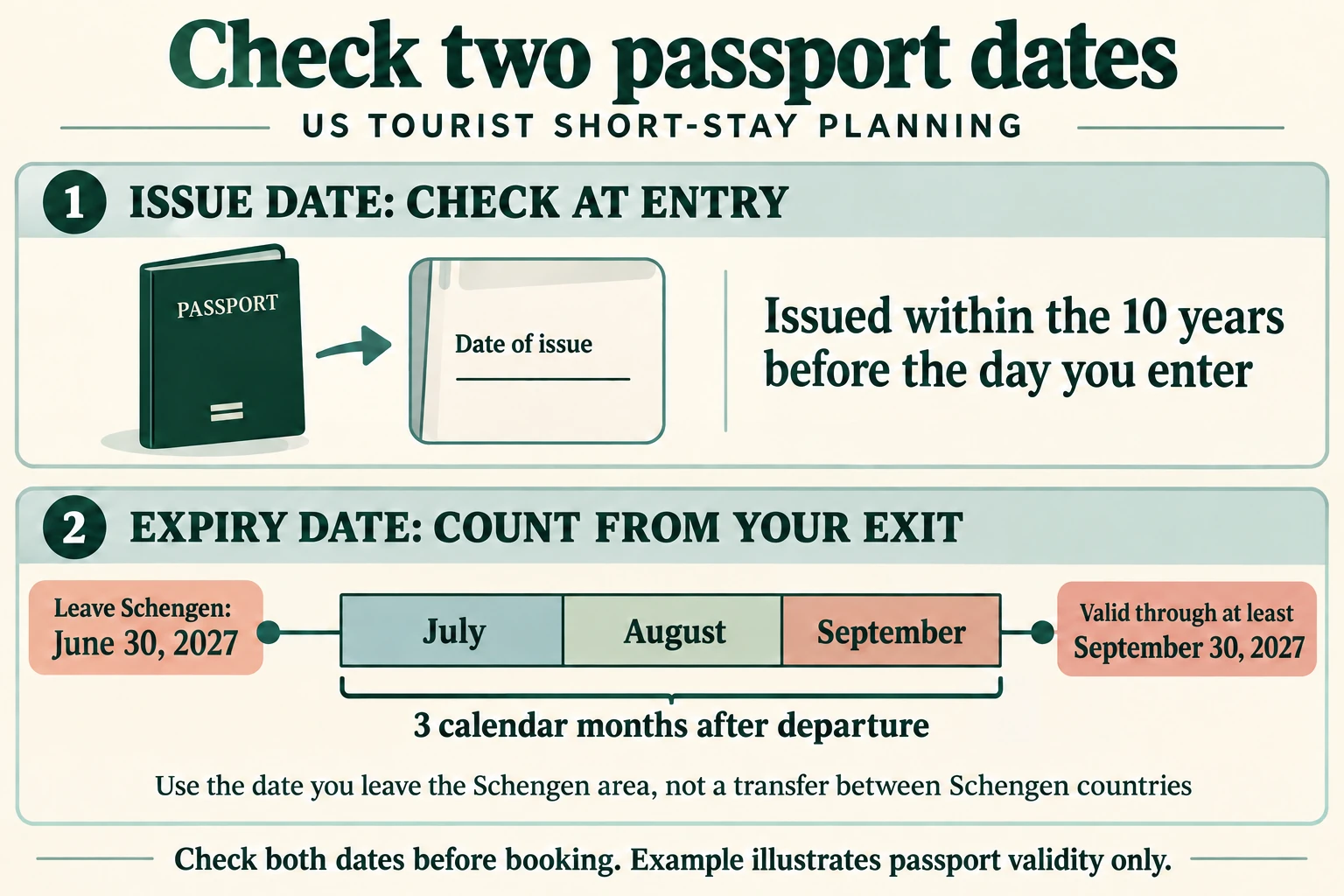
Your passport must have been issued within the 10 years before you enter Belgium. The Belgian Immigration Office’s entry conditions state this requirement under Article 6 of the Schengen Borders Code, the EU rulebook for border crossings. The issue date counts as well as the expiry date, so a passport can be unexpired and still fail this test.
The second requirement concerns the expiry date. The passport must remain valid for at least three months after your planned departure from the Schengen area. If you plan to leave on 1 March, your passport needs to stay valid until at least 1 June. An expired passport does not meet the rule. The EEAS frequently asked questions on visa-free travel confirm that the document must be valid for crossing the border and must not have expired.
Six months of remaining validity is a precaution beyond the legal minimum. Six months is a sensible margin if you plan a long trip or a stay in other countries after Belgium, because an airline can refuse boarding for a passport that does not meet its own validity rules. Carry one blank page for entry and exit stamps as well, although registration now happens electronically (covered below).
Visa-free stays and the 90-day limit
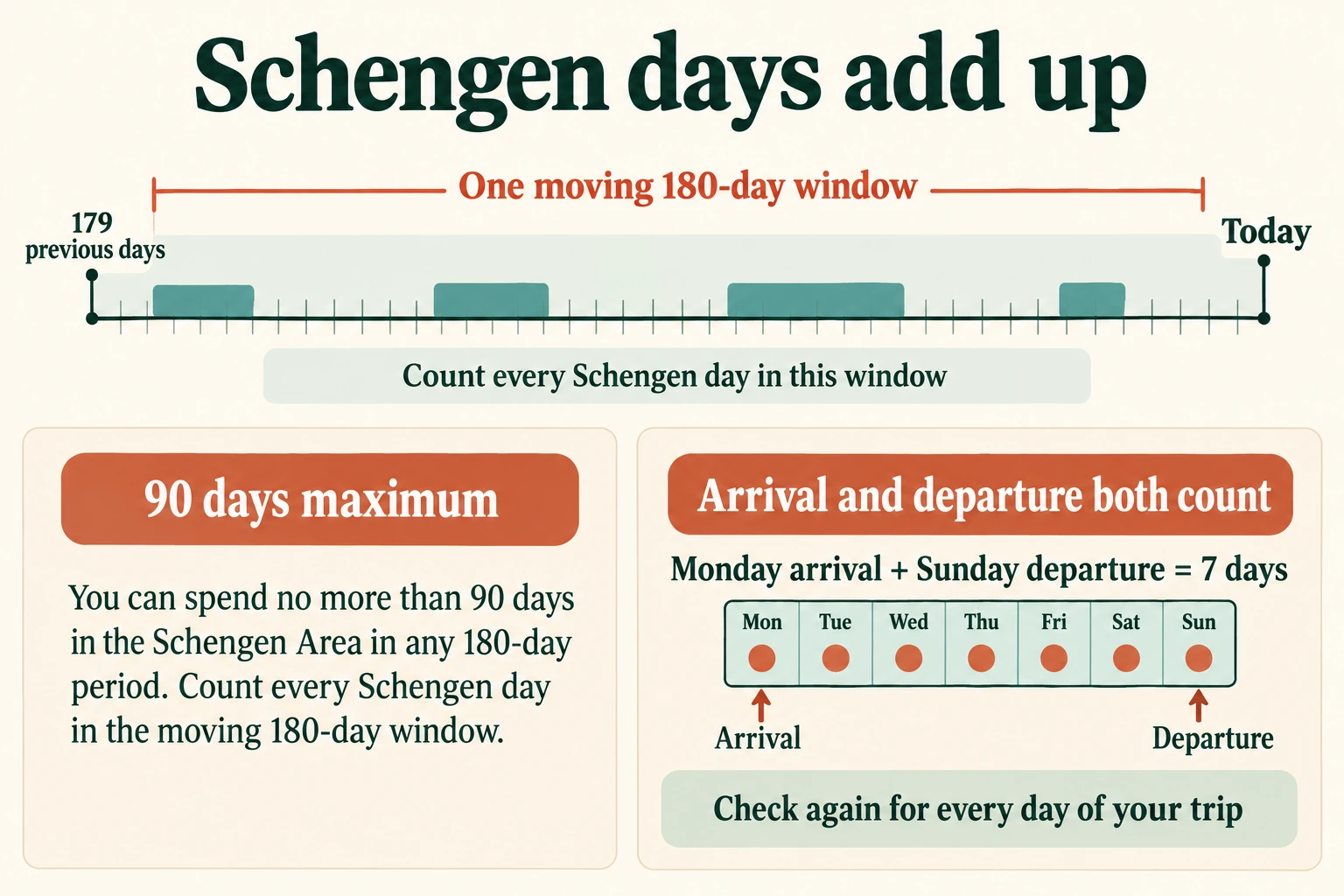
US citizens may enter Belgium without a visa for stays of up to 90 days within any 180-day period. Under this 90-day rule, Belgium is listed as "Visa not required" for US citizens (visa requirements for US citizens). The limit is one shared total for the entire Schengen area, so days in Belgium count toward the same total as days in France, Germany, or the Netherlands.
The 180-day period is a rolling window. The City of Geel, a Belgian municipality, states that the 90-day limit is counted back from each day of your stay. Suppose you spend a long stretch in Belgium and then more time in Spain. You have used all 90 days, and you cannot start a new visit until enough of those early days fall outside the 180-day window. A continuous absence of at least 90 days from the Schengen area allows a new 90-day stay, according to the Belgian guidance on short stays for non-EU nationals.
The visa-free rule covers tourism, business meetings, and private visits. Work and study fall outside this rule. Officers can ask why you are visiting, so keep your itinerary and reasons ready.
ETIAS fee and launch timing
ETIAS stands for European Travel Information and Authorisation System. It works like the US ESTA: you apply online before your trip, and the system checks your details against EU security databases. The EEAS page for US travelers describes it as an entry requirement for visa-exempt nationals, which includes US citizens.
The European Commission announced on 17 July 2025 that the fee will be €20, up from the earlier €7. Travelers under 18 or over 70 are exempt from the fee. An approved authorization is valid for three years or until your passport expires, whichever comes first. The Commission says applications are processed automatically, and a decision is expected within minutes.
The official launch timing has shifted. ETIAS is currently not in operation and no applications are collected. No start date has been officially set, and the Commission will announce the date several months in advance. Press reports point to 2027 as the likely launch year. Travelers who enter before ETIAS starts do not need it. Check the official travel-europe.europa.eu portal before you book, since the launch date will decide whether you need an authorization for a trip in late 2026 or 2027.
ETIAS leaves the 90-day stay limit as it is. The ETIAS authorization is approved before you travel, and it does not extend how long you can remain.
What border officers ask
The EEAS frequently asked questions set out three conditions for a stay of up to 90 days in any 180-day period. You need a valid travel document. You also have to justify the purpose and conditions of your stay and show sufficient means for the stay and for your return. Your name must not appear in a Schengen Information System alert, which is a shared EU database of people who have been refused entry or flagged for other reasons. A country can refuse you entry if you fail to meet any of these conditions.
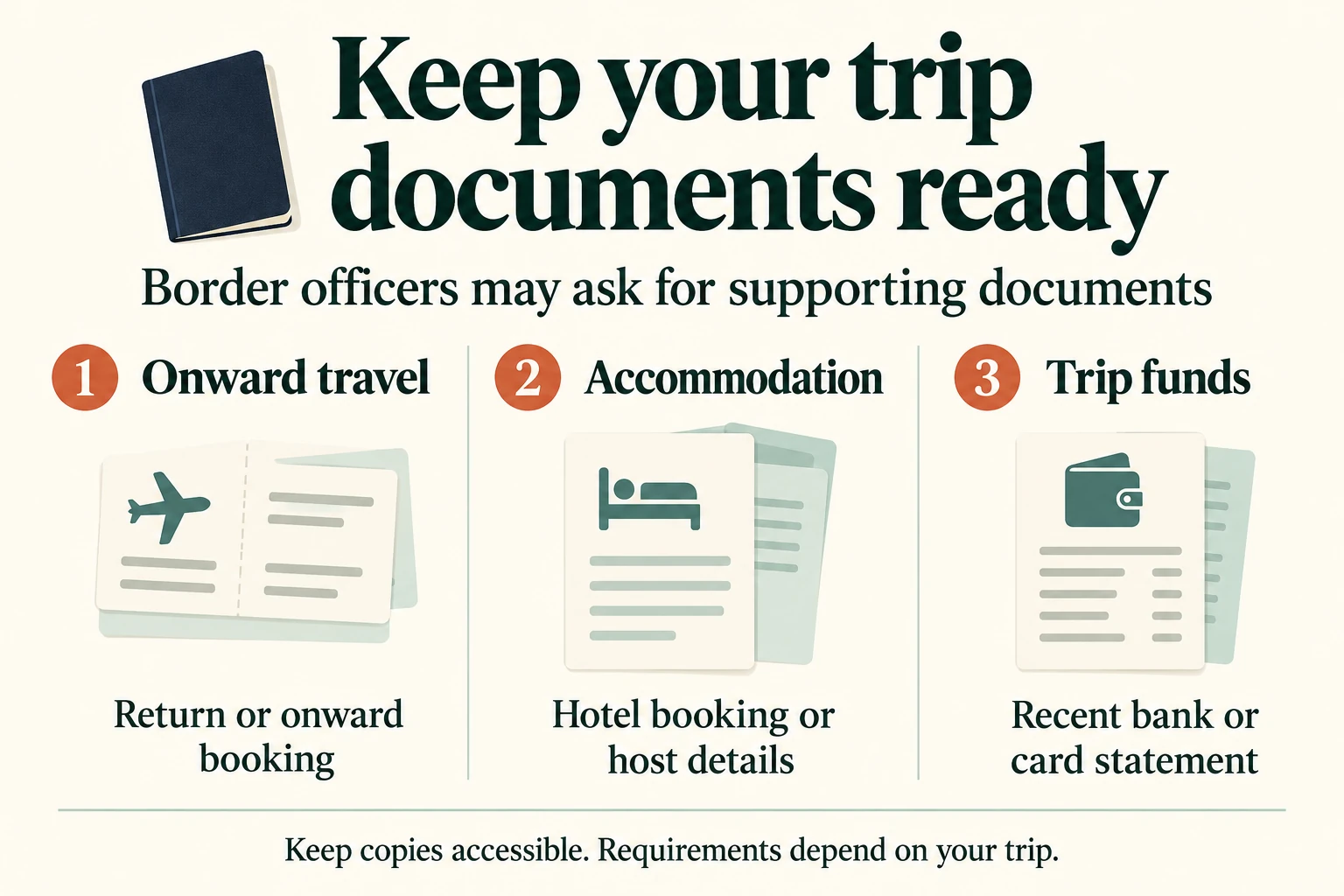
Officers start with your passport. They may then ask why you are visiting, where you are staying, how you will leave, and how you will pay for the trip. Under Article 8 of the Schengen Borders Code, officers check your travel document and, where needed, your visa. More detailed checks can cover accommodation, return travel, and money. Officers do not ask every traveler these questions. Airport arrivals on intra-Schengen flights, for example, face fewer questions than arrivals from outside the Schengen area.
Keep proof of the following items on your phone and in print:
Hotel reservations or an address where you will stay. An invitation letter if a friend or relative is hosting you. An itinerary that shows your planned dates. Evidence that you can pay for your stay and your return. The same subjects appear in Schengen border check guidance: purpose, duration, accommodation, onward travel, and funds.
How officers judge sufficient means
The EEAS frequently asked questions explain that officers assess your means of support by the length and purpose of your stay. They estimate the cost of budget accommodation and meals in the country you visit and multiply that by the number of days. You are not asked to prove a fixed sum. The Belgian Immigration Office lists cash, traveler’s cheques, and credit cards as evidence, and says host sponsorship declarations and guarantee letters can count where national law allows them.
The return trip also counts. A 2006 European Commission handbook says your means must cover your stay and your return to your home country, or your ability to obtain them legally. A booked return ticket is the simplest proof, and guidance on one-way tickets notes that a booked return ticket is not strictly required if you can show other proof of means for the trip home. Most US travelers with a round-trip flight will not need to explain this further.
Travel insurance requirements
Medical insurance is a supporting document. The policy must be valid across the Schengen area and cover emergency care, hospital stays, and repatriation, with a minimum of €30,000. The Belgian embassy in Brazil sets the same €30,000 minimum for visa-exempt Brazilian travelers. Buy a policy that covers your full stay and meets that minimum.
Fingerprints and address reporting
Belgium records entries and exits in the Entry/Exit System, or EES, which is an electronic database that replaces passport stamps as the main record of your trips. The EEAS page on travel to Europe says the EES began operating on 12 October 2025, and a travel guide updated in August 2026 reports that it has been fully operational at all Schengen crossings since April 2026.
On your first entry, a border guard or a self-service kiosk takes your fingerprints and a facial photograph. Holders of biometric passports can use the kiosk. The registration remains valid for three years. Your passport may still receive a stamp at some crossings, but the EES entry record is the one that counts for the 90-day calculation.
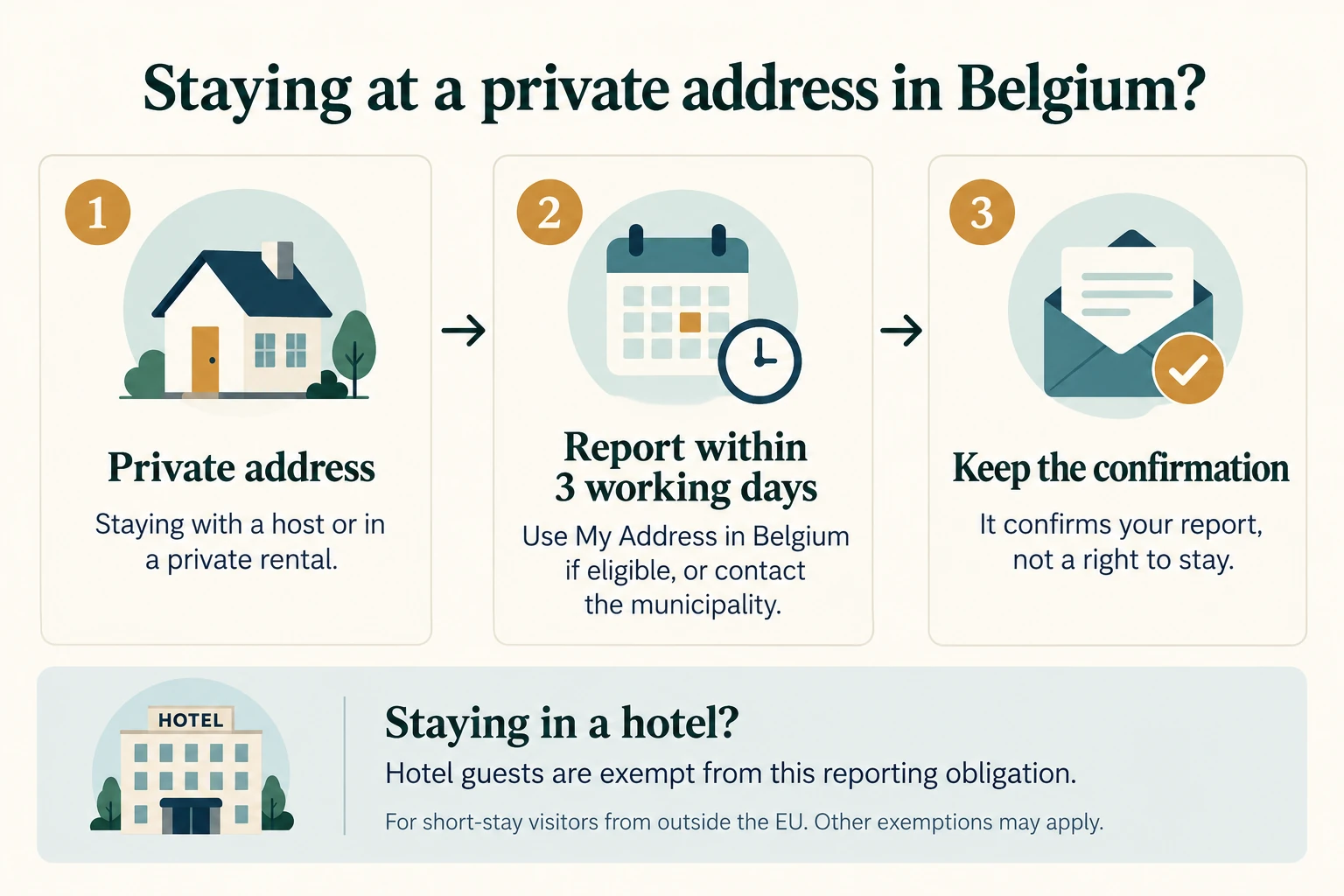
If you stay at a private address, such as a friend’s flat or a rented apartment, the City of Geel says a non-EU national staying up to 90 days must report the address within three working days of arrival. You can do this through the "Mijn adres in België" app, an online form, or an appointment at the foreigners’ office. The app confirmation email proves that you reported your address, but it does not grant legal residence. Hotel guests are registered through the hotel.
Customs limits for non-EU arrivals
The Belgian federal customs page on travel allowances sets the limits for goods you bring from outside the EU for personal use. The page was last updated on 28 March 2022. Confirm current figures with the federal tax authority, SPF Finances, at fin.belgium.be before you travel.
| Item | Allowance for non-EU arrivals |
|---|---|
| Tobacco | 200 cigarettes, or 100 cigarillos, or 50 cigars, or 250 g smoking tobacco |
| Drinks | 4 L still wine, 16 L beer, and 1 L spirits; or 2 L intermediate products (up to 22%); or 2 L sparkling wine |
| Other goods, air and sea arrivals | €430 total value per person |
| Other goods, land arrivals and private aviation or navigation | €300 total value per person |
| Other goods, under 15 years | €175 |
The tobacco and alcohol allowances apply from age 17. Goods above these limits must be declared, and customs duties and VAT apply to the excess.
Cash of €10,000 or more must be declared when you enter the EU. You do not need to declare cash below that amount. The Federal Ombudsman also says that goods from outside the EU worth more than €430 must be declared, and that jewelry counts toward this total. At the arrivals hall, use the red exit marked "Marchandises à déclarer" if you carry goods above the allowances. Use the green exit marked "Rien à déclarer" if you stay within them.

Customs officers can inspect your bags at any time. Undeclared goods can lead to duties, taxes, and a fine. Customs may offer an out-of-court settlement, and if you refuse, officers may seize the goods while the case is reviewed. The Ombudsman says it receives complaints every year about airport customs checks. Most of those complaints come from travelers who did not declare goods, often because they did not know the rule. Keep receipts for expensive purchases, since you may need to show you bought them.
Some items are restricted regardless of value. The customs page lists certain animal and plant species and products, including some ivory, shells, meats, and sausages. Firearms and ammunition may require a special permit. Counterfeit goods are prohibited to buy or import, and fines range from €50 to €20,000. Certain valuable antiquities, art, and religious objects cannot leave Belgium without special authorization, so check that rule before you buy a painting or antique.
Other passports and nationalities
The visa-exemption list is set at EU level. The Belgian Immigration Office refers to Council Regulation (EC) No 539/2001 as the legal basis for that list. Citizens of countries not on the list need a Schengen visa before travel, and the visa-free rules described above do not apply to them. If you hold a passport from another country, check your nationality’s status with the Belgian embassy or consulate in your country before you book.
Brazilian travelers face several conditions beyond the US rules. The Belgian embassy in Brazil says visa-exempt Brazilians need a passport valid at least three months beyond the planned exit from the Schengen area. They also need a non-transferable round-trip ticket and medical insurance of at least €30,000. Their stay must not exceed 90 days in any 180-day period. Brazilians who need a visa must hold a passport valid for six months and bring two photocopies of the photo page.
EU citizens follow a different path. Belgian guidance says EU nationals need only a valid passport or identity card to enter. Officers are not supposed to question EU, EEA, or Swiss citizens about hotel bookings, return tickets, or proof of funds in the same way as travelers from outside Europe. If you travel with a non-EU companion, the officer may ask that person the full set of questions.
Entry checks at a glance
- Check the passport issue date and expiry: Your passport must have been issued within the previous 10 years and remain valid for at least three months after you leave the Schengen area. Six months is the safer margin.
- Count your days across the whole Schengen area: You may stay up to 90 days in any 180-day period, and every day in Belgium counts toward that total.
- Budget €20 for ETIAS and watch the launch date: The fee applies to travelers aged 18 to 70, and the launch is now expected in 2027 according to recent reporting. Check the official travel-europe portal before you book.
- Bring proof of lodging, funds, and the trip home: Officers may ask about your accommodation, your means of support, and your return, so keep those documents on your phone and in print.
- Declare cash of €10,000 or more and goods above €430: Goods you do not declare can bring duties, a fine, or seizure, so use the red exit when you carry items above the allowances.