Greece
Etiquette and Customs in Greece: What First-Time Visitors Need to Know
Most Greek etiquette comes down to a few habits: dress modestly at religious sites, treat meals as long and shared, and follow the posted rules at each monastery or ancient site. Greeks forgive tourists’ ordinary mistakes, so a wrong fork or a mispronounced greeting passes without comment. The rules that get enforced are the ones at working monasteries, where visitors in the wrong clothing can be turned away at the gate, and at archaeological sites, where guards stop food, smoking, and certain kinds of filming.
Prices and hours change, so confirm them before you travel.
Greetings and forms of address
A handshake is the standard way to greet someone new. According to Cultural Atlas, men, women, and children all shake hands, and you should keep direct eye contact during the introduction. Looking away reads as disinterest, so keep eye contact for the whole handshake.
For the spoken greeting, "Yassas" means hello and works with anyone, including shopkeepers, hotel staff, and people older than you. "Yiasoo" is the informal version for friends and people your own age. Adding "Kaliméra" (good morning) and "Efharistó" (thank you) in shops and restaurants goes over well, even if that is all the Greek you know.
Formality matters more with older people. Greeks address an older person with a title and a last name until that person invites you to use a first name. "Kyrios" means Mr and "Kyria" means Mrs. Between young people and friends, the formality relaxes quickly. You may also hear unrelated older people called "Theia" (aunt) and "Theios" (uncle). The words express warmth toward people outside the family, and you do not need to use them yourself.
Close friends greet each other with a hug or a kiss on the cheek, and some pat an arm or a back. As a visitor, wait for the other person to lead. If someone leans in for a cheek kiss, accept it. If nobody does, a handshake is always correct. Starting a kiss with a new acquaintance can feel forward.
These small gestures set the tone for the visit. Greetings in a shop, a taxi, or a small hotel come before any request. Walking up to a counter and asking a question without a "Kaliméra" first comes across as brusque.
Dress and conduct at religious and ancient sites
Greece has no national dress code for daily life. Shorts, sundresses, and sandals are normal in cities, on islands, and at beaches. The exceptions are religious sites, where the clothing rules are strict, and archaeological sites, where "unsuitable dress" appears on the list of prohibited conduct.
The clearest rules come from Meteora, a cluster of cliff-top monasteries in central Greece. The Meteora FAQ says modest clothing is required because the monasteries are active places of worship. Women need a skirt below the knee and covered shoulders, men need long trousers, and sleeveless tops are not permitted. The same page says visitors who do not follow the code may be refused entry, and it advises bringing suitable clothing even in hot weather.
Wrap-around skirts sometimes hang at monastery entrances for borrowing, but the FAQ says visitors should not rely on them. In summer, pack a lightweight long skirt or linen trousers and a light shirt with sleeves, and carry them in your daypack rather than wearing them all day. The Meteora etiquette page adds that both men and women should cover their shoulders and describes carrying a scarf as a thoughtful gesture. The same site notes that rules may change seasonally or without notice, so check before you go.
For other working churches and monasteries across Greece, no single national rule applies. Use the strictest standard you have seen: covered knees and shoulders, no sleeveless tops, and a scarf in your bag. That outfit passes at church doors across the country.
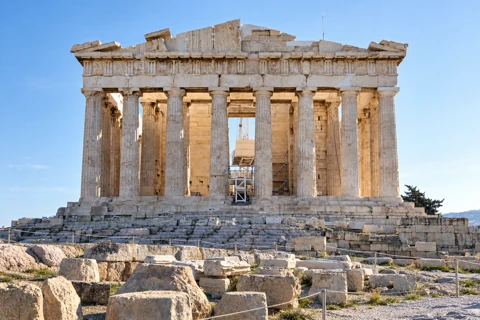
Archaeological sites follow a different logic. The Ministry of Culture’s Acropolis rules list unsuitable dress, food and drink, smoking, and pets (except assistance dogs for people with disabilities) as prohibited. On the Acropolis, you will not need a skirt below the knee, but you will want sturdy shoes, a hat, and water you finish before the entrance, because drinks are not allowed inside.
Visiting Meteora and Mount Athos
Meteora and Mount Athos are the two places where first-time visitors most often run into hard rules, and the rules differ sharply. Meteora is open to anyone who dresses correctly. Mount Athos is closed to women and requires a permit for men.
Meteora
Six monasteries at Meteora are active and open to visitors, and the site has been a UNESCO World Heritage listing since 1988. Each monastery charges an entrance fee of €5 per person, normally paid in cash at the gate. Do not count on card payment, so carry coins and small bills. Visiting three monasteries costs €15 in cash per person before you buy lunch.
Each monastery keeps its own seasonal schedule and weekly closing day. Summer hours generally run April to October and winter hours November to March, and hours change for religious celebrations, holidays, and weather. Check the monastery opening hours for your travel dates, then plan the route around whichever monasteries are closed that day. The FAQ says one full day covers the main sights, while two days allows a more complete visit.
Inside, keep your voice low, especially during prayer and ceremonies. Respect closed doors, barriers, and signs marking private or sacred spaces, because some areas are reserved for monks or hold valuable artifacts. Donation boxes near the entrance are voluntary and separate from the entrance fee. Pets are not normally allowed inside.
Mount Athos
Mount Athos is a self-governing monastic peninsula in northern Greece. Entry is banned to women by law. Men need a personal permit called a diamonitirio, which is required to board the ferry and to be received at monasteries. According to mountathosinfos.gr, the permit is valid for four days. The Holy Epistasia, the peninsula’s supervisory authority, issues it, and foreign visitors apply through the Pilgrims’ Office in Thessaloniki at 109 Egnatia Street. The municipal tourism company’s page confirms the four-day validity.
Secure accommodation first, then obtain the permit, then phone the monasteries to confirm beds, because availability is limited. Monasteries offer hospitality free of charge and accept donations. Most require advance booking. Permits go to adult men over 18, and boys under 18 may enter if accompanied by their father.
A 2023 guide gave a daily limit of about 10 permits for non-Orthodox visitors and 100 for Greek and Orthodox pilgrims, with fees of €35 for non-Orthodox visitors, €25 for Orthodox pilgrims, and €18 for students. Those figures are dated, so ask the Pilgrims’ Office for current numbers before you build a trip around them. Access is by sea only, from Ouranoupoli (used by most pilgrims) or Ierissos. A traveler who arrives at Ouranoupoli without a permit will not board the ferry. Ask the office for current ferry times as well, since the schedule changes.
Video cameras are strictly forbidden on the peninsula, and video tapes found by customs on departure are confiscated. The documented rule concerns video, so ask the Pilgrims’ Office about still cameras rather than assuming either way.
Photography and filming
Photography rules depend on the site, and posted signs override anything you read in advance. At Meteora, photography is usually permitted in outdoor courtyards and designated exterior areas. Inside monastery churches, museums, and sacred spaces, photography and video may be prohibited. Some monasteries ban photography inside entirely, and others restrict only flash. Tripods and professional equipment may also be restricted. Drones fall under Greek aviation rules and local restrictions, so confirm legality before flying one near a monastery.
A simple habit covers most situations. Keep your camera or phone in your pocket when you cross the threshold of any church or chapel, and take it out only when you see other visitors photographing or a sign that permits it. Never photograph monks or worshippers up close without asking, and avoid photographing people during prayer or ceremonies.
At state-run archaeological sites and museums, the national rules are more generous. A 1998 ministerial decision, published in the Government Gazette as ??? 620/?/1998, allows amateur photography with a simple handheld camera, without flash, in museums, archaeological collections, and sites, provided the photos are not for professional use. A 2011 joint ministerial decision makes photography at archaeological sites, historic places, museums, and monuments free when no professional equipment is used. A 2012 decision abolished the older 2005 fee schedule, so ignore any website that still lists those fees. For a typical trip, personal phone photos at the Acropolis and other ancient sites cost nothing. Tripods, lighting, and film crews fall under different terms, so ask at the ticket office on arrival.
Content rules apply too. The Athens Ephorate of Antiquities, the regional heritage authority, lists prohibited conduct under Law 4858/2021. The list includes collecting, removing, or damaging objects, polluting the site, eating, drinking, smoking, and photographing or filming "indecent or defamatory scenes." The Ephorate’s website carries the current notices. Posing in ways that mock or disrespect a monument, including climbing on ancient structures, draws a guard’s attention and can bring a penalty.
Visitors often make two photography mistakes. One is pointing a camera or phone inside a church or monastery without checking for signs, or using flash where it is restricted. The other is bringing professional gear to an ancient site without asking at the ticket office first, which can lead to a different fee or a refusal.
Eating out, the bill, and tipping
Greek dining runs later and slower than most American habits. Lunch falls around 14:00 to 15:00, and dinner starts from about 21:00, according to Lauer House’s dining guide. In high summer, families with small children order around 22:30. A taverna dinner takes two or three hours. If you arrive at 19:00, you may find staff eating or a nearly empty room. Eat a later lunch, and plan to sit down for dinner after 20:30.
Ordering and sharing
Meals are communal. GetGreece describes dishes shared across the table, with guests encouraged to try a variety. A common approach, according to the Sunset Weekly food guide, is ordering four to six dishes for two people. Ordering one dish for yourself is allowed, but it breaks with tradition. In many tavernas, you can walk into the kitchen or look at a display before choosing. Some meze restaurants (mezedopoleío, which serve small plates) offer no menu and bring what the kitchen prepared that day, according to the Wikipedia entry on Greek restaurants.
Hosts keep offering food after guests say they are full. Decline politely, and expect a second offer before the host accepts the refusal. Finishing your plate shows appreciation. Serving others before yourself is considered polite, and keeping your hands visible above the table is a common courtesy. Nobody will correct you for using the wrong fork.
Smoking follows its own rules. A 2019 ministerial decision banned smoking in food-service and entertainment premises, including restaurants, taverns, and bars, and set fines for violators. The Council of State, Greece’s top administrative court, dismissed a challenge in ruling 1727/2020. Expect indoor restaurants and bars to be smoke-free, and ask staff before lighting up on a covered terrace.
Bread, the bill, and cards
Bread often arrives on the table without a separate plate. A cover charge for bread is normal, and it appears on the bill. It is usually about €0.50 to €1.50 per person in most tavernas, though the amount varies, so check your bill.
The bill does not arrive until you ask for it. Bringing it unprompted suggests the restaurant wants you to leave. Ask with "logariasmó, parakaló" (the check, please), or mime signing in your palm, as Lauer House describes. Many places then bring a small complimentary dessert, fruit, or drink, called a kerasma. Once you are seated, the table is yours for as long as you want it, and lingering is part of the experience.
Most places accept cards, but small family tavernas appreciate cash. When a group dines, the person who invited the others often offers to pay. Splitting the bill is more common among younger groups.
Tipping
Tipping is optional and based on satisfaction. Athens Glance’s 2026 tipping guide says Greece is not a no-tip culture, but nobody expects the larger percentage tips Americans often leave at home. GetGreece likewise describes tips as appreciated but not always mandatory. The amounts below come from the Athens Glance guide, published 15 April 2026.
| Situation | Typical tip |
|---|---|
| Neighborhood taverna, excellent service | 10–15% |
| Tourist-area restaurant, decent service | 5–10% |
| Fine dining | 10–15% |
| Café with table service | €0.50–1, or round up |
| Souvlaki or gyros counter | Nothing, or a small round-up |
| Taxi on the meter | Round up by €1–2 |
| Porter | €1–2 per bag |
| Housekeeping | €1–2 per day |
| Group tour guide | €5–10 (half day); €10–15 (full day) |
| Free walking tour | €10–15 per person |
Before you add anything at a restaurant, look at the bill. The same guide says a service line is uncommon in ordinary tavernas and appears only occasionally at tourist-facing restaurants. If a service charge is already listed, do not add more. The bread cover charge is separate from service.
Cash tips reach staff directly and are the warmer gesture in family tavernas. Adding a tip on the card machine is also acceptable, and Athens Glance notes that card tips reach staff tax-free. Ask the server to add your chosen amount to the card payment, or leave coins and small bills on the table when you stand up.
The most common dining mistake is waiting for a bill that never arrives. The second is ordering one dish each without sharing. Both make the meal feel more businesslike than the table expects. Finally, adding a tip without checking the bill can mean paying twice at the few tourist-facing restaurants that already add a service charge.
Key Takeaways
- Pack monastery clothing before you leave home: Meteora requires a skirt below the knee for women, long trousers for men, covered shoulders for everyone, and no sleeveless tops. Visitors who ignore the code may be refused entry.
- Plan Mount Athos around the permit: Women cannot enter, men need a personal diamonitirio valid for four days, and video cameras are banned. Book accommodation first, then the permit, then confirm beds by phone.
- Carry cash at Meteora: Entrance is normally paid in cash and costs €5 per person, per monastery.
- Follow posted signs on photography: Courtyards and exteriors are usually fine, while church interiors, flash, tripods, and professional equipment may be restricted. Personal photography without professional equipment is free at state archaeological sites and museums.
- Ask for the bill and share the food: Dinner starts around 21:00, dishes are shared, and the check arrives only when you request it ("logariasmó, parakaló").
- Tip modestly after checking the bill: Expect 5–10% in tourist-area restaurants and 10–15% for excellent service in tavernas, and skip the tip if a service charge is already listed.