Planning the Golden Circle Route in Iceland
The Golden Circle is a loop of roads east of Reykjavík, Iceland’s capital, that links three sights: Þingvellir National Park, the Geysir geothermal area, and the Gullfoss waterfall. Geothermal areas are heated by underground hot water and steam, which produce the hot springs and geysers. Most independent travelers drive the loop as a day trip from Reykjavík. Plan a full day and expect 230 to 300 km of driving, depending on your return route. Budget 1,000 ISK for parking at Þingvellir. Check road conditions the morning you drive, since winter closures can happen without warning.
The figures are current as of 14 October 2026. The loop has no official length, and parking at Geysir and Gullfoss is less settled than at Þingvellir. A national fee on visitors to the three sites has been proposed but is not yet law. Confirm current rules before you travel.
Stops and the order to visit them
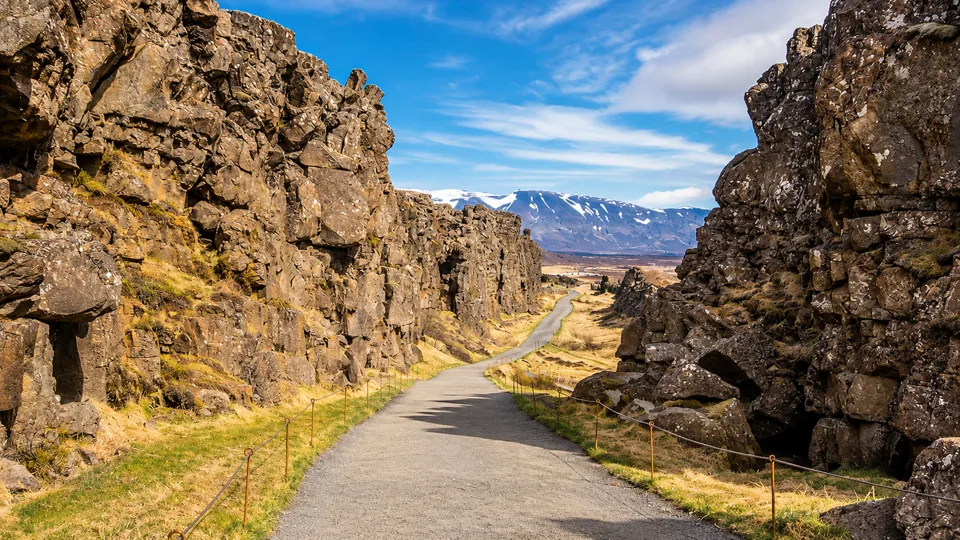
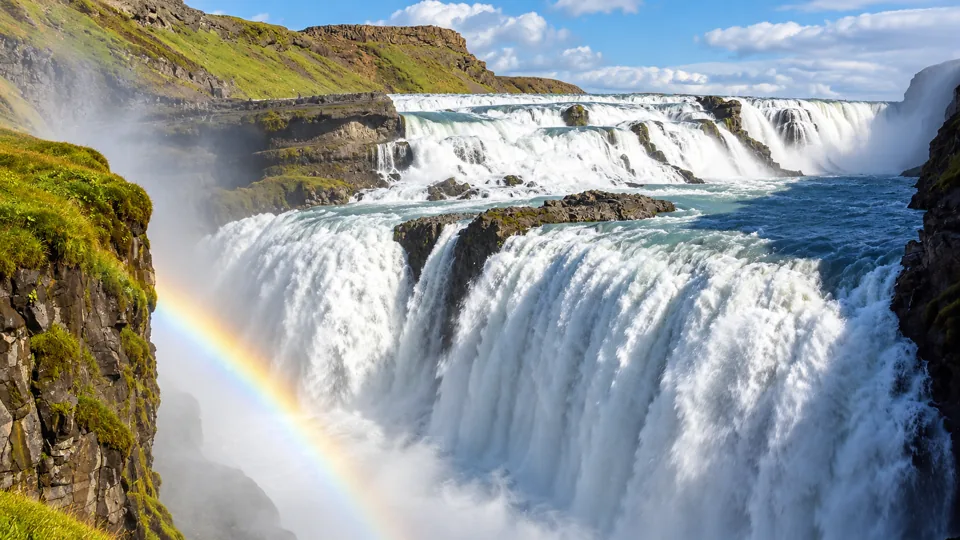
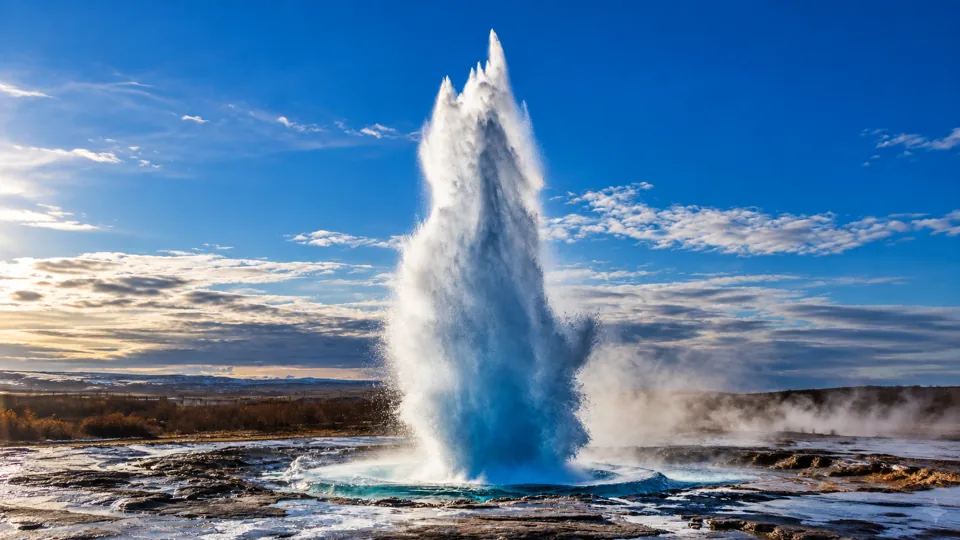
Most drivers go clockwise: Reykjavík to Þingvellir, then Geysir, then Gullfoss, and back to Reykjavík. Þingvellir is a rift valley where Iceland’s parliament met in the past, and you walk through its gorge on paths that lead between the two tectonic plates. At Geysir, the geyser Strokkur erupts repeatedly, so plan for some waiting time to see an eruption. Gullfoss is a two-tier waterfall in a canyon, and the upper viewpoints give the clearest view of it.
Driving the loop in reverse, from Reykjavík to Gullfoss, then Geysir, then Þingvellir, is a common way to reach the sites before the tour coaches arrive. Several stops sit near the core loop but are not part of it: Kerið crater, Brúarfoss waterfall, the Friðheimar tomato farm, and the Secret Lagoon. Whether to add them depends on how much time you have.
Distances along the loop
The whole loop has no fixed length. Published figures range from about 230 to 300 km, and the individual legs are estimates.
| Leg | Approximate distance |
|---|---|
| Reykjavík to Þingvellir | Estimate varies by source |
| Þingvellir to Geysir | 50 to 60 km |
| Geysir to Gullfoss | About 10 km |
| Gullfoss to Reykjavík | 110 to 120 km, via Route 1 or via Selfoss |
| Full loop | 230 to 300 km |
The leg figures added together come to less than the published loop totals. Detours, different starting points, and different return paths can all change the total, so treat it as a range. The Geysir to Gullfoss leg is the most consistent figure across sources.
Two national roads cover much of the loop. Route 35, Biskupstungnabraut) runs 69 km from Suðurlandsvegur to Gullfoss, and Route 36, Þingvallavegur) is 68 km long. The loop uses only part of each road, so these lengths do not equal the loop distance. Route 37 is sometimes mentioned in trip guides, but it is not part of the standard loop.
Driving and visit times
Driving the loop without stops takes about 3.5 hours, according to commercial estimates. The legs take a modest amount of time from Reykjavík to Þingvellir, 10 to 15 minutes from Geysir to Gullfoss, and 70 to 90 minutes from Gullfoss back toward Hveragerði. Some drivers take a variant through Laugarvatn, a lakeside town, between Þingvellir and Geysir, which adds driving time across two legs, so the individual leg times do not add up to one exact loop time.
Time on site varies more than driving time. Allow a flexible visit at Þingvellir, more if you walk beyond the main gorge. Allow time at Geysir, with extra if you want to see Strokkur erupt several times. Allow a reasonable visit at Gullfoss.
A realistic day runs 6 to 8 hours with stops, and a comfortable day with a meal and a buffer takes longer. Most visitors do not need an overnight stay, but a half day is too short to see all three sites without rushing.
Crowds shape the schedule as much as the drive does. Tour coaches peak between about 10 a.m. and 2 p.m., and many coaches leave Reykjavík between 8 and 10 a.m. Arriving at Þingvellir before 8 a.m. and at Geysir before 10 a.m. helps you avoid the largest groups. Driving the loop in reverse shifts your arrival times and often puts you at Gullfoss before the coaches.
Parking at Þingvellir
Þingvellir has the best-documented parking rules. The park’s parking page lists the fees as a service charge for running and maintaining the park’s car parks. The published tariff in ISK per vehicle is:
| Vehicle | Fee (ISK) |
|---|---|
| Motorcycle | 400 |
| Car, up to 5 passengers | 1,000 |
| Car, 6 to 9 passengers | 1,200 |
| Bus, 10 to 19 passengers | 2,200 |
| Bus, 20 to 32 passengers | 3,800 |
One fee covers parking for the calendar day on which you pay, and it covers every car park in the park. Payment runs through Checkit.is. Revenue pays for maintenance, grounds upkeep, snow clearance, and the toilets at the car parks. Vehicles with a P-sign, the disabled parking permit, are exempt, but the driver must visit the Hakið visitor center so staff can remove the plate from the camera system. The park’s page refers to a new tariff without giving an effective date, so confirm the current rate on the park’s site before you go.
The park’s own tariff is the figure to plan around. The park has no general entrance fee and is open all year, 24 hours a day. A dive operator in the park charges its own 1,500 ISK fee for a Silfra dive, which is separate from the park’s parking charge.
Parking at Geysir and Gullfoss
Parking at Geysir is not published by the site operator. A news report from June 2025 says Geysir charged 1,000 ISK for a car, and that larger vehicles often paid up to double. The same report says drivers often pay through an app or by scanning a QR code. Budget 1,000 ISK for a car, and check the signs at the car park for the current rate and payment method. Who owns the Geysir car park, the landowner or the state, has not been confirmed.
Gullfoss upper and lower car parks are currently free for private cars, tour buses and accessible parking users (checked October 2026). The 2025 news report does not list Gullfoss among the paid car parks, and a 2026 guide describes a large car park, a café, and toilets without mentioning a parking charge. Check the signs on arrival, and carry a payment method that works in Iceland.
The proposed national fee
A draft bill from the Ministry of Industry, dated 22 September 2026, would add a nature and infrastructure fee for Geysir, Gullfoss, and Þingvellir. Under the draft, the fee would be 4,500 ISK for each person aged 18 or over who does not have Icelandic tax residence. Tax residents would not pay. The draft would also abolish Þingvellir’s parking charges and assumes the state would compensate the park for the lost income, which was about 350 million ISK in 2025. A news report says the draft would not cover fees charged on private land at Geysir and Gullfoss.
The draft is not law. Parliament has not passed it, and the final rates and terms are unknown. A news report on the proposal describes a year pass at 4,500 ISK and a lower 3,000 ISK option for some visits, but eligibility for those passes is unclear, so do not budget around them. Check the Ministry of Industry notice and the parliamentary record before you travel.
Best months and daylight
The route is drivable all year, and the three main sites stay open in winter. Each month brings a different trade-off between daylight, road conditions, and crowds. March offers a balance of winter scenery and daylight, and September and October bring fewer crowds with enough light for the route. April and May have fewer tourists, and the roads are often clear from late April. June through August is the easiest period for travel. Golden Circle Iceland’s month-by-month guide lists the following average temperatures: January at -1°C, February at 0°C, March at 1°C, April at 4°C, and May at 7°C.
Daylight changes sharply through the year. Winter days are far shorter than the long evenings of June. Check a sunrise and sunset table for your exact travel dates before you plan the day around daylight.
Meltwater from spring snow makes Gullfoss more powerful than at other times of year. The season guide describes the waterfall’s strongest flow during melt season, which is useful if you want the largest flow.
Winter access and driving risk
Winter access is the area with the most open questions. The main viewpoints at Þingvellir, Geysir, and Gullfoss stay open, but specific paths can close temporarily for safety. The Almannagjá gorge path at Þingvellir keeps its main path and boardwalks open, with grit on steeper sections. The upper viewpoints at Gullfoss are open year-round, and the upper platform is gritted. The lower path at Gullfoss is less settled. Its winter status depends on conditions on the day, with the path closing when it ices over. Confirm the lower path’s status with the Gullfoss operator before you plan a visit to the lower viewpoint.
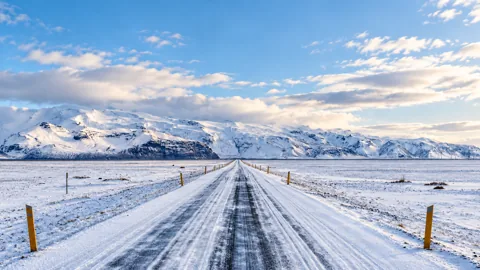
Road safety depends on the morning’s conditions. Check road.is, the portal run by Vegagerðin, the Icelandic Road and Coastal Administration, on the day you drive. Treat a closure notice as final. Route 35 to Gullfoss is exposed to wind and snow and can close in heavy weather. Winter hazards include black ice, sudden whiteouts, crosswinds, and reduced visibility. A thaw followed by a freeze can leave glassy ice on the paths at Gullfoss.
Vegagerðin issues an uncertainty alert, called óvissustig in Icelandic, when weather makes road conditions hard to predict. A Útvarp Saga report describes one such alert for the inland roads of southern Iceland, with strong westerly wind, dense snow showers, and drifting snow. It shows what the alert looks like. It does not describe current conditions. Vegagerðin’s camera page for southern Iceland lists cameras at Gullfoss on Biskupstungnabraut and on Þingvallavegur at Gjábakki. The page may be out of date, so treat the cameras as a backup check.
Do not stop on the Biskupstungnabraut bridge or the road shoulder near it. A 2023 Icelandic safety document warns that stopping there is a real hazard and cites two serious accidents recorded at or near the bridge in 2022. Use the official viewpoints and car parks for photo stops.
Road work is also underway. A report from August 2023 says Biskupstungnabraut is planned to move below Geysir so traffic no longer runs between the car parks and the hot-spring area. Vegagerðin has started preliminary design, and no completion date has been set. The same report notes a single-lane bridge over the Tungufljót river, and its status after 2023 is unknown.
For vehicles, a standard car is enough for most trips on the loop, according to the Gullfoss and Geysir guide, which says 4×4 vehicles are sometimes recommended in winter. Studded winter tires are the safer choice in snow and ice, and adventure guides recommend them. Winter tire rules are reported to require winter tires on rental cars from 1 November to 14 April, with studded tires allowed in that period. Ask the rental company for the current rule and check the dates before you drive.
What to check before you go
- Plan a full day: The drive alone takes about 3.5 hours. With stops, meals, and a buffer, it fills most of the day.
- Pay 1,000 ISK for a car at Þingvellir: The fee covers every car park in the park for the calendar day you pay. The current rate is on the park’s site.
- Budget for parking at Geysir and check Gullfoss on arrival: Geysir’s reported rate is 1,000 ISK per car. Whether Gullfoss parking is free or paid has not been confirmed.
- Check road.is on the morning you drive: Route 35 can close in winter without warning. Never stop on the Biskupstungnabraut bridge.
- Watch the draft 4,500 ISK fee: The proposal dated 22 September 2026 would charge non-tax-resident visitors at Geysir, Gullfoss, and Þingvellir. It has not become law.