Seeing the Northern Lights in Iceland
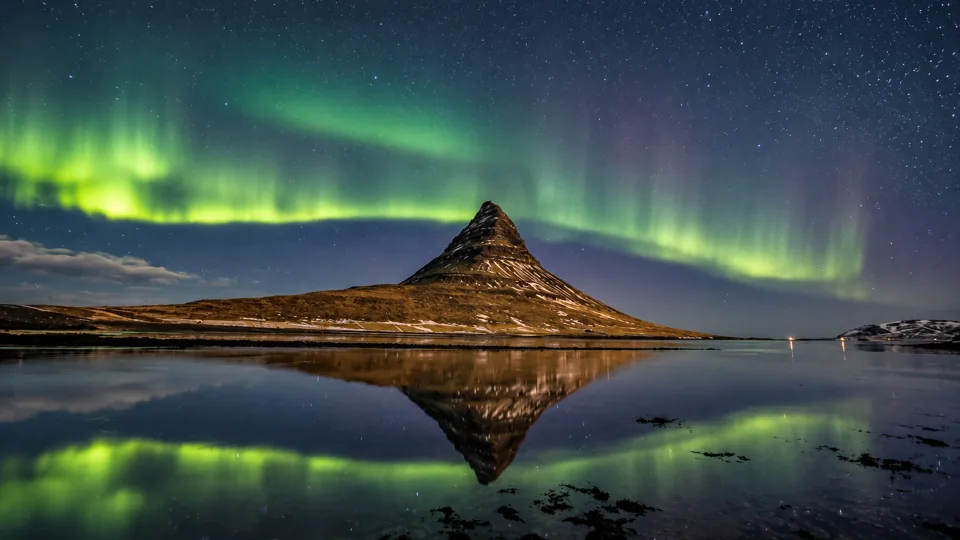
The northern lights, or aurora, are bands of green, pink, or purple light that form when charged particles from the sun hit the upper atmosphere. In Iceland, you can see them from about September to April, when nights are dark enough for the sky to show them. Clouds decide most nights, so plan for enough nights to outlast a cloudy spell, a clear spot within reach, and a route you can drive safely.
Book at least a week in the dark months if you can, and stay outside Reykjavík, where city lights wash out the sky. Check the Icelandic Met Office aurora forecast for cloud cover before you head out each night. If you would rather not drive after dark on icy roads, book a tour. If you drive yourself, rent a winter-suitable vehicle and read the gravel and road-closure terms before you sign.
When to Go
The dark season runs roughly from September to April. Perlan, a Reykjavík attraction, says May, June, and July have too much daylight for the aurora to show, and A tour operator reaches the same conclusion about summer nights. How long the nights are determines the exact start and end dates. Early September and late August are the usual starting points, and the end falls somewhere from early to late April. A late-March or early-April trip is a reasonable bet, but it does not guarantee a visible display.
A recent travel guide points to February and March, and October and November. A travel guide says September through March is the window and no single month stands out. The longest nights fall in December, but the aurora is not always strongest then. Cloud cover matters more than the calendar. Long nights do not guarantee clear skies, and that is the main reason to pick a window of several weeks rather than one fixed date.
Midwinter daylight lasts only about four to five hours, and darkness length shifts with the month. A rental guide puts darkness at up to 19 hours a day in December and January, and a tour operator says up to 20 hours without naming a month. For Reykjavík in April, plan around about five hours of usable darkness per night. Some published figures for that month run to 13.5 to 16.5 hours, but they do not state how they were measured, so do not plan around them.
Most published guides put the peak viewing window between about 10:30 p.m. and 1 a.m., with a wider 9 p.m. to 2 a.m. window common in Iceland. Perlan notes that no time is guaranteed. Lights can appear any time after dark, so the practical rule is to stay out past midnight on any night the forecast looks clear.
Where to Watch From
Street lighting in Reykjavík washes out faint displays, so the best views usually come from places a short drive out of town. One operator says the Westfjords and North Iceland have longer darkness and fewer city lights, and A travel guide advises staying outside towns to reduce light pollution. A travel guide ranks six areas within reach of the capital: the Reykjanes Peninsula, the Golden Circle, Hvalfjörður, the South Coast, Snæfellsnes, and Borgarfjörður. The same guide suggests checking a light-pollution map before you leave.
Reykjavík itself still works on strong nights. A travel guide names Grótta Nature Reserve on the western edge of the city as the top spot, recommending the lighthouse or the nearby coastline for darker views. It also names Öskjuhlíð Hill, next to Perlan, which has less light pollution than downtown. Suburban lighting can still block the sky, so a short drive beyond the last streetlights helps more than a change of viewpoint within the city.
Akureyri, the largest town in North Iceland, sits in a different position. One operator advises skipping it because of light pollution. The general pattern still holds: the closer you stand to a town, the more the sky fades. Confirm the road and the parking area for each site before you drive out, especially in winter when a road can be closed.
Reading the Aurora Forecast
The Icelandic Met Office publishes an aurora forecast page, titled Norðurljósaspá fyrir Ísland (aurora forecast for Iceland). The page shows a cloud-cover map for Iceland. A slider beneath it lets you pick a day in the coming days. The page describes green areas as cloudy and white areas as clear. Check that legend on the live page before you rely on it, because the page does not state how far ahead the slider runs.
The same page shows an activity figure for midnight on a 0 to 9 scale. The page does not explain what each value means for visibility. Read the number as a loose guide to how strong the activity is, and confirm its meaning on the Met Office site. The page also lists sunrise, sunset, and moon times for Reykjavík. Those times apply to the capital, not to the viewing site you pick.
Forecasters measure aurora strength with the Kp index, a 0 to 9 scale of geomagnetic activity. A higher number means the lights can reach farther south. A rental guide calls a Kp of 3 or higher ideal for viewing. A Kp of 2 can produce aurora in northern Iceland, but Kp 3 or 4 is more reliable from Reykjavík. Labels such as weak, moderate, strong, and storm come from travel sites and forecasting tools, so read them as informal shorthand rather than Met Office terms.
Check the Met Office site for how often the forecast updates. One travel guide says cloud forecasts are most reliable within 6 to 12 hours. Treat a forecast two or three days ahead as a rough planning tool, and treat the forecast on the afternoon of your night as the one to act on.
Cloud is the factor that most often ends a night. Operators describe cloud as the most common reason guests miss the lights, and one guide warns that cloud moves quickly across Iceland. In practice, check the cloud map in the afternoon. By early evening, decide whether a clear gap is reachable. Be ready to move. A strong forecast does not help under overcast skies. An operator’s anecdote describes a strong Kp storm under cloud that produced no visible aurora, while a Kp 3 night under clear rural skies did show lights. That is one example, not a rule, but it shows why the cloud map matters more than the Kp figure.
Tours or Self-Drive
A tour removes the driving from your night. The guide picks the viewing spot. The vehicle handles the road. The departure time is fixed. Tours suit first-time visitors and people who do not drive in snow. They also suit anyone who wants a guide to handle the cold and the timing. The tradeoff is control. If cloud covers the chosen area, the group drives on to another spot or returns, and you cannot pick a different night on your own.
Self-driving gives you the freedom to chase a clear gap, return to the same spot on another night, and stay out as long as the sky holds. It also puts weather, road conditions, and cost on your shoulders. One operator’s comparison says self-drive suits visitors who stay several nights and are comfortable driving in winter. Self-drive costs such as daily rental rates, fuel, and insurance premiums vary by rental company, so you cannot compare total trip cost until you have quotes. Request a rental rate sheet and a fuel estimate from the rental company before you decide.
Tour prices vary widely, and each operator sets its own. Tours generally run from about 8,000 to 18,000 Icelandic krónur per person, or about €55 to €125. A bus tour from Reykjavík was listed at about $83. A budget bus tour, lasting about three hours and 40 minutes, was listed at $42 to $55. Small-group minibuses were listed around $85 to $150, boat tours around $97 to $110, a Super Jeep tour at about $173, and a private tour at about $329. Budget bus prices differ by nearly double, so compare prices on the operator’s own booking page before you pay. Tours typically leave Reykjavík around 9 to 10 p.m. and return around 1 to 3 a.m., and they last roughly two to four hours depending on the operator and the weather.
Tour terms for refunds and rebooking differ sharply, and no operator guarantees a sighting. Some offer a free retry on another night, with validity of two years or three years depending on the company. One operator offers a free retry only if you request it before 2 p.m. the next day and allows no transfers. Still another says its ticket never expires. Some operators offer a refund only if they cancel the tour before departure, and one says a joined departure is non-refundable regardless of visibility. Read the cancellation clause before you pay, and buy travel insurance if your dates are fixed.
Operators promote guides who know viewing spots away from city lights and can handle winter roads safely. That local knowledge is the practical advantage of a tour. A visitor who does not drive in winter gets more out of a tour than a visitor who would spend the drive worrying about ice.
Winter Driving Cautions
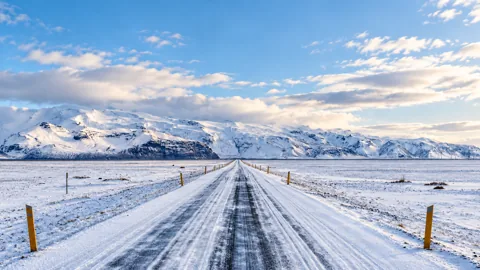
Icelandic roads change fast in winter, and the closures that matter most come from specific storms, not a fixed calendar. The Icelandic Road Administration, known as Vegagerðin, records road conditions across the country, and its explainer says road-condition data is updated from 07:00 to 22:00 daily from 1 October to 30 April and from 08:00 to 16:00 daily from 1 May to 30 September. Check Vegagerðin’s main road-condition site each day before you set out to confirm closures.
Recent closures show how quickly a route can close. On 23 March 2026, a storm closed the Holtavörðuheiði and Öxnadalsheiði mountain passes, the Ring Road between Kálfafell and Síða, and the road to Siglufjörður after an avalanche, according to an Icelandic news report. On 13 October 2026, police announced a closure of the Ring Road under the Eyjafjöll mountains from 05:00 on 14 October until at least 09:00, according to a separate news report. The same day, weather warnings covered the Westfjords, Strandir, and northwest Iceland, and police in those regions asked travelers to delay trips or bring them forward. These events were tied to particular storms and dates, so they show the pattern rather than a standing rule. Plan for a day of delay in your itinerary, and build any night drive around the current forecast.
Rental companies recommend a four-wheel-drive vehicle or a larger SUV for winter. The reasons are snow, ice, and wind. One guide calls studded winter tires essential on icy roads. A rental guide suggests a 4×4 for the Highlands or winter self-driving and a smaller car for summer or trips limited to Reykjavík. Those are commercial recommendations, and the official rules on vehicle type and tires should be checked before you book.
Gravel is the damage that rental insurance treats most carefully. Stones kicked up by traffic can crack a windscreen, and one insurer says gravel can appear almost anywhere, including roads near Reykjavík. Gravel Protection, a common add-on, covers windscreen, headlight, and mirror damage from gravel, with an excess of ISK 40,000 for those items. Standard coverage often leaves out the windscreen, so you should confirm in your contract whether you need Gravel Protection. An unofficial estimate puts windscreen replacement at ISK 50,000 to 150,000. Sand and Ash Protection matters most on the South Coast around Vík and Mýrdalssandur and during spring thaw, when gravel loosens.
Most rental packages exclude river crossings and water damage. They also exclude off-road driving, undercarriage damage, lost keys, and negligence. An approved 4×4 is required on F-roads, the rough highland tracks. Even the top insurance package does not cover river-crossing damage on those routes. Credit-card rental insurance often excludes gravel, F-roads, 4x4s, and campervans. Those exclusions come from rental-company guides, so read the contract wording itself before relying on them. Driving too fast on ice can count as negligence under some contracts, which would void cover. Drive at a speed that suits the snow and ice you see rather than a fixed number.
Stopping on the road to watch the aurora is a safety decision that falls to the driver. Keep the vehicle fully off the travel lane, use hazard lights, and step onto the verge only after checking traffic in both directions. Do not stop on a bend, a bridge, or a crest where drivers cannot see you. Check Vegagerðin for F-road rules and seasonal closures before you drive any highland route.
Key Takeaways
- Plan a week in the dark months: Cloud blocks the view on most nights, so several nights give you room to move toward a clear sky.
- Check the cloud map every afternoon: The Icelandic Met Office cloud map and the aurora forecast show where the sky will clear. Cloud cover matters more than the Kp figure.
- Leave Reykjavík’s lights behind: Head to darker sites such as the Reykjanes Peninsula, the Golden Circle, or Snæfellsnes, and confirm road and parking conditions before you go.
- Compare tour refund terms before paying: Refund and rebooking rules vary widely, and no operator guarantees a sighting.
- Check Vegagerðin before every winter drive: Storm closures come with little warning, so confirm the route status on the day and read the gravel and F-road terms in your rental contract.