Best Time to Visit Spain
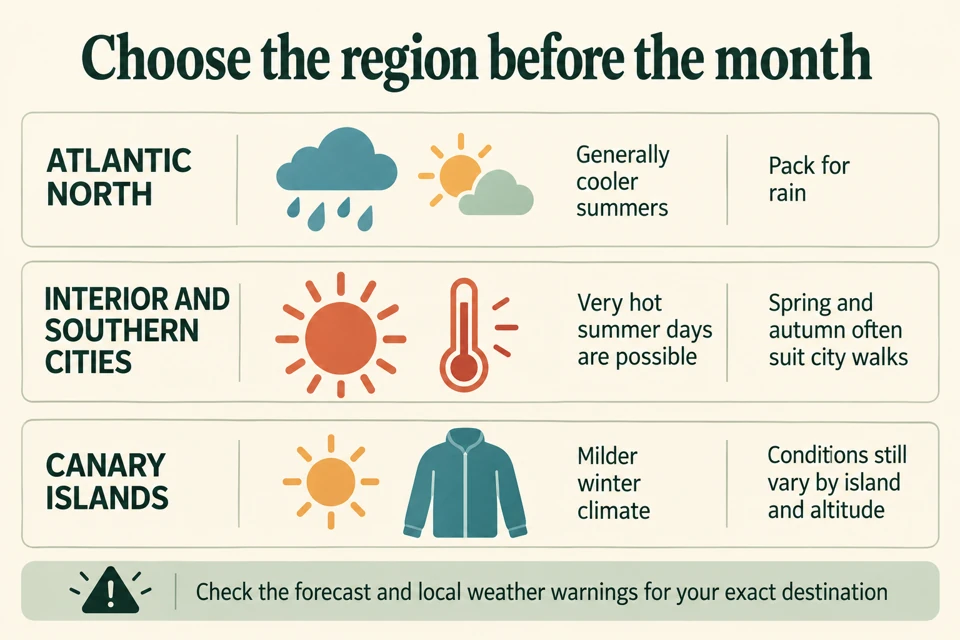
For most trips to mainland Spain, May and June and September and October are the best months. Temperatures are workable for walking around cities, hotel rates are lower than in the summer peak, and the Mediterranean coast has usable beaches. Winter suits the Canary Islands, which stay mild while most of Europe is cold. July and August work for the northern Atlantic coast and the Balearic beaches, but they are the worst months for sightseeing in Seville, Córdoba, Madrid, and the interior south.
AEMET, Spain’s state meteorological agency, publishes the official climate averages and issues color-coded weather warnings. INE, the national statistics institute, tracks hotel stays and room rates. Spain has several distinct climates, so the best month depends on the region you choose.
Climate by Region
Spain’s climate differs more from one region to the next than from one month to the next. The north coast (Galicia, Asturias, Cantabria and the Basque Country) is green because rain falls in every season, with the wettest weather in autumn and winter and the most comfortable temperatures in summer. Bring a rain jacket in any month.
The interior plateau, the Meseta, includes Madrid, Toledo, Segovia and Salamanca. It has cold winters and hot, dry summers, and spring and autumn are the moderate seasons. The Mediterranean coast from Catalonia through Valencia to Murcia has mild winters and hot, humid summers. Andalusia is the hottest part of the country in July and August, particularly in the inland cities of Seville, Córdoba and Jaén, while the sea tempers coastal Málaga and Cádiz.
The Balearic Islands are Mallorca, Menorca, Ibiza and Formentera. They have a Mediterranean climate, with the swimming season in summer and a quiet, cooler winter. The Canary Islands sit far to the southwest in the Atlantic and have a mild climate year-round. The southern coasts of the larger islands are the sunniest, and the northern slopes are cloudier and wetter.
Recent years have run warm, which matters for planning shoulder seasons. AEMET reported that peninsular Spain’s mean temperature in 2024 was 15.0 °C, 1.1 °C above the 1991–2020 average. The Balearic Islands averaged 18.0 °C (+0.9 °C) and the Canary Islands 19.6 °C (+1.2 °C), and AEMET classed both island results as "extremely warm." Individual months swing even more: April 2023 averaged about 14.9 °C across the peninsula, 3.0 °C above the April normal, and was the driest April since 1961, with 14.2 mm of rain, 22% of normal. Treat April and October as moderate months that sometimes behave like summer or winter.
For exact monthly figures at a specific station, AEMET publishes 1991–2020 climate normals, the current reference averages. These list each month’s mean, maximum and minimum temperatures and the accumulated precipitation. Its seasonal rainfall graphs use the median of that period rather than the mean, so a very wet or very dry year does not distort the typical value.
Month by Month
January
Winter is at its coldest on the Meseta, so Madrid, Burgos and Segovia are cold, and the north coast is wet. The southern coast and the islands are mild, which is why the Canaries draw winter visitors. Hotel demand is low. INE’s provisional figure for January 2026 was an average daily rate (ADR, the average price per occupied room) of €116.0 across hotels.
Festivals this month are local. The Festival de la Exaltación del Botillo in Bembibre (León), a regional sausage festival of international tourist interest, takes place on the third weekend of January. The Three Kings parades take place at the start of the month.
February
February is similar to January, with an average hotel rate of €116.3 in 2026, only slightly higher than January’s. Cities are uncrowded and museum queues are short. Carnival, in Cádiz and Santa Cruz de Tenerife especially, falls in late winter and fills those two destinations. Book ahead if your dates coincide.
March
Spring begins, though the Meseta stays cool and the north stays wet. The Mediterranean coast warms up, and Andalusia and the Canaries are pleasant for walking. The ADR in March 2026 was €117.8. Valencia holds its Fallas festival in March, and Semana Santa (Holy Week, the week before Easter) falls in either March or April depending on the year, so check the Easter date before booking.
April
April offers some of the best sightseeing weather in the south, and many travelers pick it for Seville and Córdoba. It also has the biggest event pressure. Semana Santa processions are listed as festivals of tourist interest in Córdoba, Cádiz, Almería, Barbastro and Teruel, and Seville’s Semana Santa and Feria de Abril are on the international list. Seville’s Feria follows in the weeks after Easter. Hotels in these cities fill and raise prices during those weeks. Skip Seville in Holy Week if you want quiet streets, or choose it specifically for the processions and book early. Weather is variable, as April 2023 showed.
May
May is among the most reliable months for an all-around trip. Temperatures are comfortable in most of the country, and the southern heat has not yet arrived. Beaches and sea are cool in the north but increasingly usable in the south and the Mediterranean. The ADR for May 2026 was €123.7, up 4.2% on a year earlier, and the Illes Balears had the largest regional price rise that month at 8.9%. Córdoba holds its courtyard festival in May, so the city is busy.
June
June opens the beach season, and the south and interior begin heating up. Daytime sightseeing in Seville and Córdoba shifts to mornings and evenings by late June. The Hogueras de San Juan in Alicante and the midsummer night bonfires along the coast give the month a festival focus around the summer solstice. Prices rise toward summer levels, though no INE figure for June is available here. Early June is a strong compromise for a trip that mixes cities and coast.
July
July is the peak. INE’s revised July 2025 figure was an ADR of €146.9. The latest figure, July 2026, is €156.92 (+6.79% on the year) and 44,846,714 overnight stays. That is about a third more per room than in January. Marbella had the highest ADR among tourist points in July 2025 at €375.1.
Heat peaks in the south and interior. This is the month for the north coast (San Sebastián, Asturias, Galicia) and for the Balearic beaches. San Fermín takes place in Pamplona in July, which fills the city and its hotels.
August
August brings the same heat, high prices and full beaches as July. Many Spaniards take their own vacations this month, so coastal towns are crowded with domestic travelers, and some small shops and restaurants in cities close for a few weeks. Check opening hours for specific restaurants before you plan around them. Two festivals in the research fall in this month. The Fiesta de San Roque in Calatayud (Zaragoza), a festival of national tourist interest, runs 14 to 18 August, and La Tomatina tomato fight in Buñol (Valencia) takes place at the end of the month.
September
September is the best month for combining beach and city travel. The sea has held its summer warmth, crowds thin after the first week, and the southern interior is still hot early in the month but easing. The Fiesta del Pino in Teror, Gran Canaria, a pilgrimage festival that is the island’s largest, is listed for 7 and 8 September. Prices fall from the July level, but INE has no figure for September.
October
October is mild in the south and on the Mediterranean, and cooler and wetter in the north. It suits city trips to Madrid, Seville, Granada and Barcelona. Rooms cost less than in summer, and the Canaries begin their winter season. Plan for rain in Galicia and the Basque coast, and keep a flexible day in the schedule.
November
November is the quietest month on the mainland, and hotels cost the least. INE reported an ADR of €113.7 for November 2024, the lowest in the snapshots. Weather is changeable, with rain in the north and cold nights inland. It suits museum-heavy city trips and the Canaries.
December
December has Christmas lights and markets in the larger cities, and cold on the Meseta. The Canaries stay warm and busy. Spain’s FRONTUR survey of international arrivals showed that Canarias arrivals in December 2025 were flat (?0.1%) while Catalonia dropped 7.3%, which points to the islands’ pull in winter. The Immaculate Conception holiday in early December creates a long weekend that fills hotels in some regions, and the Christmas to Epiphany period is busy for domestic travel.
Heat Warnings and Heatwave Rules
AEMET’s warnings come in three levels, yellow, orange and red, above a green no-risk state. Per the official help page, orange means significant danger, where vulnerable people or those in exposed areas could suffer serious impacts, and red means extraordinary danger with very serious or catastrophic impacts possible. AEMET can issue warnings up to 72 hours ahead. Warnings apply to zones rather than provinces, so a single province can have different alert levels in different parts of it.
The temperature that triggers a warning differs by zone. In 2023, yellow began at a maximum of 34 °C, 36 °C or 38 °C depending on the zone, according to Maldita.es. AEMET last changed the trigger temperatures in 2022, when it raised them in the Balearic Islands and did not lower them. The 2023 numbers are therefore out of date, and the current values should be read from AEMET on the day.
A heatwave has its own definition. According to a summary of AEMET’s criteria, it needs at least three consecutive days, extremely high temperatures at 10% or more of reference observatories, and maxima above the 95th percentile of July–August temperatures from 1971–2000. Because the benchmark is relative to each place, a hot day in Jaén differs from one in A Coruña. Jaén’s station thresholds are 39 °C, 40 °C and 42 °C, while A Coruña’s are 29.2 °C, 30 °C and 31.6 °C. A Coruña can be in a heatwave at temperatures that would be an ordinary day in the south.
Spain’s civil protection service runs a separate high-temperature framework with green, yellow, orange and red levels, based on the number of days expected to exceed temperature thresholds in the 52 provincial capitals. Because it is a different system from AEMET’s warnings, check which one a news report is describing.
The heat risk concentrates in the July–August reference period used in the heatwave definition, and the south and the interior are the most exposed. If you travel then, schedule outdoor sights such as the Alhambra gardens, Roman ruins and old-town walks for early morning, use the afternoon for museums or rest, and check the warning for your zone each day. Leave a day or two with slack rather than packing every day.
Hotel Prices and Crowds by Month
The INE hotel figures show how rates move across the year. They cover hotels only, exclude rental housing, and come from different years, so read them as a shape rather than a continuous series.
| Month | Average daily rate | Hotel overnight stays |
|---|---|---|
| November 2024 | €113.7 | not stated |
| January 2026 | €116.0 | not stated |
| February 2026 | €116.3 | not stated |
| March 2026 | €117.8 | not stated |
| May 2026 | €123.7 | not stated |
| July 2025 | €146.9 | not stated |
| July 2026 | €156.92 | 44,846,714 |
The winter and spring rates cluster between roughly €113.7 and €123.7, and the jump to summer is clear. In November 2024, prices rose faster (ADR +8.4%) than stays (+5.4%), so cheap months are getting less cheap.
Rental housing sometimes diverges from hotels. In October 2025 hotel stays rose 0.5% while rental housing rose 8.9%, and in December 2025 hotels rose 7.3% while rental housing fell 9.3%. Apartment prices therefore do not move in step with hotel prices.
Spain received a record 96.8 million international tourists in 2025, up 3.2%. Catalonia took about 20.1 million, and the Illes Balears and Canarias each took 15.7 million. The UK, France and Germany are the top source markets. The most common stay length was four to seven nights.
Balearic and Canary Islands
The Balearics are a summer destination. July and August bring the highest prices and the most crowding, and the beaches and ferry routes are at full capacity. The Illes Balears also had the largest regional price rise in May 2026, so early-season pricing is already rising. In winter the islands are cool, quiet and good for walking, but seasonal hotels, restaurants and beach clubs in resort areas close, so confirm what is open for your dates before you book.
The Canaries suit any month. Tenerife, Gran Canaria, Lanzarote and Fuerteventura carry the winter demand from Northern Europe. The Fiesta del Pino in early September is one calendar anchor. Choose the south of an island for the most sun and the north for green hiking terrain and more cloud. Adeje in southern Tenerife appears among the top-priced tourist points in some months of the INE data.
Teide Access Rules
Teide National Park on Tenerife requires permits for some trails, and the rules changed in 2026. Reservations go through the Gobierno de Canarias availability and permits system. The Telesforo Bravo trail (PNT 10), which connects the upper cable-car station with the 3,718 m summit, has strictly regulated access.
Bookings open up to 56 days ahead, and a new week of slots is released every Monday at 07:00 Canary time. The official page gives an example: on Monday 16 March, slots for 4 to 10 May open up. For summer or holiday dates, set an alarm for the release day. One Teide guide reports that the summit permit usually sells out weeks ahead in high season.
A notice dated 14 October 2026 adds three trails to the permit system, reported by Diario de Avisos. PNT 09 (Teide, Pico Viejo and Mirador de Las Narices del Teide) gets 95 places per day. PNT 23 Los Regatones Negros and PNT 28 Chafarí get 65 each. Together that makes 225 places per day (150 private, 75 professional). Conditions for Montaña Blanca–La Rambleta (PNT 07) and Telesforo Bravo (PNT 10) were also modified. Permit holders must show the permit and official ID on request, and fines of up to €600 are reported.
Fees vary by trail and by whether you are a resident, so read the amounts on the official reservations page rather than relying on older blog posts that describe the summit permit as free. Carry your passport or national ID with a copy of the permit, and cancel any booking you will not use so the place is released. Mountain weather changes quickly, so check conditions on the day you go up.
How Festivals Affect Hotel Prices
Spain’s tourism ministry maintains lists of Festivals of National and International Tourist Interest, and the ministry page is the place to begin. The years in parentheses on that page are declaration years, not event dates. A 2026 round of recognitions added new festivals, including 5 international and 11 national, and the coverage cites 266 recognized festivals in total.
Festivals cut both ways. They are the reason to visit some towns, and they push hotel prices up and fill rooms. Semana Santa, Feria de Abril, San Fermín, Fallas and La Tomatina are the ones that most affect accommodation in their host cities. Moros y Cristianos festivals, with mock battles between Moors and Christians, take place in many Valencian towns, including Elda and Calpe. Confirm exact dates with the regional tourism office, since movable festivals shift each year.
Choosing Your Month
For a first trip to Andalusia, Madrid and Barcelona, pick May, early June or late September to October. For beaches, July and August are warmest, with the highest prices. For hiking and quiet cities with fewer crowds, choose November through March, with the Canaries as the warm option. For the north coast, pick July to September, and bring rain gear regardless. If a specific festival is the goal, book accommodation as soon as you fix the date.
Key Takeaways
- Pick May, June, September or October for mainland trips: These months avoid the July and August heat in the south and interior, and rates stay well under the summer peak (ADR of €123.7 in May 2026 versus €156.92 in July 2026).
- Go to the Canaries in winter and the north coast in summer: The islands stay mild year-round, while Spain’s Atlantic north is the coolest place to be in July and August.
- Check AEMET’s warning for your zone daily in summer: Warnings are issued by zone up to 72 hours ahead. Trigger temperatures were lowered in 2024, and a heatwave threshold is relative to each place.
- Book Teide permits 56 days ahead: New weekly slots open Mondays at 07:00 Canary time. A notice dated 14 October 2026 added three more trails to the permit system, and fines up to €600 are reported.
- Plan around festivals: Semana Santa, Feria de Abril, San Fermín, Fallas and La Tomatina fill their host cities, so book early or avoid those dates. Confirm dates with the regional tourism office.