Australia
Australia Travel Costs: Daily Budgets, Prices and Ways to Save
A first trip to Australia costs more per day than most visitors expect, mainly because of lodging and the distances between places. Entry is cheap, though. U.S. citizens pay a AUD 20 service charge for the electronic permit that replaces a visa. Public transport in Sydney has daily and weekly price caps. Many sights cost under AUD 50. All prices below are in Australian dollars (AUD), so convert them at the current exchange rate before you set a budget.
Tourism Research Australia (TRA), the government’s tourism statistics unit, reports that international holiday visitors spent an average of $131 per night in 2024. That figure varies sharply by home country: visitors from the United Kingdom, Germany and Japan averaged less than the $131 overall figure, while U.S. visitors averaged $218. The three budget levels below start from these averages: lean, mid-range and higher comfort. Each level then lists published prices for lodging, local transport and main sights. Prices were checked against official pages and are dated where the source gives a date. Fees change, so confirm them on the operator’s page before you book.
Entry costs and the ETA
Most U.S., Canadian, Japanese and U.K. travelers enter Australia on an Electronic Travel Authority (ETA, subclass 601), a digital travel permit linked to your passport. The Department of Home Affairs lists eligible passports and the cost. There is no visa application charge. The only fee is an AUD 20 service charge for using the Australian ETA app, which the Australian Embassy in Washington describes as an "application service fee of AUD20 to use the Australian ETA app."
You apply in the free ETA app from the App Store or Google Play. You must be outside Australia when you apply and when the ETA is granted. The permit is valid for 12 months or the life of your passport, whichever is shorter, and it allows multiple entries with each stay up to 3 months. Home Affairs says the result is immediate in most cases and advises waiting for the grant before you book flights. That advice was current in late September 2026.
Anyone who asks for more than AUD 20 is running a scam. The embassy warns against applying through a website, against paying for "premium" or "expedited" processing, and lists five third-party sites it says are not approved platforms. The Home Affairs ETA page confirms the current process.
Some European passport holders have a second option, the eVisitor (subclass 651). The Home Affairs cross-reference table lists Germany, France, Italy, Spain and the United Kingdom as eligible for both the ETA and the eVisitor. The United States, Canada, Japan and Singapore are not eligible for the eVisitor, so travelers from those countries use the ETA. If you hold one of the listed European passports, compare both options on the Home Affairs site before paying.
Three daily budgets
The table below pairs each comfort level with a TRA spending reference and the published prices that apply at that level. The spending references are 2024 per-night averages across all categories, taken from the TRA annual benchmark report. They show what real visitors spent, not a minimum.
| Lean | Mid-range | Higher comfort | |
|---|---|---|---|
| Spending reference per night (2024 average) | Below $131 (Germany, Japan, UK) | $131 (all international holiday visitors) | $218 (U.S.) |
| Lodging | Shared room or rented apartment split between travelers | Rented apartment, or a hotel room split between two | Hotel room at the national average of $226 in winter or $251 in summer |
| Sydney transport | Weekly cap of $50 | Daily cap of $19.30 on weekdays, $9.65 Friday to Sunday | Same caps; add taxis as needed |
| Main sights | Free sights plus one paid entry every few days | Opera House tour at $50 pre-booked | Opera House Backstage Tour |
Lean. A lean budget sits below the $131 average, as visitors from the U.K., Germany and Japan spent. Two people splitting a hotel room at the national average of $226 pay $113 each before eating anything, so lean travelers look at apartments and shared accommodation. Hostel and dorm prices vary by city and date, so price them on booking sites before you fix a number. Sydney transport stays at the $50 weekly Opal cap. Sights come mostly from free beaches, walks and harbor viewpoints, plus a paid entry such as the $25 Kakadu pass when you reach the Northern Territory.
Mid-range. The $131 average is a workable target here. A rented apartment, or a hotel room shared by two, fits inside it only if you keep daily meals modest, because a hotel room at the average rate split in half takes $113 of the $131. A weekday of heavy transit costs up to $19.30, and the $50 Opera House tour fits about once per city.
Higher comfort. The $218 per night that U.S. visitors averaged sits close to the national hotel rate of $226 in winter and $251 in summer for one traveler. Meals fit only if you share a room or choose carefully. Add paid sights such as the Backstage Tour, and the daily total climbs quickly on days you book a premium experience.
No national food rate is published, because menu and grocery prices vary by city and neighborhood. Subtract your lodging, transport and sights from the nightly envelope and treat the remainder as your food allowance. If that remainder is thin, shift toward groceries. TRA’s 2024 data shows Australians on domestic overnight holidays spent 7% more on groceries and 6% more on takeaway and restaurants than a year earlier, and 25% less on tours. TRA reads that shift as more self-prepared meals. The data covers domestic travel, but it shows locals cutting back on paid experiences before they cut back on eating.
Lodging: hotels and rented apartments
In 2024, TRA’s national average daily rate (ADR, the average price paid per occupied room) for larger establishments was $251 in summer and $226 in winter. ADR rose 1.3% over the year. Average occupancy was 71%, lowest from April to June and highest in November. Hotels have the most empty rooms from April to June.
Summer runs December to February, so the $251 figure covers the Christmas and January peak. Winter, June to August, is the cheaper hotel period nationally. The Northern Territory’s dry season falls in those months, though, and it carries its own pricing. Any hotel quote for your dates will differ from these national averages. Sydney and Melbourne sit at the top of the range and regional towns at the bottom, but the report publishes only the national average.
Rented houses and apartments take a large share of international visitor nights. Of 73.2 million nights international visitors spent in Australia in 2024, 27.4 million were in hotels, resorts or motels (37%), and 32.2 million were in rented houses or apartments (about 44%). Renting a home beat hotels among international visitors, especially on longer stays. Renting appeals to budget travelers for practical reasons. An apartment with a kitchen cuts the daily food cost, and splitting the rent between two or more people lowers the per-person lodging figure. Check cleaning fees and minimum-stay rules on the booking page before you compare a nightly rate with a hotel.
For a first trip of one to two weeks, combine the two. Book a hotel in the city where you land, since jet lag makes self-catering a chore on arrival day. Then rent an apartment for stays of four nights or more. On a lean budget, two people sharing an apartment each pay half the nightly rate, and the kitchen keeps the food line low.
Getting around Sydney with Opal caps
Sydney’s public transport runs on the Opal network, which covers trains, metro, buses, ferries and light rail. You pay by tapping on and off with an Opal card, a contactless bank card, or a phone wallet such as Apple Pay, Google Pay or Samsung Pay. Transport for NSW says visitors who tap a contactless card get the same fares and caps as Opal card users. Use the same card or device for every tap, because the caps count per card.
The caps are the main budget control for adults. A NSW Government release dated 12 April 2026 and the Opal benefits page list these amounts, which took effect on 14 July 2025 per the IPART fare fact sheet:
| Adult cap | Amount |
|---|---|
| Daily, Monday to Thursday | $19.30 |
| Daily, Friday to Sunday and public holidays | $9.65 |
| Weekly, Monday to Sunday | $50 |
Once you reach a daily cap, travel is free for the rest of that day. The weekly cap works the same way. After $50 of fares in a Monday-to-Sunday week, further trips cost nothing, so a visitor who reaches the weekly cap pays no more than $50 for that week. The April 2026 release says fares are about 30% cheaper on Fridays, weekends, public holidays and outside peak times. A $2 adult transfer discount applies when you switch between metro or train, ferry, bus and light rail within 60 minutes of your last tap-off.
Single adult fares are distance-based. Metro Sydney lists five bands from $4.33 to $10.66. Two exceptions matter for planning. The Sydney Airport station access fee falls outside the daily, weekly and Friday-to-Sunday caps, and a separate weekly cap applies to it, per the Transport for NSW fares page. If you ride the train from the airport, budget for that fee on top of your cap. The caps also cover only Sydney’s Opal network. Melbourne, Brisbane and other cities, along with flights and long-distance trains between cities, are priced separately.
For the cheapest week, schedule your longest transit days on Friday to Sunday or a public holiday, when the daily cap drops to $9.65. Switch modes within 60 minutes to collect the $2 discount.
Sights and park passes
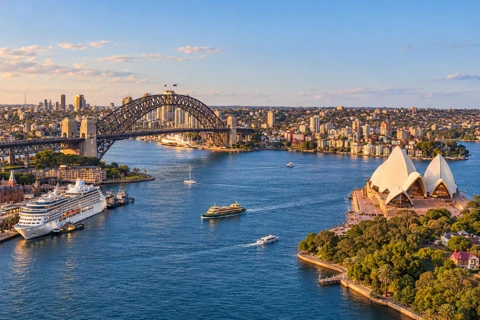
Sydney Opera House. The standard one-hour tour is the main paid sight in Sydney. The official page lists adult tickets at AUD 50 pre-booked and AUD 55 on the day. From 1 April 2027 those rise to AUD 52 and AUD 57. Children aged 5 to 15 pay a child rate, and children under 5 are free. Concessions go to Australian Seniors Card holders, Australian Pensioners and full-time students aged 16 and over. Family tickets cover 2 adults and 2 children aged 15 and under. The tour runs daily in English, French, German, Spanish, Japanese, Korean and Mandarin. It covers up to 2.5 km on foot with around 300 stairs, no lift or escalator access and limited seating. Booking ahead saves AUD 5 per adult against the day-of price. The Backstage Tour costs more than the standard tour, lasts about 135 minutes and includes breakfast, according to the independent Opera House guide. Sydney Spirit’s listing gives the same duration.
Kakadu National Park. Kakadu is a federally managed park in the Northern Territory, and its passes are per person. Parks Australia lists these prices:
| Category | Dry season (15 May to 31 Oct) | Tropical summer (1 Nov to 14 May) |
|---|---|---|
| Adult (16+) | $40 | $25 |
| Child (5 to 15) | $20 | $12.50 |
| Family (2 adults + 2 or more children) | $100 | $65 |
| Concession | $30 | $19 |
A Parks Australia release dated 25 June 2026 says pass fees drop to tropical-summer pricing from 1 July to 31 October 2026. During that window the adult pass costs $25 instead of $40. Check the dates before you buy, because the price depends on when you visit.
Ulu?u-Kata Tju?a National Park. Parks Australia’s pass page lists an adult (18+) annual pass at $50. A 3-day adult pass costs $38 and extends by two more days at no charge, according to Australia So Much To See, and Nomadic Camping Hire gives the same figure. Confirm the 3-day price and the free extension on the official page before you buy. Ask whether the 3-day pass matches your plans before you pay for the annual pass. A Ulu?u pass covers Ulu?u-Kata Tju?a only, and a Kakadu pass does not cover Ulu?u, so a trip to both needs two passes.
Other parks. Kakadu and Ulu?u are federal. Most other national parks are run by the state or territory where they sit, so fees and pass types vary by location, as Gallivanting Oz notes. Check each park’s own page when you route a road trip.
Key Takeaways
- Pay only AUD 20 for entry: The ETA has no visa application charge, only a AUD 20 service charge in the official app. Anyone asking for more is running a scam.
- Set the daily budget by home-country benchmark: TRA’s 2024 averages ran lower than $131 per night for U.K., German and Japanese visitors, $131 for all international holiday visitors and $218 for U.S. visitors. Pick the level that fits your lodging style.
- Rent an apartment or split a room: The 2024 average hotel rate was $226 in winter and $251 in summer per room, so two people sharing a room pay half of that each. Rented homes made up about 44% of international visitor nights.
- Let Opal caps limit Sydney transport: Adults pay at most $19.30 on weekdays, $9.65 Friday to Sunday and on public holidays, and $50 per week. The airport station access fee sits outside the caps.
- Time park and tour purchases: Pre-book the Opera House tour to pay AUD 50 instead of 55, and buy a Kakadu adult pass for $25 on dates from 1 July to 31 October 2026.