Best Time to Visit Denmark

The best times to visit Denmark for most travelers are late May through early June and September. Days are long or still decent, and temperatures are mild. Crowds are thinner than in July and August. Summer (June to August) is the warmest season with the longest daylight. It is also the peak for festivals and prices. Winter is dark and cold, but it suits Christmas markets and budget city breaks.
Denmark’s coastal climate makes the weather changeable in every month, and no month is reliably dry. The monthly figures below are country-wide 1991–2020 climate normals (30-year averages) from the Danish Meteorological Institute (DMI). Visitor figures come from Statistics Denmark (Danmarks Statistik, abbreviated DST), which counts overnights at hotels, rented holiday houses, holiday centers, hostels, campsites, and marinas. Travelers choosing dates should weigh three things: how much daylight and warmth they want, whether they want festivals, and whether Tivoli Gardens in Copenhagen will be open.
Best Months by Trip Type
For the best balance of weather, daylight, and crowds, aim for late May to early June, or September. May has the most sunshine of any month in the normals (236.6 hours), and September still averages a daily high of 17.2 °C.
For festivals and the longest days, choose July and August. Expect the highest prices, the largest crowds in popular coastal areas, and more rain showers than in spring. August has the second-highest monthly rainfall total.
For budget travel, March to May and October to November are the cheaper windows, though March is cold and windy and November is wet and dark. For a winter trip built around Christmas, go in the weeks after Tivoli’s Christmas season opens on 13 November 2026 or through December. January and February, and the first half of March, are the weakest months for outdoor sightseeing.
Weather Across the Year
Westerly winds dominate and bring mild, cloudy weather in winter and cool, often wet weather in summer. Heat waves need air from the continent, and easterly or southerly winds produce Denmark’s cold winter spells and its hot summer days, according to DMI’s climate report. The 1991–2020 normals are labeled provisional, and the figures cover Denmark as a whole. The 1991–2020 normal year is about 1.0 °C warmer and 47 mm wetter than the 1961–1990 normal, so older guidebook figures run cooler and drier.
| Month | Mean daily max (°C) | Mean daily min (°C) | Precipitation (mm) | Sunshine (hours) |
|---|---|---|---|---|
| Jan | 3.6 | -0.7 | 65.3 | 52.0 |
| Feb | 3.7 | -0.9 | 50.3 | n/a |
| Mar | 6.4 | 0.3 | 46.4 | 130.6 |
| Apr | 11.2 | 3.4 | 38.5 | 188.2 |
| May | 15.6 | 7.1 | 47.3 | 236.6 |
| Jun | 18.5 | 10.4 | 64.3 | 227.3 |
| Jul | 21.2 | 12.7 | 65.8 | 227.8 |
| Aug | 21.2 | 12.8 | 82.1 | 197.9 |
| Sep | 17.2 | 10.1 | 74.7 | 143.5 |
| Oct | 12.3 | 6.4 | 83.2 | 99.1 |
| Nov | 7.6 | 3.1 | 70.3 | 53.8 |
| Dec | 4.7 | 0.4 | 70.9 | 42.9 |
Two patterns in the table surprise many visitors. The wettest months by total rain are October (83.2 mm) and August (82.1 mm), while spring is the driest stretch, with April at 38.5 mm. July has the most summer days (days above 25 °C) of any month, at 5.2 on average, and the 1991–2020 normal absolute maximum is 35.1 °C, recorded in August. Frost days run to 15.3 in January and 14.8 in February, and the normal absolute minimum is -23.1 °C, in February.
Summer rain tends to arrive as downpours. DMI counts cloudburst days (more than 15 mm of rain in 30 minutes) at an average of 7.1 in August and 5.4 in July for 2011–2024. Autumn is the gale season, since most gales occur in autumn and early winter. Late winter and spring bring easterly winds, which Danes call "påskeøsten" (the Easter east wind) because they are frequent at Easter. Pack layers and a waterproof jacket in every month.
Month-by-Month Guide
January
January is the coldest month, with a daily high of 3.6 °C, frost on 15.3 days on average, and snow cover on about 7 days. Days are short enough that Denmark is dark by early afternoon from December to February, and northern lights are possible in those months. Crowds are at their lowest.
Tivoli Gardens closes from 4 January to 18 March 2027. The Denmark-wide Vinterjazz series runs 29 January to 28 February 2027. January suits indoor city breaks, museums, and quiet-week bargains. It does not suit beaches or long outdoor days.
February
February has nearly the same temperatures as January (daily high 3.7 °C, frost on 14.8 days, snow cover on 7.4 days), but precipitation drops to 50.3 mm and sunshine begins to rise. Snow in winter turns to slush quickly. Fastelavn, Denmark’s carnival, falls on 7 February 2027. The Copenhagen Light Festival is listed for February and gives short days a purpose for evening walks. Tivoli stays closed. This is still a month for winter city breaks and light-festival visits.
March
March warms to a daily high of 6.4 °C, with frost on 12.5 days and snow cover on 3.9 days. Sunshine jumps to 130.6 hours, a clear increase on February. Spring arrives in late March or April, and easterly winds are common, so the first half of the month feels like winter. Prices remain low.
Tivoli reopens for its Easter season, 19–29 March 2027, after closing until 18 March. Easter weekend is 25–29 March 2027. March suits travelers who want low prices and accept cold, windy weather.
April
April brings a daily high of 11.2 °C and 188.2 hours of sunshine. Frost falls to 4.2 days and snow cover to 0.2 days, so snow rarely interferes with a trip. Tivoli’s summer season began on 7 April in 2026 and begins on 30 March in 2027. April counts as shoulder season: crowds are thin, daylight is long, and weather is changeable. The SPOT Festival, a music festival in Aarhus, is held in spring.
Rain is a real risk in April. April 2024 was the wettest April since 1874, at 104.2 mm, according to the DMI report, against a normal of 38.5 mm. April suits visitors who want fewer people and bring a rain jacket.
May
May is one of the strongest months overall. The daily high is 15.6 °C, there are 236.6 hours of sunshine (the most of any month), and frost has almost disappeared (0.5 days). Tourism is still in shoulder season, and May is less busy while Copenhagen enjoys good weather. DST counted about 6.2 million tourist overnights in May 2024, up 4% on May 2023, so it is not empty, but it has not reached the July peak.
Parks bloom in Copenhagen and Aarhus, and the sky stays not fully dark from mid-May to mid-July in what Danes call the white nights. Late spring is also a good time to rent a cottage, with cheaper and less competitive bookings. The Copenhagen Marathon is held in May, and Ascension Day, a public holiday with closures, falls on 6 May 2027.

June
June has a daily high of 18.5 °C, 227.3 hours of sunshine, and 64.3 mm of rain. Copenhagen’s daylight lasts until close to 10 pm. Summer days (above 25 °C) average 1.7, so most days are mild rather than hot.
Early June is quieter than July. DST’s June 2024 release showed total overnights down 1% on June 2023, with Danish overnights down 11% and foreign hotel overnights up 9%. Copenhagen Distortion, a street festival, takes place in early June, and the Roskilde Festival begins at the end of the month. Tivoli’s summer season includes Friday Rock concerts. June suits long-daylight travel with fewer crowds than July and August, particularly in its first half. Copenhagen’s weather is rated best from June to September, peaking in June.
July
July is the warmest month, tied with August at a 16.9 °C mean and a daily high of 21.2 °C. It has the most summer days of any month, and highs of about 26 °C are possible. Rain is 65.8 mm, and cloudbursts average 5.4 days.
July is peak season and the main Danish holiday month. Danes head to the countryside or the coast, so only the most popular areas feel crowded, and cities feel somewhat quieter because residents leave for summer houses or abroad. Travel guides describe summer prices as sky-high.
Festivals cluster here. The Roskilde Festival in 2026 ran 27 June to 4 July, drew more than 130,000 attendees in 2024, and is one of Europe’s largest music festivals. The Copenhagen Jazz Festival ran 3–12 July 2026 with over 1,000 concerts, many outdoors and free. The Aarhus International Jazz Festival is listed for 25 June to 4 July 2027, and the classical Copenhagen Summer Festival is likely 18–29 July 2027. The Moesgård Viking Moot, a Viking reenactment event near Aarhus, ran 24–27 July in 2025. July suits festival-focused travel and long days, and it requires booking ahead and a higher budget.
August
August matches July for warmth (daily high 21.2 °C, minimum 12.8 °C) but is wetter: 82.1 mm of rain, the second-highest monthly total, and 7.1 cloudburst days, the most of any month. Sunshine falls to 197.9 hours, and summer days average 4.3. Peak season continues, and the coast is busy.
Copenhagen Pride ran 9–17 August in 2025, alongside the Copenhagen Cooking food festival (15–24 August 2025). For 2027, Copenhagen Pride Week is listed for 14–22 August and the Hans Christian Andersen Festival in Odense for 19–28 August. Smukfest, a large music festival near Skanderborg, runs in August, and the Tønder Folk Festival follows in late August. Copenhagen Fashion Week also runs in August. August suits festival travel, warm weather, and long days, with a rain jacket in the daypack.
September
September is a shoulder month with a daily high of 17.2 °C, 143.5 hours of sunshine, and 74.7 mm of rain. Summer days fall to 0.3 on average. Cloudbursts drop to 2.5 days.
Travel guides recommend September for similar appeal at lower cost. DST counted just over 1 million campsite overnights in September 2024, with Danish overnights up 8% and foreign up 19%, so campgrounds remain active. Tivoli’s summer season ends on 20 September 2026 and 26 September 2027. September suits travelers who want warm-ish weather, fewer people, and the first autumn atmosphere.
October
October has a daily high of 12.3 °C and the highest monthly rainfall in the normals at 83.2 mm, with only 99.1 hours of sunshine. Frost returns on 2.2 days. Autumn brings slightly more rain and wind to the Jutland peninsula, and gales become more likely.
October remains a shoulder period. DST recorded 5.6 million tourist overnights in October 2025, up 1% on October 2024, with hotels up 7% and holiday centers up 11%, while holiday-house overnights fell 4%. Tivoli’s Halloween season runs 2 October to 1 November 2026, with Villa Vendetta, a haunted house with 12 themed rooms. October suits museum visits, autumn city breaks, and budget travel.
November
November has a daily high of 7.6 °C, frost on 6.0 days, snow cover on 1.1 days, 70.3 mm of rain, and only 53.8 hours of sunshine. Gales remain most common in autumn and early winter.
DST counted almost 3 million tourist overnights in November 2024, up 6% on November 2023 and the highest November count since the series began, with hotels up 7%. Tivoli is closed 2–12 November 2026, then opens its Christmas season on 13 November. J-Day, the early-November release of Christmas beer in central Copenhagen, falls on 5 or 6 November in 2026. November suits budget travelers and early Christmas planning, with cool, wet weather.
December
December has a daily high of 4.7 °C, frost on 12.2 days, snow cover on 4.2 days, and just 42.9 hours of sunshine, the lowest of any month. Winter is cold and windy. DST counted 2.8 million tourist overnights in December 2024, up 10% on December 2023, with hotels up 7% and holiday houses up 12%. Christmas markets open in early December, and Tivoli’s Christmas season (13 November 2026 to 3 January 2027) fills the month with lights and trees. December suits cozy winter travel, Christmas markets, and northern-lights attempts, with the shortest days of the year.

Regional Differences
DMI publishes its normals for the whole country, so regional comparisons come from single-year figures for 2024 and from the character of each destination. These single-year values show which areas run warmer, sunnier, or wetter, though they are not long-term averages.
Copenhagen and Zealand
Copenhagen’s weather is rated best from June to September. The city has long summer evenings, harbor swimming, and Tivoli. Spring and autumn are cool and quieter, and suit museum visits. Winter is dark but has the Christmas season at Tivoli. Zealand also holds Roskilde, whose festival runs at the end of June into early July. Copenhagen Card holders get free Tivoli entry, and the card also covers public transport, so a pass pays off most in a museum-heavy spring or autumn trip. Region Hovedstaden, which includes the capital, had the largest percentage increase in holiday-house overnights in 2024 at 10%.

Jutland
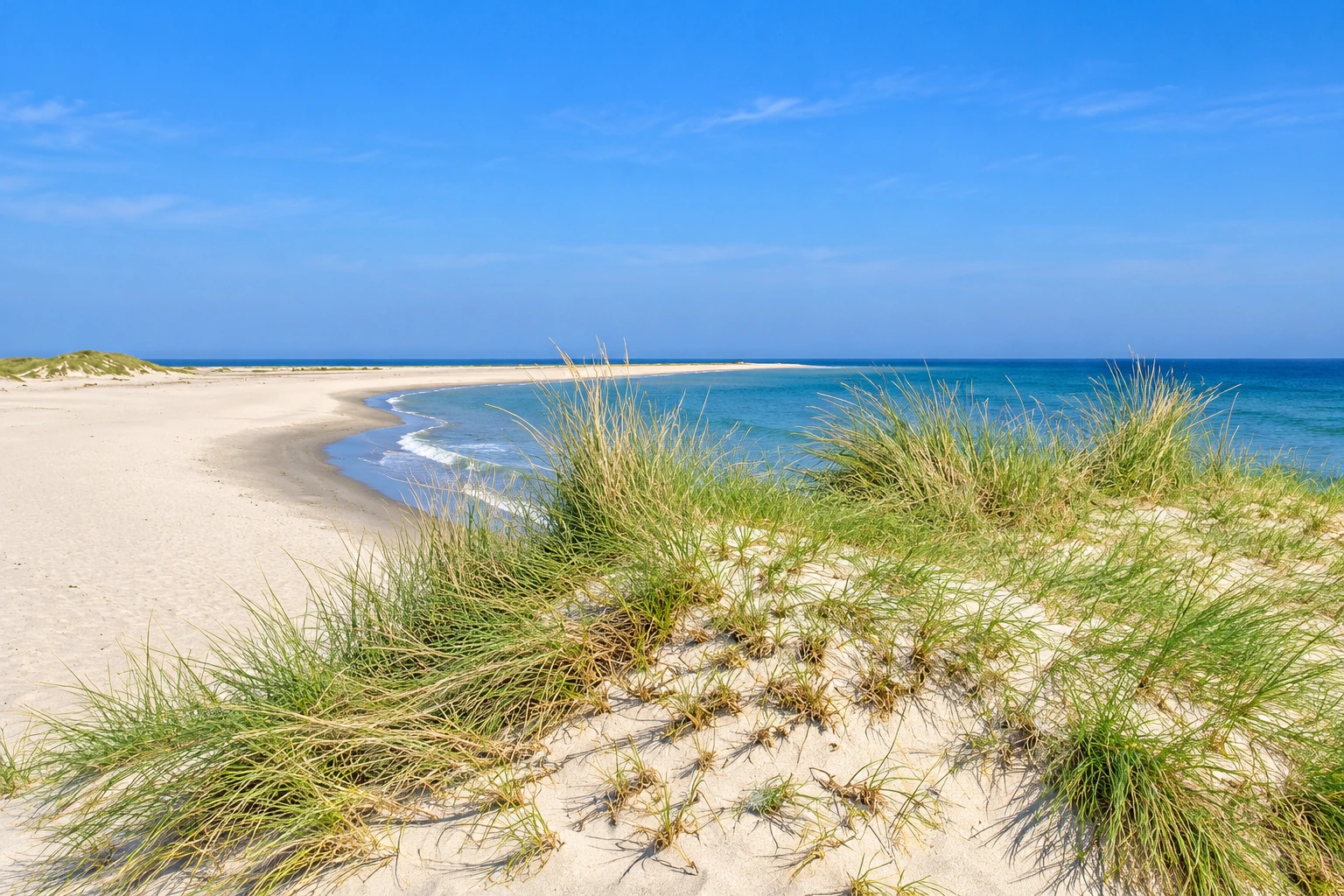
Jutland is exposed to wind and rain, particularly in autumn. In 2024, Nordjylland was the coolest region (9.4 °C annual mean), Midt- og Vestjylland had the least sunshine (1,643.7 hours), and Syd- og Sønderjylland had the most rain (1,148.2 mm). Plan Jutland beach and coast trips for June to August, and expect wind year-round. Aarhus is a city break in any season, with blooming parks in May, the SPOT Festival in spring, and the Aarhus International Jazz Festival listed for 25 June to 4 July 2027. At Skagen, on Jutland’s northern tip, summer days run even longer than in Copenhagen, with sandy beaches backed by dunes. Region Syddanmark had the most holiday-house overnights in 2024 (8.5 million), which signals that cottage areas are busiest in summer.
Funen and Bornholm
Funen (Fyn) was the warmest region in 2024, at a 10.3 °C annual mean. Odense hosts the Hans Christian Andersen Festival (19–28 August 2027), which makes late August the natural time for a Funen trip. Bornholm, the island in the Baltic Sea, had the most sunshine (1,989.1 hours) and the least rain (739.2 mm) in 2024, which points to late spring and summer as strong choices there.
Crowds and Prices
Tourist overnights in Denmark reached 66.2 million in 2024, up 2% on 2023, and the foreign share was 52%. Hotels drove the increase with 850,000 more overnights, and holiday houses rose 2%. Within the year, July and August are the busiest months, but Danish holiday habits shift the crowds: cities feel lighter while beaches, ferries, and holiday-house areas fill. Late autumn and December are growing, which makes Christmas weeks busier than they once were.
Prices follow the same pattern. Summer brings higher prices, and the cheaper windows are March to May and October to November. Compare hotel rates for your specific dates, and book the cheaper windows early to lock in the lower cost.
Tivoli Opening Dates
Tivoli is open in blocks, and a trip planned outside them misses it entirely. The current calendar from Copenhagen Tourism, updated October 2026, runs as follows.

| Season | Dates | What it suits |
|---|---|---|
| Easter | 19–29 March 2027 | Short late-March spring season |
| Summer | 7 April to 20 September 2026; 30 March to 26 September 2027 | Longest season; gardens, flowers, Friday Rock concerts |
| Halloween | 2 October to 1 November 2026 | Halloween theme, Villa Vendetta |
| Christmas | 13 November 2026 to 3 January 2027 | Lights, trees, Christmas market |
| Closed | 2–12 November 2026; 4 January to 18 March 2027 | No general admission |
Entry is 200 DKK for adults and 100 DKK for children aged 3–7, and under-3s enter free. Entry covers the gardens, live music, and restaurants, and rides cost extra: an all-day ride pass is 269 DKK (134 DKK for children). The best time of day is from 7 pm, when the lights come on at dusk. Friday, Saturday, and Sunday are the busiest days. Hours differ by day, so check the official opening hours before going. Tivoli received 4.25 million visitors in 2024.
Key Takeaways
- Pick late May to early June, or September, for the best balance. May has the most sunshine (236.6 hours), and September still reaches a 17.2 °C daily high with fewer visitors than July and August.
- Choose July and August for festivals and the longest days, and budget for it. Roskilde, Copenhagen Jazz, and Pride all fall here, but prices peak, and August has the most cloudburst days (7.1).
- Pack a waterproof layer in every month. No month is reliably dry. October and August are the wettest, and autumn is gale season.
- Check Tivoli’s calendar before fixing dates. It is closed 2–12 November 2026 and 4 January to 18 March 2027, and its Christmas season starts 13 November 2026.
- Use March to May and October to November for lower prices. Accept cold winds in March and short, wet days in November, and book cottages in late spring.