France
France Entry Requirements for US Travelers
US citizens can visit France without a visa for tourism, business, family visits, or short courses, as long as the stay stays within the Schengen limit of 90 days in any 180-day period. France is part of the Schengen Area, a group of European countries that apply one shared set of entry rules at their external borders. Before you travel, check your passport’s remaining validity, how the 90-day limit is counted, and what happens at the border. The Entry/Exit System, a new biometric check, is already in use. The electronic travel authorization ETIAS is not yet operating.
Confirm fees, launch dates, and border procedures on the official pages before you book, because they change.
Passport validity rules
Your passport must be valid for at least three months after the date you plan to leave the Schengen Area. Article 6 of the Schengen Borders Code sets this requirement. Count three months forward from your planned departure date, not from the day you arrive. The code also allows an emergency to justify waiving the rule, but you should not plan a trip around that exception.
The passport must also have been issued within the previous 10 years. The consolidated text of the code, dated 10 July 2024, reflects amendments made by Regulation (EU) 2024/1717 of 13 June 2024.
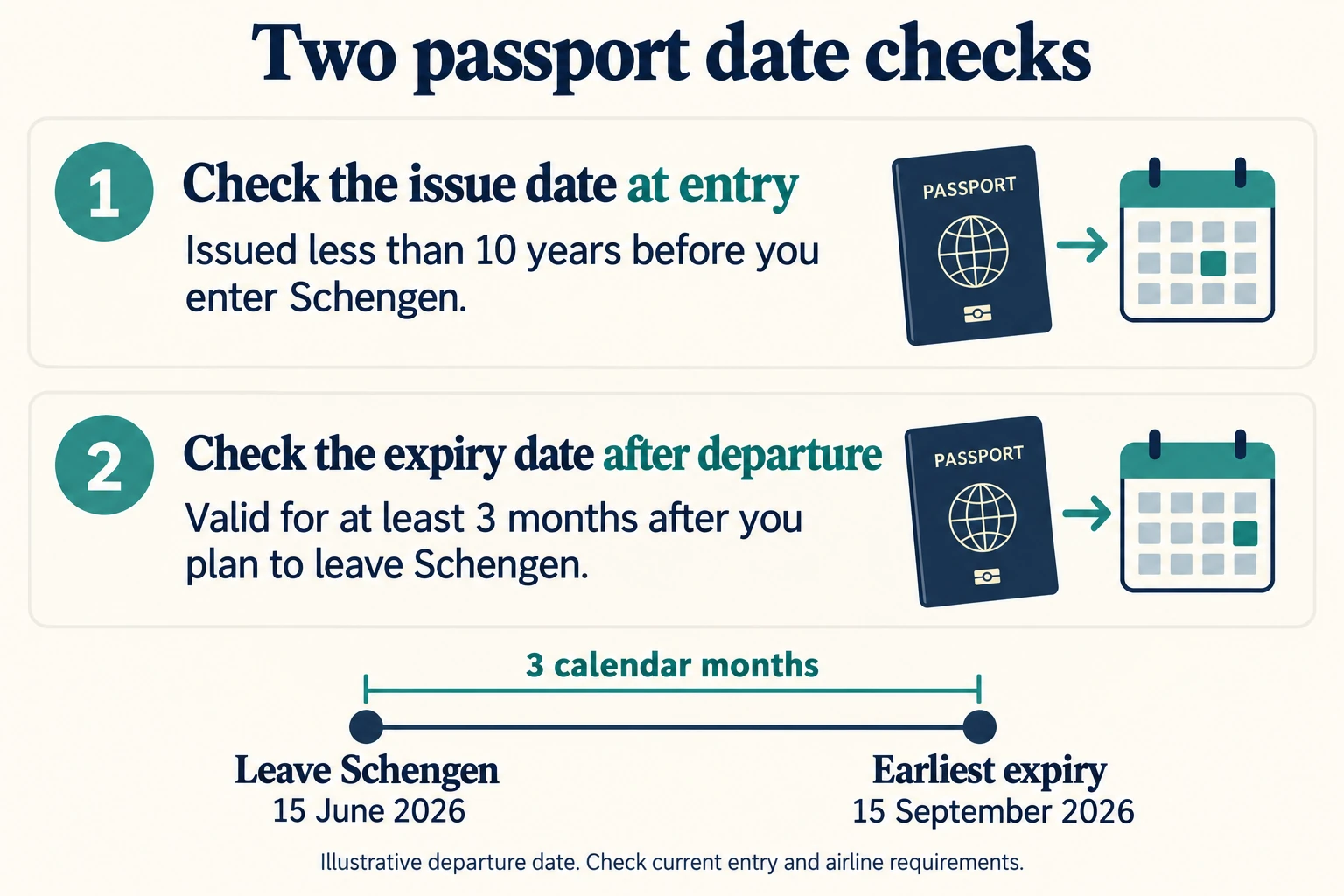
Many airlines ask for more than the legal minimum. Airlines often ask for six months of validity, even though the Schengen rule is three months. Check your airline’s requirement at the time you book, and build in the extra months if the airline asks for them.
Two passport problems can stop you at check-in or at the border. The passport needs at least one blank page for entry stamps, as a US passport guide for Schengen travel explains. The 12-page US emergency passport is not accepted for entry into France, so you need a full-size passport for this trip.
Visa-free stays and the 90-day limit
You do not need a visa for a visit to France for tourism, business, family visits, or short courses. The June 2023 Anafé checklist on Schengen entry conditions lists the United States among the countries exempt from the Schengen visa "whatever the purpose of stay." The exemption applies automatically. You do not apply for it before you travel, but it does not waive the entry checks at the border.
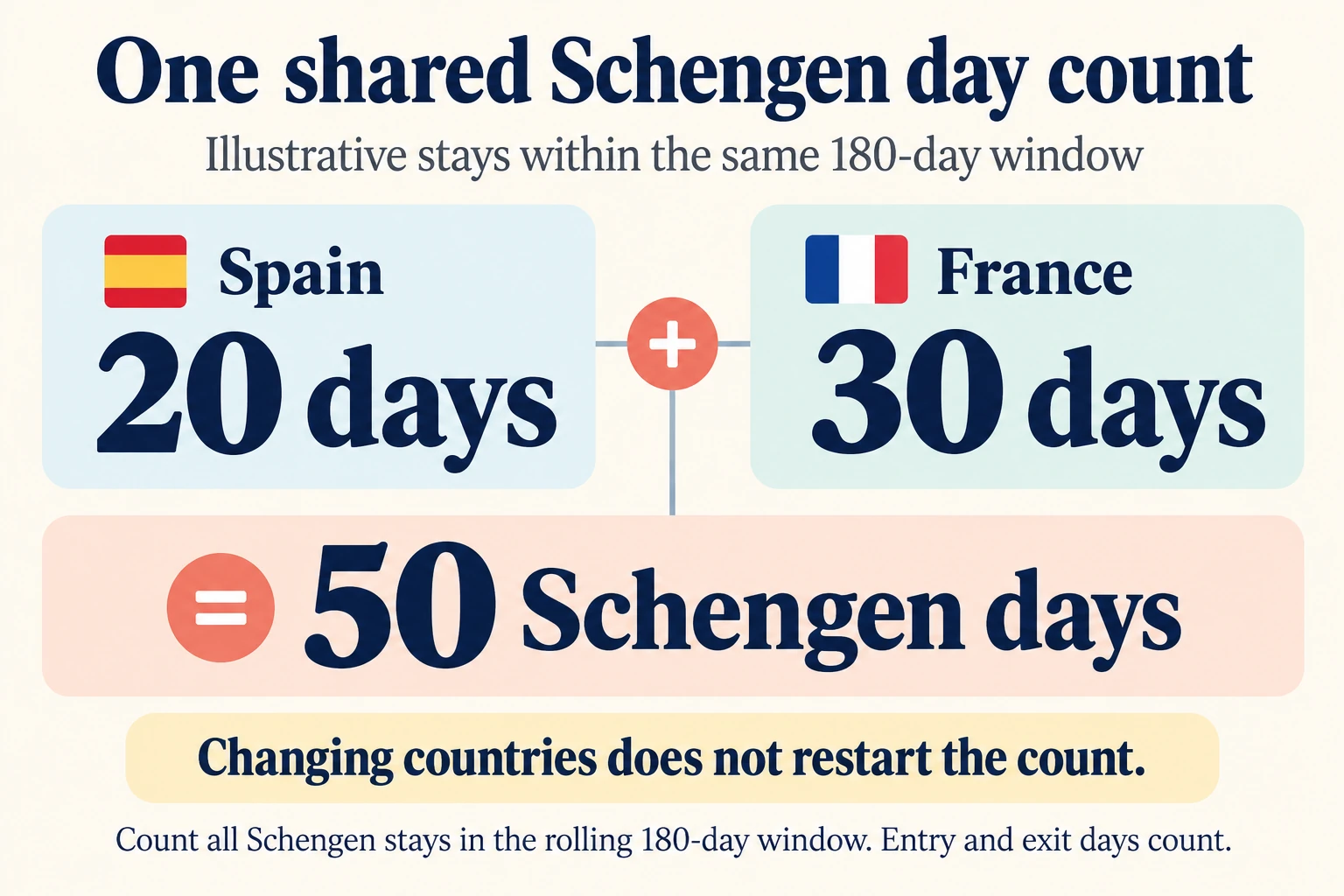
The allowance is 90 days within any 180-day period across all Schengen countries combined. The Schengen Borders Code counts backward from each day of your stay and checks the 180 days before it. A few weeks in Spain followed by a month in France both count against the same 90 days. Days spent in the United Kingdom or Ireland do not count, because neither country is part of the Schengen Area.
Visa-free entry covers temporary visits only. It does not permit work, long-term study, or residence. A stay longer than 90 days requires a long-stay visa, which you must obtain before you leave the United States, whatever the purpose of your trip. Students and other long-term visitors face the same long-stay requirement, as SKEMA Business School’s guide also describes.
EES and ETIAS checks
The Entry/Exit System, or EES, is the biometric system that replaces entry and exit stamps in passports for short-stay travelers from outside the EU. The French government’s public service page on the EES, verified on 12 October 2025, states that the system records personal data and data on entry, exit, and refusal of entry for non-EU nationals staying less than three months in France. Because the system logs each entry and exit, the record shows exactly how many days you have spent in the Schengen Area. As of August 2026, the EES has been fully operational at all Schengen borders, including France, since 10 April 2026. Keep your own count of your days in each country, so the record and your plans match.
ETIAS, short for European Travel Information and Authorisation System, is a separate electronic travel authorization. The official EU travel site states that ETIAS is not in operation and that no applications are being collected. It also says the EU will announce the start date several months before launch. An EEAS page for US travelers, last updated in July 2025, said the launch was planned for the last quarter of 2026. Check the official site before you travel, because the date may still move.
When ETIAS starts, it will work like the US ESTA for visa-exempt travelers. The EEAS page describes it as an entry requirement for visa-exempt nationals and says it is "not a visa." The EU’s stated fee is €20. The authorization is valid for three years or until the travel document expires, whichever comes first. Some travelers are exempt, including travelers under 18 and older travelers around the age of 70. Apply only through the official EU ETIAS portal. Commercial sites that charge extra fees for the application are scams, and the official route carries no extra charge.
What border officers ask
At the border, an officer checks whether you meet the entry conditions in Article 6 of the Schengen Borders Code. Anafé’s June 2023 checklist lists the conditions an officer can verify. Your passport must be authentic. It must also have been issued within the previous 10 years and remain valid for three months beyond departure. You must be able to show the purpose of your trip and the documents that support it, along with proof of where you will stay. You must also show that you have enough money for the trip, a return or onward ticket, and medical coverage of at least €30,000 for the whole stay.
Officers can ask about the purpose of the trip, accommodation, funds, medical insurance, and the return journey. A visa holder must prove every entry condition at the border, even when the same documents supported the visa application. Officers may ask for documents you already submitted, so keep copies of your hotel confirmation, insurance policy, and return ticket in your carry-on bag. The border authority can ask for this proof even when it was supplied for a visa (Touteleurope).
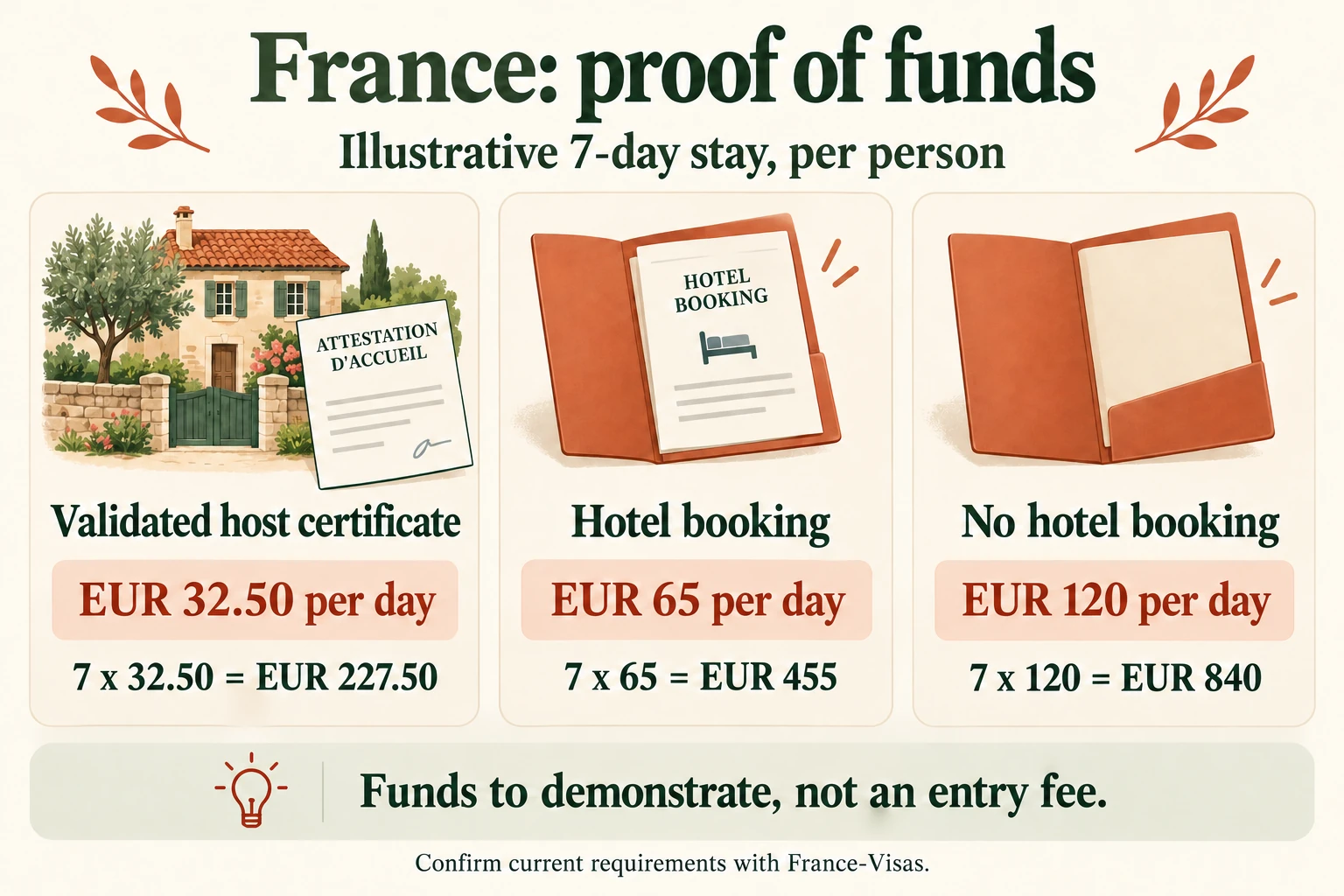
Officers set the amount of money you must show per day. The June 2023 Anafé checklist gives three figures, each per day per person:
- €32.50 with a host’s attestation d’accueil, meaning the certificate of accommodation the host gets from the town hall
- €65 with a hotel booking already confirmed
- €120 with no accommodation arranged in advance
Confirm the current figures on the service-public.fr page, because Anafé’s table dates from June 2023. Multiply the daily figure by the number of days you plan to stay to estimate the total funds an officer may ask you to show.
Officers at Paris Charles de Gaulle and other airports also check your departure plans. A travel guide for the US passport advises carrying proof of departure within the 90-day window, and it notes that budget airlines check this at check-in. Buy your return ticket before you fly if you can.
Officers can also check your biometric data and your documents against databases. Refusing to provide biometric data leads to a refusal-of-entry decision. Officers check the Schengen Information System and Interpol’s database of stolen and lost travel documents, according to the European Parliament’s summary of the 2017 amendment. Each member state decides how far to use self-service systems and automated border gates, so the process at a particular airport can differ from the process at another.
Customs limits for goods and cash
Customs rules apply to goods you bring into France from outside the EU. The French customs authority states on its official page for travelers from outside the EU that goods below the exemption thresholds carry no duties or taxes. Goods above a threshold owe VAT and excise duties. The customs page on calculating duties on purchases abroad explains the calculation, and the official site offers the DéclareDouane tool for estimating duties on goods you bring back.
Cash has a separate rule. Anyone carrying €10,000 or more, or the equivalent in another currency, into or out of France from a non-EU country must declare it to customs. The rule covers banknotes, coins, bearer negotiable instruments, gold, and prepaid cards. The French government’s ministry page on customs describes the same declaration rule.
The value allowance for other goods depends on your age and how you arrive. These amounts come from the EU’s Your Europe page on carrying alcohol, tobacco, and cash:
| Traveler | Mode of arrival | Allowance |
|---|---|---|
| Age 15 and over | Air or sea | €430 |
| Age 15 and over | Land (car, train), or other non-air or sea modes | €300 |
| Under 15 | Any mode | €150 |
You cannot add the thresholds together. If the total value of your goods exceeds the threshold for your mode of arrival, the whole basket becomes taxable, including the amount below the limit. Keep receipts for purchases made abroad so you can prove their value at the border.
Tobacco limits for arrivals from outside the EU are 200 cigarettes, or 100 cigarillos, or 50 cigars, or 250 grams of smoking tobacco. You can bring only one of these categories, because the categories are not cumulative. The 800-cigarette figure applies to goods returned from other EU countries. The French ministry page states that those ceilings do not apply to arrivals from outside the EU.
For alcohol from outside the EU, the limits are 1 liter of spirits above 22 percent alcohol by volume, or 2 liters of intermediate-strength drinks such as port, plus 4 liters of still wine and 16 liters of beer. Travel rules guidance for French customs lists these amounts. Exceeding the alcohol or tobacco limits can lead to confiscation of the goods and fines.
Some goods face their own rules no matter how small the amount. The official customs page names medicines, plant products such as fruit and vegetables, animal products, cultural goods, and duty-free purchases as categories with specific requirements. If you carry prescription medicine, bring it in its original packaging with the prescription, and check the customs page before you fly.
Entry rules for other passports
Most of the rules in this article describe US citizens. Travelers with other passports face different conditions, and the June 2023 Anafé checklist shows where those conditions differ. The checklist cites Regulation (EU) 2018/1806 for the visa lists, which set the visa status of each nationality for entry at the external borders.
Citizens of Albania, North Macedonia, Bosnia and Herzegovina, Georgia, Moldova, Montenegro, Serbia, and Ukraine are exempt from the visa only when they hold a biometric passport. Serbia adds an exclusion for passports issued by the Serbian coordination directorate. Taiwan’s exemption applies only to Taiwan-issued passports that include an identity card number. Holders of Hong Kong and Macao passports are listed as exempt, and so are holders of United Kingdom passports. Certain British categories, such as British National (Overseas) citizens and citizens of the British Overseas Territories, appear on a separate line of the list. A valid Schengen residence permit also counts as a basis for the exemption.
Those differences matter if you hold one of those passports or travel with someone who does. Check the visa status of your own nationality on the official site of the French consulate or embassy in your country before you book, because the lists change.
What to check before you travel
- Keep 90 days in view: Count every day you spend in any Schengen country across a rolling 180-day window, because the EES records each entry and exit.
- Check passport dates first: Confirm your passport is valid for at least three months past your planned departure and was issued within the previous 10 years, and expect airlines to ask for six months.
- Carry proof of your trip: Bring documents for your purpose, accommodation, funds, medical coverage of at least €30,000, and your return ticket, because officers can ask for any of them.
- Declare cash at €10,000 or more: Declare any cash or equivalent value of €10,000 or more when you enter or leave France from a non-EU country.
- Watch the ETIAS date: Expect the €20 travel authorization to become a requirement once it launches, and apply only through the official EU portal.