Best Time to Visit Switzerland
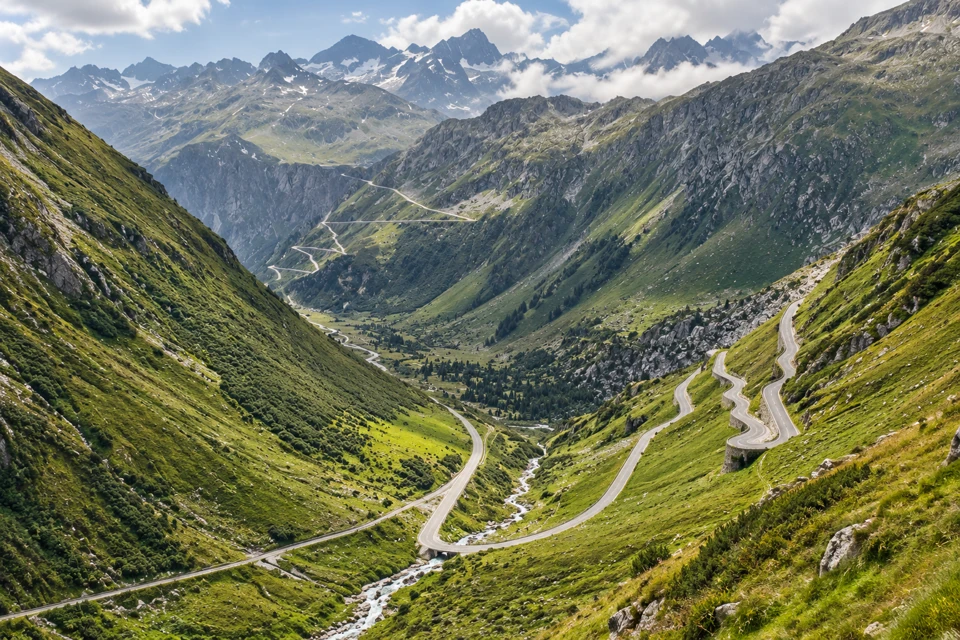
For most visitors, June through September is the best time to visit Switzerland. Lowland weather is warmest and sunniest then, and high alpine passes such as Furka and Susten, which climb to high elevations, are normally open. Snow sports work best from December through March. Spring and late autumn suit city trips and quiet travel, but mountain access is limited and lowland skies are grayer.
The right dates depend on region as much as season. Zürich in January has a mean maximum of 3.8 °C and little sunshine that month, while mountain stations log more sun and far more snow in the same months. Crowds follow the calendar too: the summer season (May to October) recorded 25.2 million hotel overnights in 2025, compared with 18.6 million in the winter season (November to April).
Which Season Suits Which Trip
Summer fits lakes, hiking, and festivals. At Zürich, July is the warmest month (mean daily maximum 25.1 °C) and the sunniest (237 hours), and the Valais valley station at Ulrichen records no snow days in July or August. The festival calendar is also densest from late June through August.
September is the best month for travelers who want sunshine without peak summer. Zürich still gets 159 hours of sun and a mean maximum of 19.8 °C, and the alpine cattle descents (Alpabzug in German, Désalpe in French) take place in mid-to-late September. October brings autumn color and the chestnut festival in Ascona, but sunshine in Zürich drops and the first passes close for winter.
Winter suits snow sports and Christmas-season city visits. Lowland Decembers are dark (little sun in Zürich), so a winter trip works best when it includes elevation, where sunshine totals are higher. Spring, from March to May, sits between the two: lowland temperatures climb from a mean maximum of 10.8 °C in March to 19.4 °C in May, but snow lingers up high and pass roads reopen only from late April to early June.
Weather by Region
Switzerland’s climate changes with altitude and with the Alpine divide, so five weather stations give a useful regional picture. All figures are 1991–2020 normals, the current reference period used by MeteoSwiss, the national weather service.
Northern lowlands: Zürich
The Zürich/Affoltern normals represent the northern cities, including Zürich, Lucerne, and Basel, and the lakes around them.
| Month | Mean max (°C) | Mean min (°C) | Precipitation (mm) | Sunshine (hours) |
|---|---|---|---|---|
| Jan | 3.8 | ?1.9 | 63 | 51 |
| Feb | 5.7 | ?2.2 | 55 | 81 |
| Mar | 10.8 | 0.8 | 65 | 139 |
| Apr | 15.3 | 3.9 | 73 | 178 |
| May | 19.4 | 8.3 | 115 | 195 |
| Jun | 23.1 | 11.9 | 112 | 216 |
| Jul | 25.1 | 13.6 | 116 | 237 |
| Aug | 24.7 | 13.4 | 109 | 219 |
| Sep | 19.8 | 9.7 | 79 | 159 |
| Oct | 14.3 | 6.1 | 80 | 95 |
| Nov | 8.0 | 1.8 | 74 | 51 |
| Dec | 4.3 | ?1.0 | 80 | 40 |
Rain falls in every month of the year. Zürich receives 1,022 mm a year across about 125 wet days, and the wettest months are the warm ones: May (115 mm), June (112 mm), and July (116 mm), mostly because summer rain arrives in heavier falls. February is the driest month at 55 mm. Pack rain gear for any month, and expect the heaviest falls on summer afternoons.
Western foothills: La Dôle
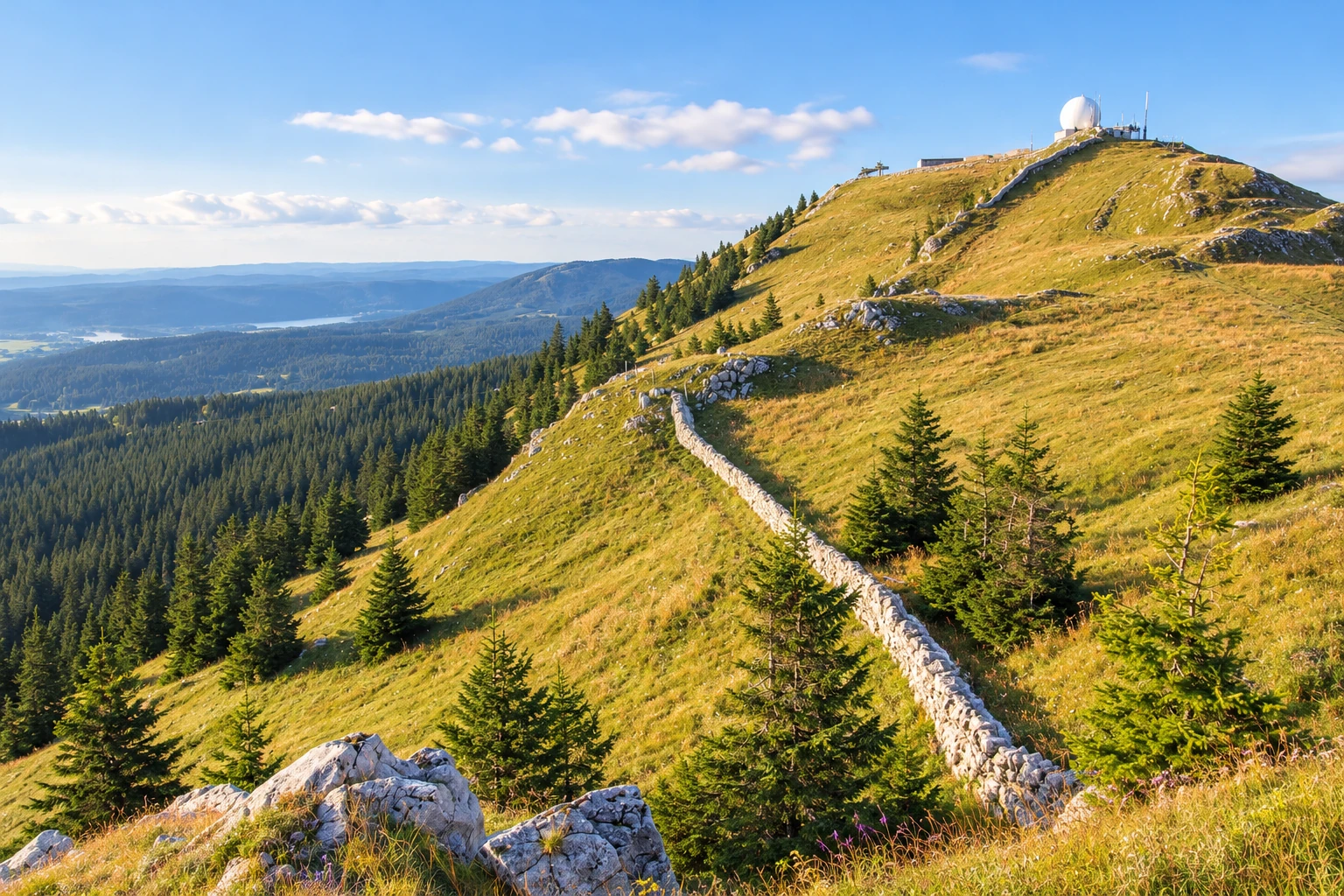
La Dôle stands at 1,670 m in the Vaud Jura above Geneva and shows what the heights near Lake Geneva are like. The mean daily maximum is 0.2 °C in January and 16.2 °C in July and August. Sunshine peaks at 210.6 hours in July. Precipitation totals 1,845 mm a year, spread fairly evenly, and winter storms are common. Annual mean wind speed is 8.0 m/s, so pack for wind on exposed ridgelines in every season.
Valais high valleys: Ulrichen
Ulrichen, a village in the upper Rhône valley, shows the snow calendar for high Alpine valleys. Days with at least 1 cm of snow run from November to April: 8.9 in November, 10.8 in December, 9.5 in January, 10.1 in February, 8.3 in March, and 4.4 in April. May has few snow days, June 0.1, July and August none, and September 0.1. October has 1.4, which is the first sign of winter. Sunshine peaks at 215.6 hours in July and falls to 54.1 hours in December, with 70.9 hours in January. The station averages 54.5 snow days a year.
For hikers, this means July and August are the safest months for snow-free trails in the high valleys, with June and September close behind.
Ticino and the southern Alps
The south has a different rhythm from the north. At Cimetta, a high-altitude station in the southern Alps, January is the driest month (48.6 mm). Sunshine peaks at 258.1 hours in July, for an annual total of 2,255.8 hours. Autumn is the wet season: precipitation runs about 189 to 196 mm a month from August through November. Humidity averages 68% over the year.
Ticino therefore suits late spring, early summer, and sunny winter days better than October and November. A NOAA bulletin for December 2024 recorded Lugano 1.1 °C above its 1991–2020 norm, and the Southern Alps region 1.3 °C above, so December ran mild there.
Eastern hills: Hörnli
Hörnli, a high-altitude station in the Zürich Oberland, reflects the hills of eastern Switzerland. Monthly sunshine is 82.8 hours in January, 131.1 in March, 188.1 in June, 210.4 in July, 153.2 in September, and 79.2 in December. The annual total is 1,651.1 hours, 41% of the possible maximum. Its winter sunshine is well above Zürich’s, and its July total is close to the city’s.
What the comparison means
In winter, altitude brings more sunshine: Hörnli in January (82.8 hours), La Dôle in December, and Cimetta in January all beat the lowland figures for those months. A winter trip that spends daytime hours on a mountain gets more light than one spent in the cities. In summer the gap closes, so the lowlands offer the warmest temperatures and the heights offer cooler hiking.
Crowds and Hotel Demand
The Swiss Federal Statistical Office (BFS) counts hotel overnight stays, which measure nights slept in hotels, not individual visitors, and exclude holiday apartments and campgrounds. Its 2025 release reports 43.9 million hotel overnights, up 2.6%, with 22.8 million from foreign guests and 21.1 million from domestic guests. The summer season reached a record 25.2 million overnights and winter 2024/25 a record 18.6 million. Summer carries the larger load, so July and August are the months to book accommodation early.
July is the peak month for domestic guests: 2.2 million overnights in July 2025, about 70,000 more than July 2024. Foreign demand is strong in summer as well. Summer 2024 recorded 13.0 million foreign overnights (up 3.9%), including 3.0 million from American guests (up 13.1%).
Year-over-year changes show where demand is softest, though they describe change, not total volume. In 2024, every month rose except April (down 3.2%) and September (down 1.1%), with domestic guests falling 5.3% in April and 6.0% in September. In 2025, every month rose except February (down 2.9%) and November (down 0.7%). December 2025 posted the strongest gain at 6.8%, and foreign overnights in December 2024 rose 10.7%, so the holiday period is busier than it used to be.
The latest monthly update shows June 2026 at 4.1 million overnights, down 2.2%, with foreign guests down 4.4% and domestic guests up 0.4%. January to June 2026 totaled 20.3 million, down 0.7%. For a traveler, the practical reading is that April, November, and early autumn have the least pressure on beds, while July, August, and the weeks around Christmas have the most.
When Mountain Passes Open and Close
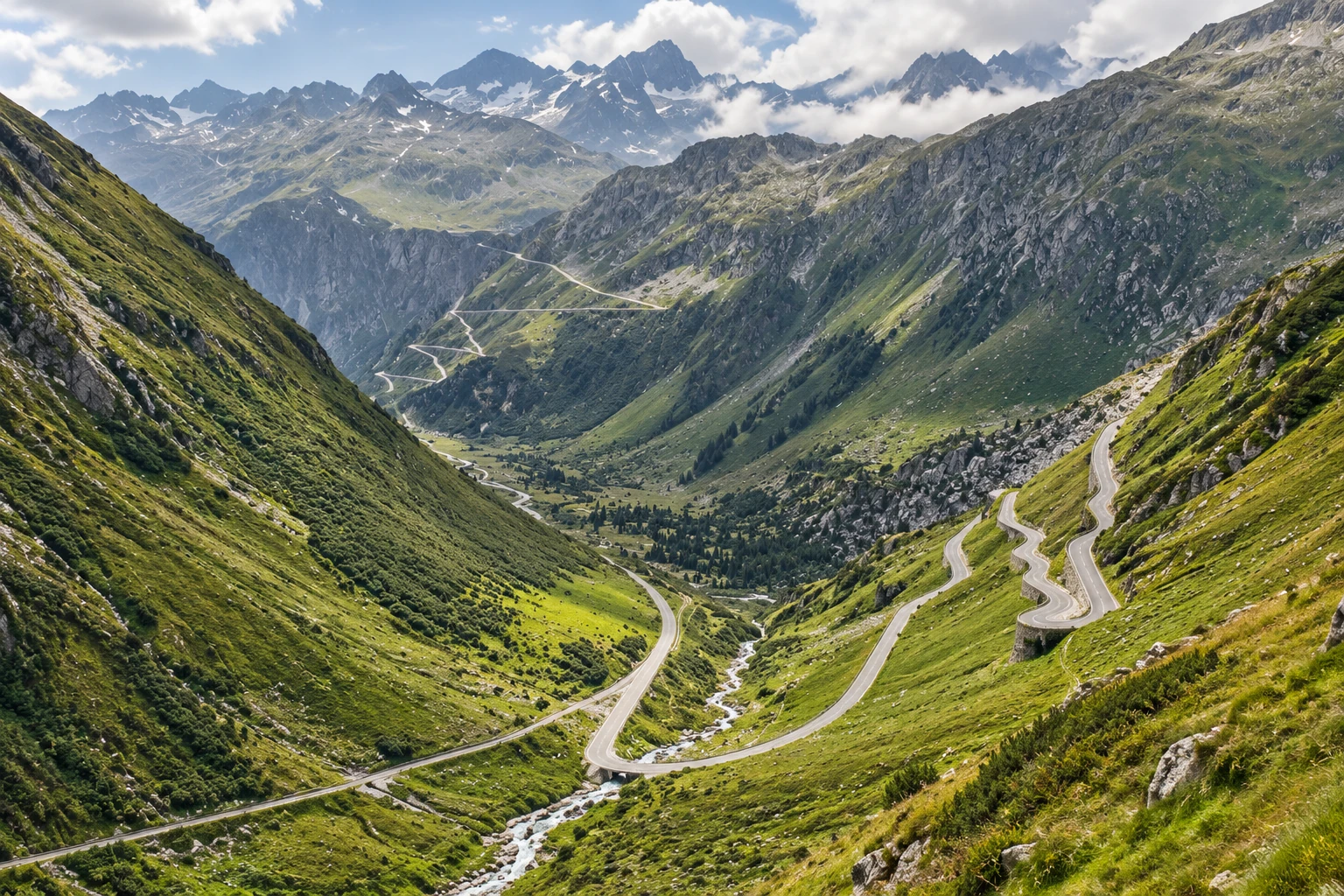
Alpine pass roads decide how much of the mountain network a car or motorcycle traveler can use. According to a seasonal pass guide, the usual closure windows are:
| Pass | Usual closure |
|---|---|
| Great St Bernard | October to June |
| Furka, Grimsel, Susten, Nufenen | November to June |
| Gotthard pass road, Klausen | November to May |
In 2025, Oberalp reopened on 25 April, the Gotthard pass road on 16 May, Glaubenberg on 23 May, Furka on 28 May at 10:00, and Susten in early June. Great St Bernard (2,469 m) was still under winter closure on 3 June 2025. In 2026, the Gotthard road reopened before Ascension and Whitsun, and Furka, Grimsel, and Nufenen reopened on 29 May, while Susten was still closed at that point. The passes sit high, which explains the delay. Gotthard is at 2,108 m, Grimsel at 2,164 m, Susten at 2,234 m, Furka at 2,429 m, and Nufenen at 2,478 m.
Autumn closures arrive just as quickly. On 27 October 2025, the Uri cantonal government confirmed Susten and Furka closed for winter, and Oberalp and Klausen were shut because of snowfall. The Gotthard road between Hospental and Airolo was also closed by weather. A single early storm can close a pass with a day’s notice.
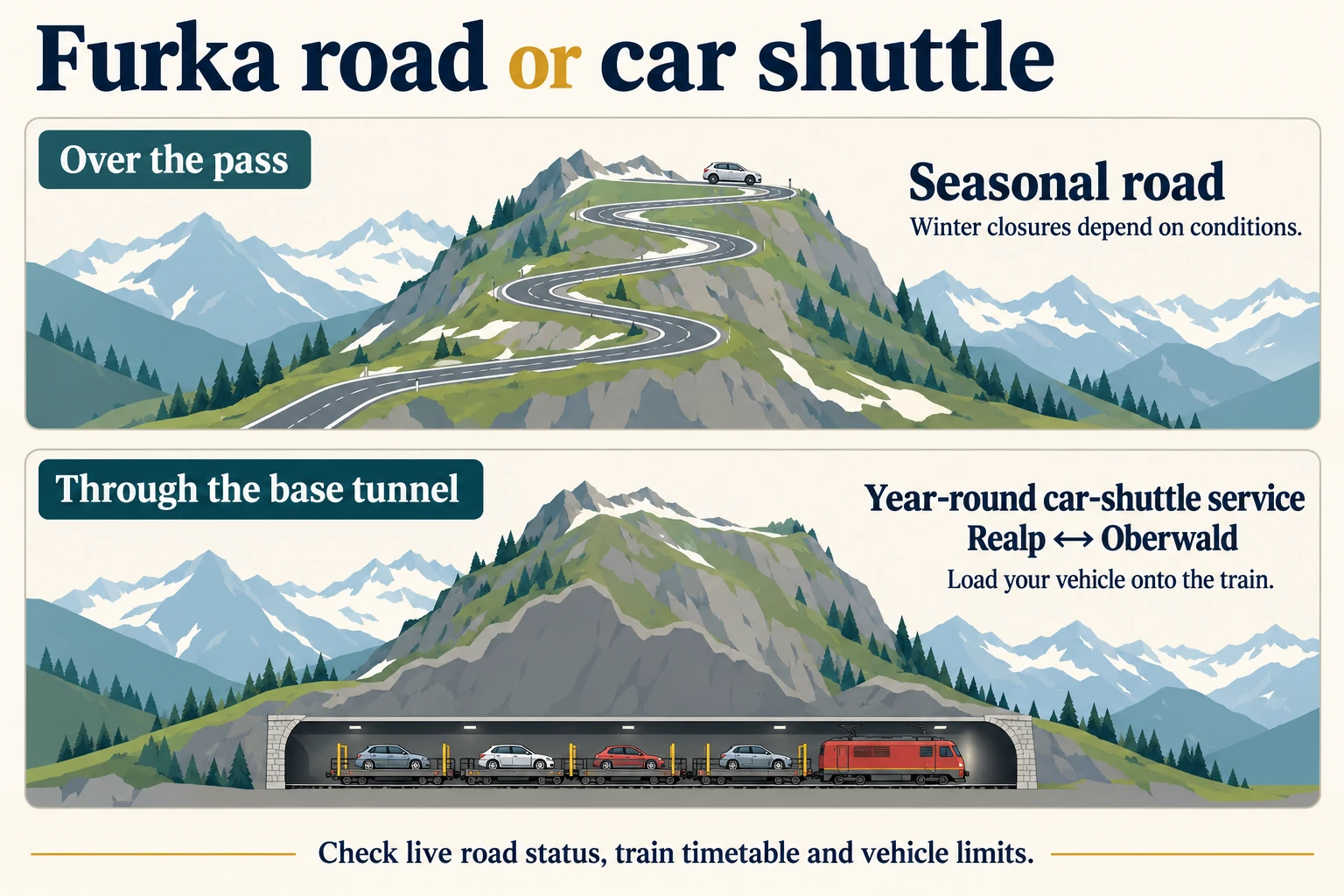
The Gotthard route stays open when its pass road closes. The Gotthard road tunnel runs beneath the closed pass, and the car-carrying train through the Furka base tunnel, between Realp and Oberwald, operates year round. Drivers should also know the standing limits. Trailers are banned on Furka, and no lorries with trailers or articulated vehicles are allowed on the Gotthard road. The old Tremola road has a 3.5 t limit, and Susten has a 32 t limit between Wassen and Innertkirchen. The same guide lists each of these limits.
Cycling events close passes for a day at a time in summer. In 2025, Julier and San Bernardino closed on 19 June for the Tour de Suisse. Albula, Julier, Maloja, Splügen, and Via Mala on 22 June were closed for the Alpen Challenge Lenzerheide. Gotthard (Tremola), Furka, and Nufenen closed on 20 July for Granfondo Gottardo. On 6 September, Susten, Grimsel, Nufenen, Lukmanier, Oberalp, and Gotthard closed for Alpenbrevet. Check the current year’s event dates before planning a pass day. Road status for the current week is posted by the cantonal authorities.
Month by Month
Festival dates below are 2025 listings. The MySwitzerland events search shows the current year’s dates.
January
Zürich has a mean maximum of 3.8 °C and a mean minimum of ?1.9 °C, with little sunshine. Ulrichen averages 9.5 snow days. High passes are closed, so this is a month for ski resorts, cities, and museums. It also sits inside the record winter 2024/25 season, so popular resorts fill up.
February
February is the driest month in Zürich (55 mm) and gets more sun than January. Ulrichen averages 10.1 snow days, the most of any month except December. Skiing and winter sports are at their most reliable. Hotel overnights fell 2.9% in February 2025, which makes it one of the quieter winter months.
March
Zürich warms to a mean maximum of 10.8 °C with 65 mm of precipitation. Ulrichen still has 8.3 snow days, so the mountains remain wintry while the lowlands start to feel like spring. March 2025 overnights rose only 0.6%, the smallest gain among the spring months.
April
Zürich reaches a mean maximum of 15.3 °C. Snow days at Ulrichen fall to 4.4. April had the largest monthly decline in 2024 (down 3.2%), which marks it as a quieter month for lowland trips. The Oberalp Pass reopened on 25 April 2025, but most high passes stay closed, and the ones that open still have snow.
May
Mean maximum in Zürich is 19.4 °C, but May is among the wettest months at 115 mm. Snow is nearly gone at Ulrichen. The Gotthard road reopened on 16 May in 2025, Furka on 28 May, and Furka, Grimsel, and Nufenen on 29 May in 2026. Domestic overnights rose 3.8% in May 2024, since Ascension and Whitsun holidays draw Swiss travelers. Low-elevation hiking is good, but high-pass drives are still uncertain.
June
Mean maximum in Zürich is 23.1 °C with 112 mm of rain. Ulrichen records 0.1 snow days. Susten reopened in early June in 2025, and Great St Bernard was still closed on 3 June that year. The Greenfield Festival and Sierre Blues Festival ran in June 2025, and AquaLumina in Arosa ran from 27 June to 18 October 2025. Watch for cycling-event pass closures on 19 and 22 June in 2025.
July
July is the warmest (mean maximum 25.1 °C) and sunniest (237 hours) month in Zürich, with 116 mm of precipitation. Festivals this month include Thunerseespiele in Thun (9 July to 23 August 2025, staging The Hunchback of Notre Dame) and the 26th Rencontres Musicales de Champéry (31 July to 14 August 2025). Swiss National Day falls on 1 August, with events dated 31 July and 1 August. July is also the peak month for domestic guests, so book rooms early and expect crowds at lakes and lifts.
August
Zürich holds a mean maximum of 24.7 °C. Cultural festivals peak: the Locarno Film Festival ran 6 to 16 August 2025, the Lucerne Festival in Summer from 12 August to 14 September 2025, and the Murten Classics Summer Festival from 11 to 31 August 2025. Foreign demand is at its yearly high, including record American arrivals in summer 2024. Reserve lake-town hotels well ahead.
September
September is the best balance of weather and crowds. Zürich has a mean maximum of 19.8 °C, 159 hours of sun, and only 79 mm of rain, the driest month since February. Ulrichen records 0.1 snow days. Hotel overnights fell 1.1% in September 2024, with domestic guests down 6.0%.
The MySwitzerland page on traditional events describes the Désalpe in Charmey as held every year in late September, when farmers bring decorated cattle down from the high pastures. The alpine festivals listing shows events from 12 September in Gryon to 26 September in Lignières, Charmey, and Plaffeien-Schwarzsee. In between are Innertkirchen (13 September 2025, with a market, music, and children’s activities), Sigriswil and Sumiswald in the Emmental (18 September), and Ayer, Grächen, Urnäsch, and Flims (19 September). One caution for drivers: Susten, Grimsel, Nufenen, Lukmanier, Oberalp, and Gotthard closed on 6 September 2025 for Alpenbrevet.
October
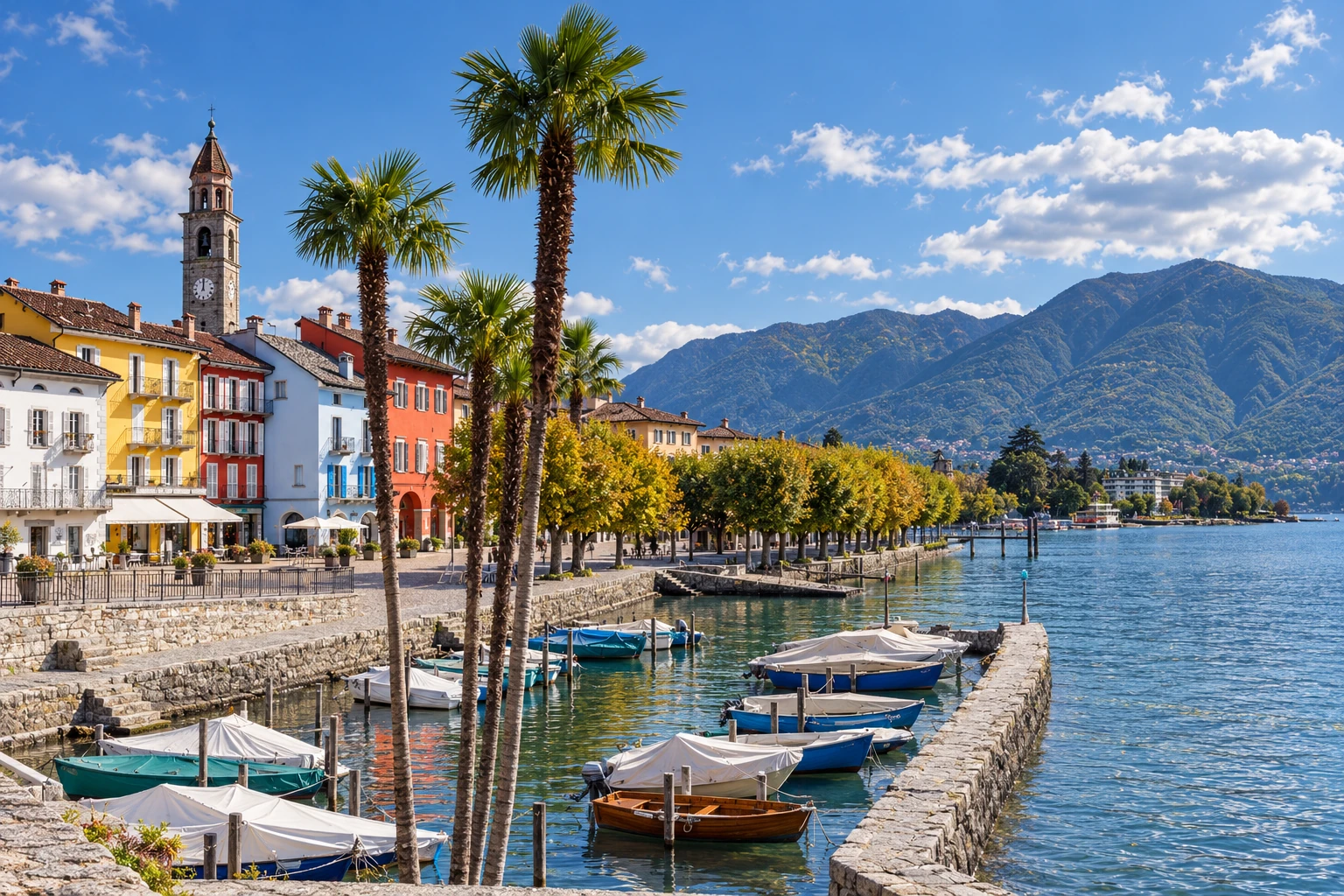
Zürich drops to a mean maximum of 14.3 °C with 80 mm of precipitation. Ulrichen sees 1.4 snow days. In Ticino, rain is heavy, at about 189 mm a month at Cimetta. Autumn color and food draw visitors, with the Chestnut Festival in Ascona held in mid-October and AquaLumina in Arosa running until 18 October 2025. Pass roads begin to close, with Susten and Furka shut on 27 October 2025, so plan October drives around the lowlands and valleys.
November
Zürich has a mean maximum of 8.0 °C with little sun, and Ulrichen has 8.9 snow days. The usual closing window for Furka, Grimsel, Susten, and Nufenen begins now, and the Gotthard road and Klausen close from November as well. November overnights fell 0.7% in 2025, so this is the quietest period for city visits and museums. Ski areas are not yet in full swing.
December
Zürich is at its darkest (little sun, mean maximum 4.3 °C) with 80 mm of precipitation. Ulrichen has 10.8 snow days, the most of any month. Passes are closed. Demand is strong: December 2025 overnights rose 6.8%, the largest monthly gain of the year. Christmas-season city travel and early-winter skiing both draw crowds, so reserve in advance.
Swiss Travel Pass Prices
Hotel prices vary with demand, but the Swiss Travel Pass (a rail, bus, and boat ticket valid across the country) is priced by validity and class, with no seasonal surcharge. SBB’s prices are for adults 25 and over, in CHF, and valid until 31 December 2026.
| Validity | 2nd class | 1st class | Flex 2nd class | Flex 1st class |
|---|---|---|---|---|
| 3 days | 254 | 405 | 289 | 461 |
| 4 days | 309 | 492 | 349 | 555 |
| 6 days | 399 | 634 | 424 | 674 |
| 8 days | 439 | 697 | 459 | 729 |
| 15 days | 499 | 787 | 519 | 819 |
The standard pass covers consecutive days and needs no activation. The Flex version lets you choose any 3, 4, 6, 8, or 15 days within one month and must be activated before first use. Travelers under 25 get a 30% discount: CHF 179 for three days in 2nd class and CHF 356 for 15 days. Children under 16 traveling alone pay the youth price at 50%. The pass is not available to residents of Switzerland or Liechtenstein.
The pass includes free entry to over 500 museums and covers trips to Rigi, Stoos, and Stanserhorn, as the Switzerland Travel Centre explains. It also gives discounts on other mountain railways. MySwitzerland lists the panoramic trains: seat reservations and supplements may still apply on the Glacier Express, Bernina Express, Gotthard Panorama Express, and Palm Express.
A summer visit that stacks lake boats, mountain railways, and museums uses the pass fully. In winter, with fewer mountain excursions running, a Flex pass or point-to-point tickets can fit a trip built around two or three cities. A week of train-based travel usually points to the 6-day or 8-day pass, while a longer trip across several regions suits the 15-day pass at CHF 499 in 2nd class.
Key Takeaways
- Choose June to September for hiking and lakes. Zürich peaks in July (25.1 °C mean maximum, 237 sunshine hours), Ulrichen has no snow days in July or August, and the festival calendar is fullest, though July and August carry the highest hotel demand.
- Pick September for the best balance. It has 159 sunshine hours in Zürich, lower rainfall (79 mm), the cattle descents from 12 to 26 September, and hotel overnights fell 1.1% in September 2024.
- Check pass roads before driving in spring or late autumn. Furka, Grimsel, Susten, and Nufenen typically reopen in late May to early June and close from late October or November, and event days add one-day closures in summer.
- Go up in winter. Lowland Decembers are dark in Zürich, while high stations such as La Dôle and Cimetta get more sun; Ulrichen has frequent snow days from November to March.
- Use the Swiss Travel Pass by trip length, not season. Prices are fixed by validity and class (CHF 254 for three days in 2nd class to CHF 499 for 15), so a busy, multi-excursion summer trip gets the most from it.