Getting Around Germany

Travelers in Germany can take long-distance trains run by Deutsche Bahn (DB), long-distance coaches, rental cars, or taxis, or buy the Deutschlandticket, a monthly pass for regional and local transit. Trains are the fastest way between big cities, and fares depend on how far ahead you buy. Coaches usually cost the least and take the longest. The Deutschlandticket covers regional trains, local buses, trams and subways, but not ICE, IC or EC trains, DB’s fast long-distance services. A rental car offers the most freedom. German law restricts ride-hailing, which limits which app services operate.
Choose the option that fits your trip, then confirm the final price on bahn.de or the DB Navigator app before you buy. Fares and conditions change often.
Which option fits which trip
The table pairs common trip types with the option that suits them and the cost and time figures that go with it.
| Trip type | Best option | Typical cost and time |
|---|---|---|
| City to city, speed matters | ICE, IC or EC train | Berlin–Hamburg takes about 1:40 by ICE. Advance Sparpreis fares start at roughly €18 to €22. |
| City to city, lowest price | Long-distance coach | Berlin–Hamburg takes about 4 to 5 hours. Early fares run from about €5 to €10. |
| Regional and local travel over a month | Deutschlandticket | €63 per month from 1 January 2026. |
| Luggage, rural areas, route freedom | Rental car | Roughly €35 to €80 per day in 2025, depending on car type and season. |
| Short hops inside a city | Taxi | Fares are set by the local authority. |
DB’s own comparison describes coach as usually the cheapest and rail as usually the fastest, particularly on ICE routes. Car travel time depends on traffic, and car costs depend on fuel prices, tolls and parking. Rail also gives more freedom of movement than a coach.
Long-distance trains
Booking window and where to book
The quickest route is bahn.de or the DB Navigator app. Enter the departure, destination, date, passengers and any discount cards, then pick a fare. The price calendar (Bestpreissuche) compares prices across several days, which helps when your dates are flexible. The booking tool shows the cheapest fare for each train first, and clicking it reveals the Super Sparpreis, Sparpreis and Flexpreis options. Resellers also sell German tickets. Rail Europe sells tickets for DB trains, and DB operates them.
Most German long-distance trains open for booking up to 12 months ahead for Super Sparpreis and Sparpreis, and up to six months ahead for Normalpreis. The cheapest fares are released on that day and sell out in price order. Each train has a fixed number of Super Sparpreis seats, and once they are gone the next, higher price tier applies.
Fare types and what they allow
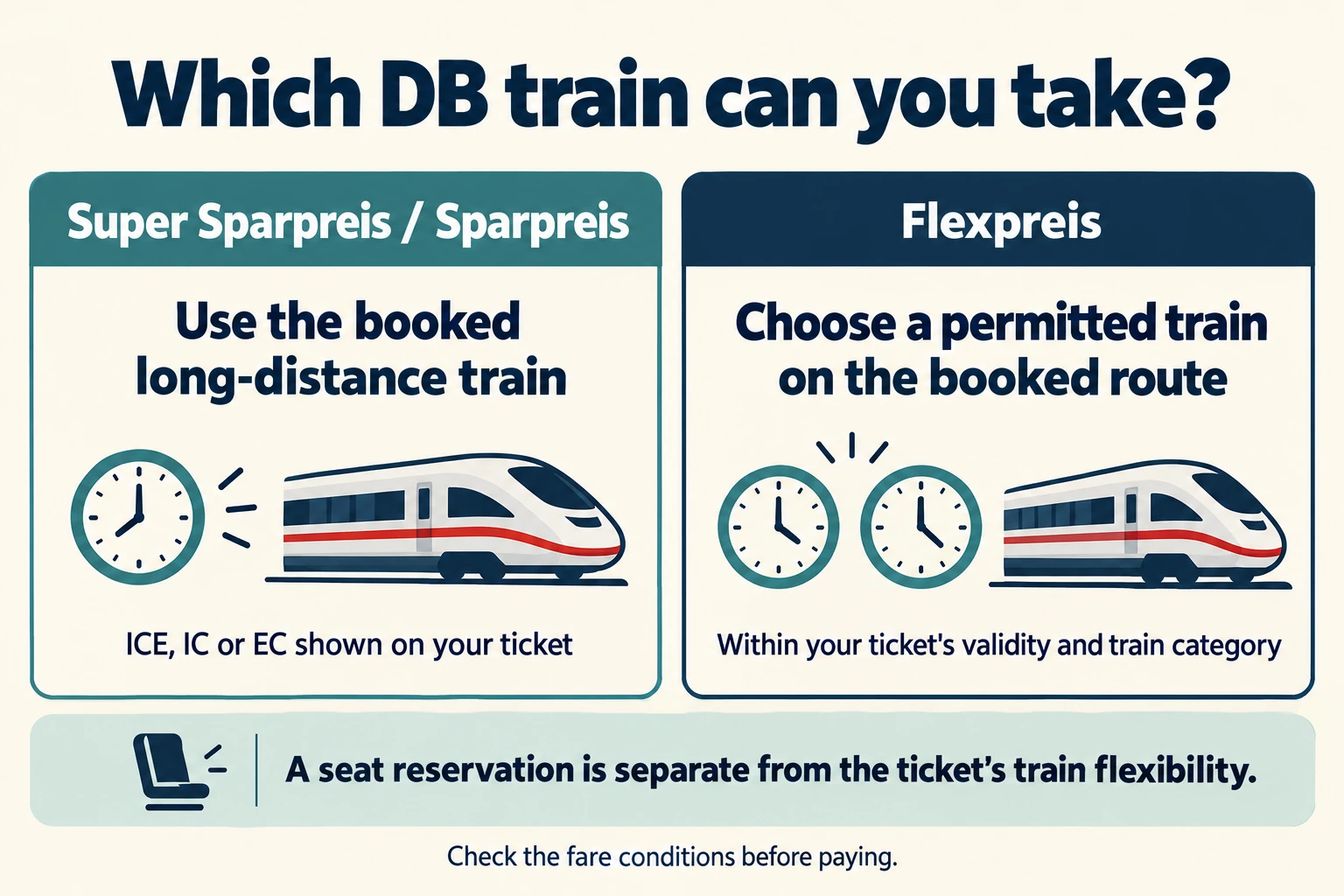
The Super Sparpreis is DB’s cheapest domestic fare, with second-class entry prices from €17.90. It is tied to one specific train and cannot be exchanged or refunded.
The Sparpreis is available on most domestic trains, including ICE, and is also tied to the booked train. Entry prices start at about €21.90. A Sparpreis from €21.99 carries a €10 cancellation fee, and a refund is issued as a cancellation voucher (Stornogutschein) redeemable on DB’s website and valid for three years.
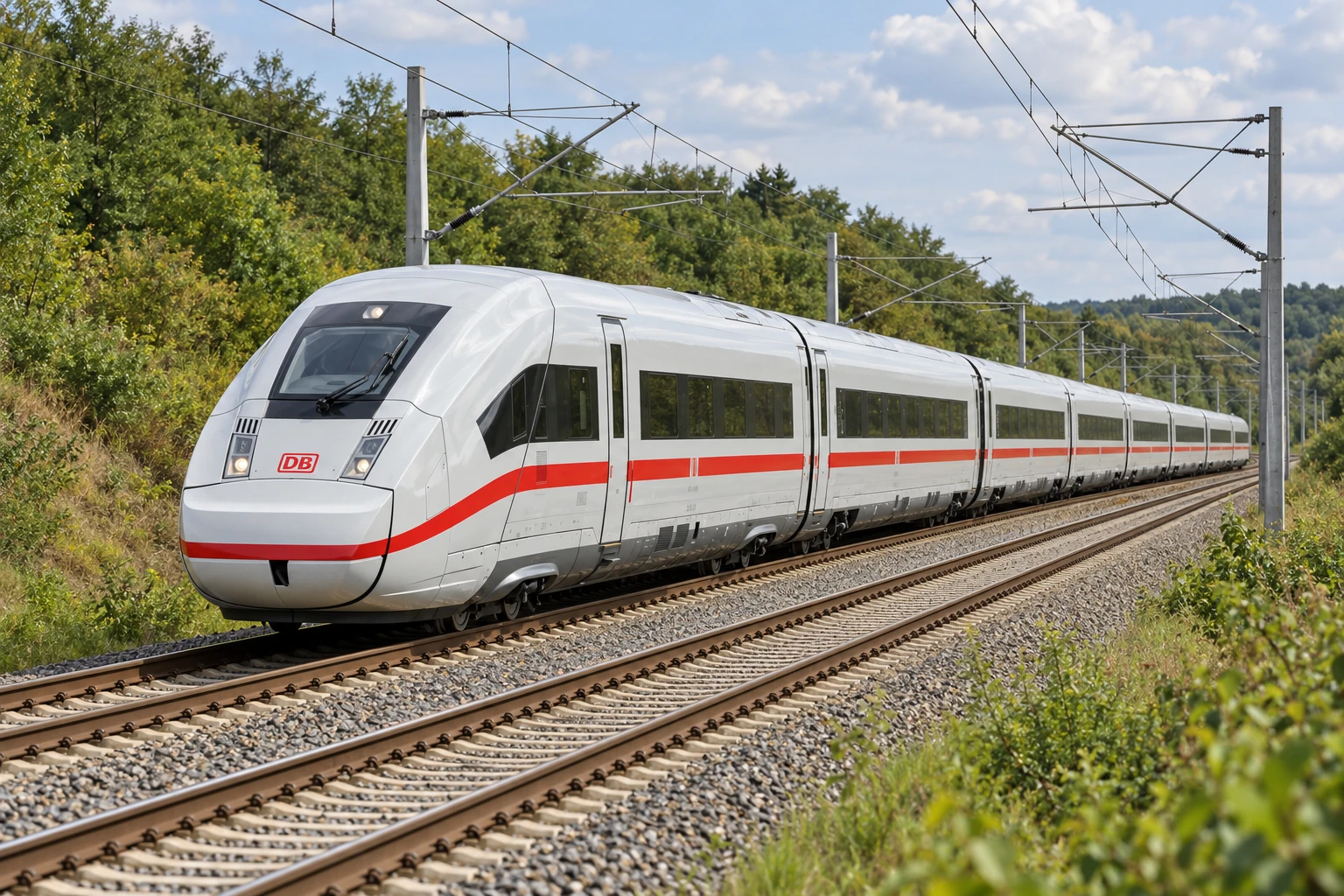
The Flexpreis is the full-price fare. It allows any train on the booked route on the travel day and can be cancelled free of charge up to one day before validity. Approximate Flexpreis fares show the cost of buying late: Frankfurt–Berlin €130–180, Munich–Hamburg €150–200 and Cologne–Munich €120–160. A spontaneous Flexpreis on Berlin–Hamburg ran €60–90.
How price rises with lead time
A second-class, mid-distance ICE trip shows how steeply fares climb as departure approaches:
- Six months out, on release day: €17.90–29 (Super Sparpreis)
- Three to five months: €29–49 (Super Sparpreis or Sparpreis)
- One to three months: €49–79 (Sparpreis)
- Two to four weeks: €79–130 (Sparpreis or Flexpreis)
- Under one week: €130–250 or more (Flexpreis)
Plan fixed-date legs, such as a Berlin–Munich leg timed to a festival or hotel booking, as early as possible. If your itinerary may change, pay the higher Flexpreis fare so you are not left holding a nonrefundable ticket when plans shift.
Seat reservations and cross-border trips
A second-class seat reservation on DB long-distance trains costs €5.50. A first-class Flexpreis includes one. Reservations are optional on most domestic ICE trains, but trains are busy on Fridays, Sundays and holiday peaks, so reserving is strongly recommended then.
For trips abroad, the Sparpreis Europa is valid on ICE, IC, EC and regional trains between Germany and 16 countries. Most can be booked up to six months ahead, and 12 months for Belgium, Luxembourg, the Netherlands and Switzerland. Second-class fares start at €14.99 (Dresden–Prague, 2026), and first class from €69.
The Deutschlandticket for regional travel
Price and coverage
The Deutschlandticket is a monthly pass for regional rail and local public transport across Germany. It cost €49 per month from May 2023 to December 2024, per the Verbraucherzentrale, and €58 during 2025. The tariff terms set the price at €63 per month from 1 January 2026, and DB Regio MV lists the same figure. From 1 January 2027 the ticket is listed at €66.80 per month. Berlin’s transit operator BVG says existing subscriptions carry over unchanged and the new amount applies automatically. The regular right to cancel is unaffected.
The ticket gives unlimited second-class travel on regional rail within the tariff area and on other local public transport in participating areas. That includes street trams, trolleybuses and local buses. The tariff terms exclude long-distance trains in principle, and BVG states the ticket cannot be used on IC, EC or ICE trains. The ticket is also not valid on vehicles run mainly for tourist or historical purposes. On-demand services such as shared taxis and call-buses, and some special railway operations, may carry a surcharge under local rules. Bikes and dogs need a regular ticket wherever those carry a fare, and DB Regio MV says dogs are not covered by the ticket nationwide. Children up to and including age 5 travel free, and anyone aged 6 or over needs a ticket.


The ticket pays off when you stay in one region for a few weeks and ride regional trains and city transit daily. For a trip made mostly of long ICE hops between cities, it adds nothing on those legs.
Buying and canceling
The Deutschlandticket is a subscription that runs until canceled and can be canceled monthly. The cancellation must reach the operator by the 10th of the month and takes effect at the end of that calendar month. Subscriptions start on the 1st, and the ticket stays valid until the end of service on the last day of the month, and no later than 03:00 the next day. According to the Verbraucherzentrale, ordering after the 10th means paying for the current month and the following month. Visitors on a short trip should therefore order before the 10th of the month before they arrive and cancel as soon as they have bought it.

The ticket is personal and not transferable. It is issued as a chip card or mobile ticket and must show at least first and last name. Carry an official photo ID, although children under 16 may show a school ID.
Long-distance coaches
Journey times and fares
The long-distance coach market opened in 2013, and many providers have since merged or left, so a few firms run large networks. FlixBus is the largest in Germany and Europe. Other operators include IC Bus (DB’s coach offer), BlaBlaCar Bus, Marflix and DeinBus. Comparing providers pays, because a smaller operator is sometimes cheaper.
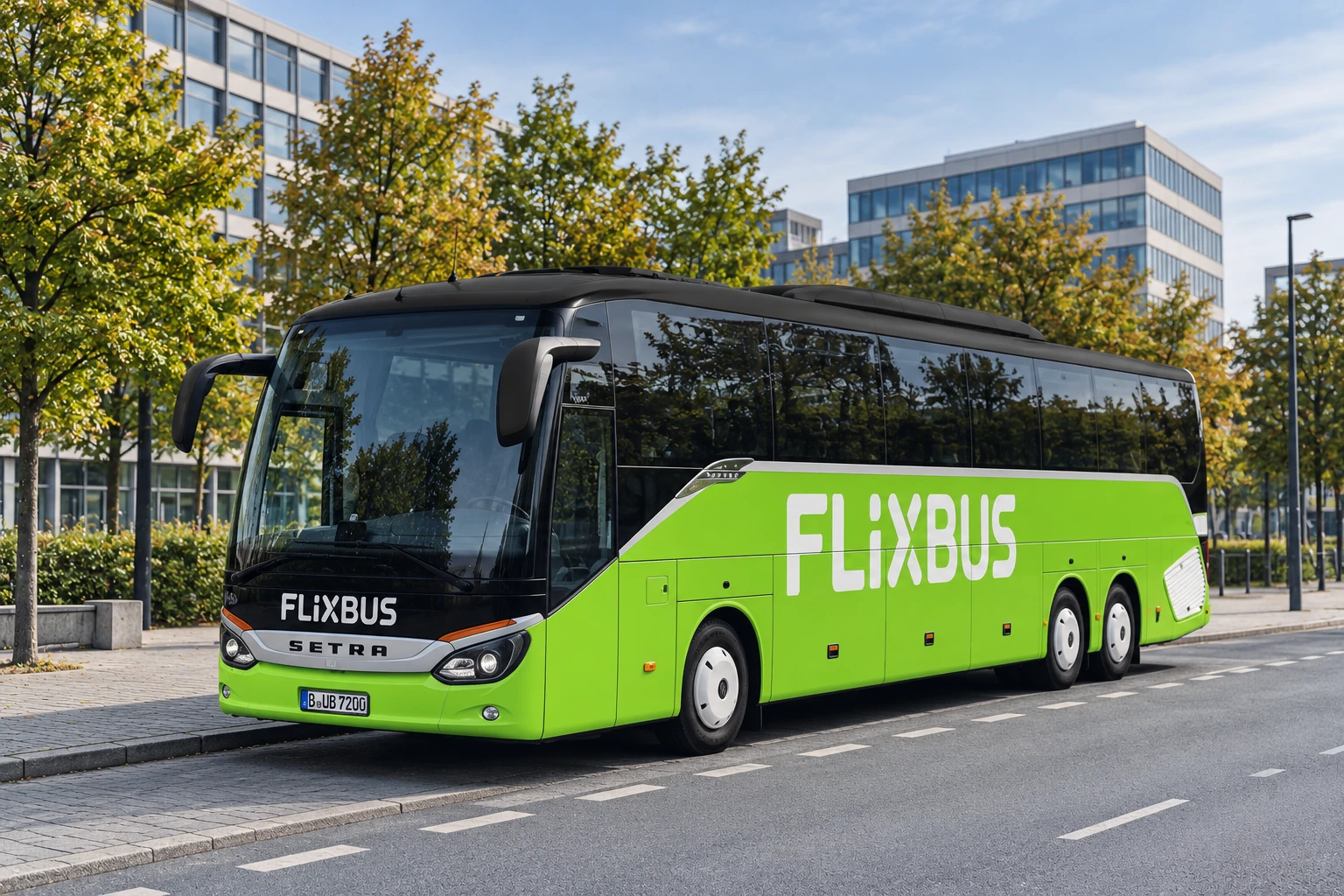
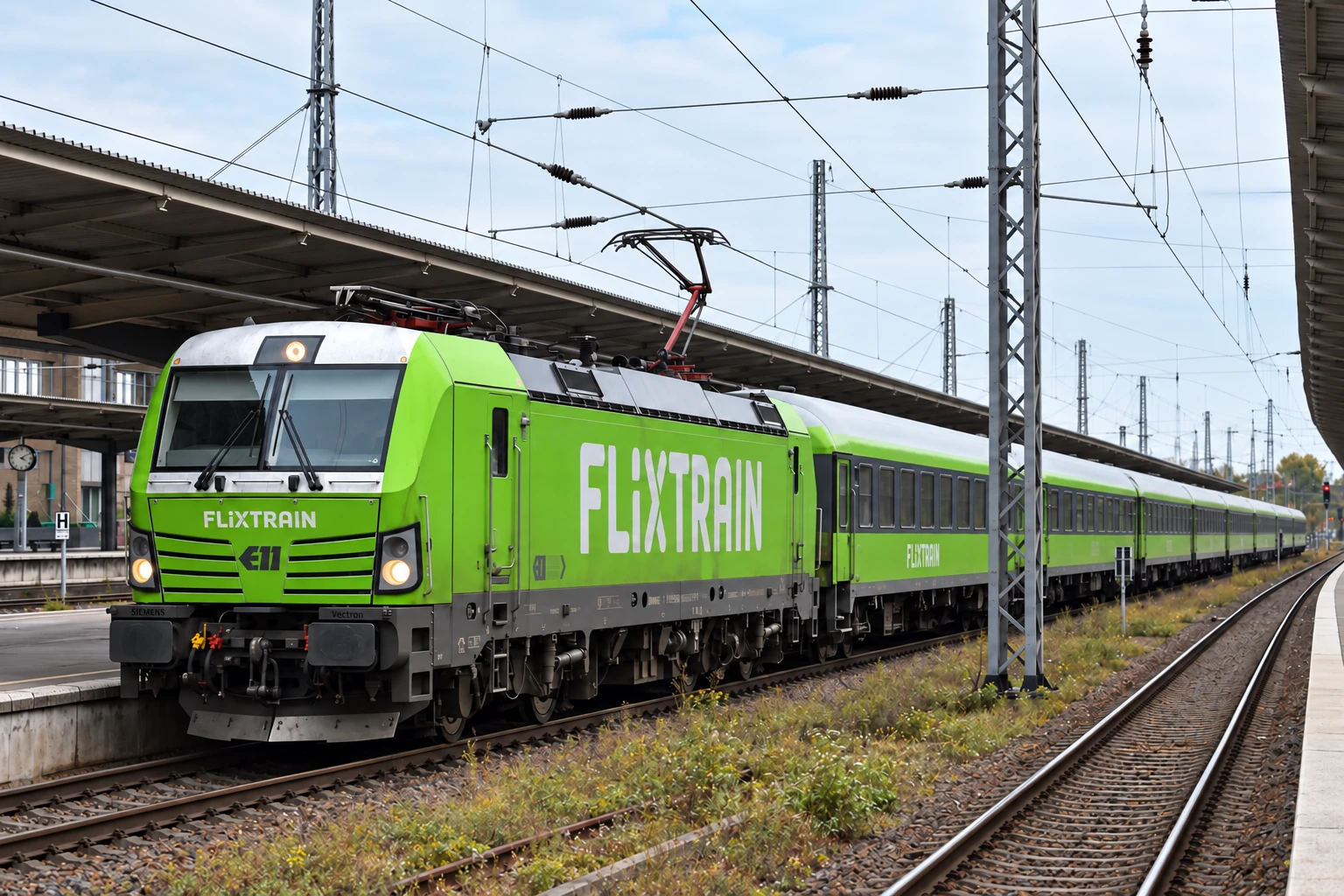
Coaches are far slower than trains. Berlin–Hamburg, about 290 km, takes roughly 4 to 5 hours by coach and about 1:40 by rail, and rail is two to three times faster on this route. Berlin–Munich, about 900 km, takes 11 to 13 hours by coach depending on stops. FlixTrain, a separate train product, runs much faster than FlixBus, almost as fast as an IC, at a fraction of the price.
Coach prices follow demand and booking date. Typical FlixBus prices run as follows:
- Booked two to three weeks ahead: fares start at about €10.
- Booked one week ahead: €18–25.
- Booked on the day of travel: €35–50.
Early-bird Hamburg–Berlin fares run €5–8, and travel one day earlier or later changes the price by €5–15. Promotional fares of €3.99–4.99 appear only in special promotions, and normal prices are mostly €10–25. Coach fares run 30–75 percent below a spot-booked DB ticket on most routes. A DB Super Sparpreis booked four to eight weeks ahead often comes close to FlixBus pricing, so check the rail fare before assuming the coach is cheaper. Seat selection on FlixBus carries a fee that depends on route, seat category and booking, and two trips between the same cities can cost different amounts.
Booking and onboard comforts
Compare options by travel time, changes, price and comfort, including night and direct services. Book through a comparison portal, the operator’s app, or DB’s inquiry form. Tickets arrive digitally in an app or by email, so printing is usually unnecessary. DB lists free WLAN on some segments, power sockets or USB at many seats, toilets on board and large luggage racks.
Coaches also carry an environmental advantage. Verbraucherzentrale Bayern figures, cited by Utopia, put a coach at about 31 g CO? per passenger-kilometer and a car at about 138 g. Leipzig has a long-distance bus terminal described as Germany’s most modern.
Renting a car
Age and license rules
A car suits itineraries with luggage, rural stops or no fixed route. Minimum age is 18 at Sixt Germany, with a young-driver fee for drivers under 23, and some car categories require a higher minimum age. QEEQ gives the young-driver fee band as 18 to 23. Most companies set 21 as the minimum age, and a surcharge typically applies to drivers under 25. Fees for drivers under 23 add up fast. Companies may also require a license held for one or two years. Check the exact age policy of your rental company before booking.
EU-issued licenses are accepted, and a foreign license can be used on a short visit for up to six months. Non-EU licenses other than Swiss are accepted if the holder has a visa in the passport and has not been in Europe more than six months. Beyond that, an EU-country license is needed. Confirm these rules with the rental company before you book. If the license uses a non-Roman alphabet such as Arabic, Japanese or Cyrillic, carry an International Driving Permit (IDP) or an official English translation. The IDP never replaces the regular license, and you must carry both while driving. Some companies require a photo-ID license. UK drivers with the photo card need both the paper counterpart and the card. For non-EU license holders, an IDP is recommended, and it is valid for one year.
Costs, deposits and one-way trips
Daily rates run roughly €35 to €80 in 2025 depending on car type and season. A credit card in the primary driver’s name is usually needed for the deposit, and the deposit can be a few hundred euros. Fuel, tolls and parking add to the daily rate.
One-way rentals between Sixt stations in Germany are generally possible for a fee, which is useful on a Munich-to-Berlin route where you do not want to drive back. Additional drivers must be named in the contract and show original licenses at pick-up. A fee applies per additional driver unless you book the multiple-driver flat rate, which covers any number of extra drivers for one fee. Sixt lists 28 airport locations and says it has more than 450 locations in Germany.
Drive on the right. Speed limits are posted in kilometers per hour, and some Autobahn sections have no maximum speed limit.
Taxis and ride-hailing
Taxis in Germany must charge the fares set by the local authority and cannot set their own. They must take passengers and must operate, and they are bound by a tariff duty. They may also wait at designated stands. Rental cars with a driver have no tariff obligation, so prices can in principle be freely agreed, but they may take only pre-booked trips. Both types need a license (Konzession) and proof of professional competence, according to Verkehrsleiter.

On 3 June 2026 the Bundesgerichtshof (Federal Court of Justice) ruled in case I ZR 123/25 and confirmed the return obligation (Rückkehrpflicht) for rental cars with a driver. After finishing a passenger order, the vehicle must generally return without delay to its registered base, unless a new order already exists. The rule comes from the federal passenger transport law (PBefG), so it applies across Germany. The case came from Cologne, where a taxi cooperative brought it against a rental-car company that brokers trips through Uber X. The court found no constitutional or EU-law grounds to question the rule. The return duty stops rental cars from waiting on the streets for passengers, which would put them in direct competition with taxis.
For travelers, the practical result is that app-based rides in a rental car with a driver are pre-booked trips by design. Uber says UberX brokers trips to licensed local rental-car companies and that Uber Taxi connects users to classic taxis. Uber and Bolt are subject to the return duty as well. Uber criticizes the rule as economically and ecologically harmful and says it dates from the 1980s. Rental-car operators must also follow local municipal rules. For a predictable fare, use a taxi from a stand. For a pre-booked car at a price agreed in advance, a rental-car-with-driver service fits.
Key Takeaways
- Book rail early for the lowest fares: DB opens long-distance booking 180 days ahead, and Super Sparpreis fares start at €17.90 in second class. Fares climb to €130–250 or more in the final week.
- Choose coaches when price outranks time: Berlin–Hamburg takes about 4 to 5 hours by coach against about 1:40 by ICE, but a Super Sparpreis booked four to eight weeks out often matches coach pricing.
- Use the Deutschlandticket only for regional travel: It costs €63 per month from 1 January 2026 and excludes ICE, IC and EC trains. Cancel by the 10th of the month to stop the following month’s charge.
- Check age, license and deposit before renting a car: Young-driver fees apply under 23 or 25 depending on the company. Licenses in a non-Roman alphabet need an IDP or translation, and the deposit goes on a credit card in the driver’s name.
- Expect taxis at set fares and rental-car-with-driver rides by pre-booking: Since the 3 June 2026 Federal Court of Justice ruling, rental cars with a driver, including Uber X trips, must generally return to base after each trip.