Germany Entry Requirements for US Travelers
US citizens can enter Germany without a visa for up to 90 days in any 180-day period. That 90-day limit covers all Schengen Area countries combined, not Germany alone. The Schengen Area is the group of European countries that have removed routine passport checks at their shared borders. Your passport must be valid for at least three months after your planned departure from the Schengen Area and must have been issued within the previous 10 years.
Two border systems also affect your trip. Since 12 October 2025, the EU Entry/Exit System (EES) has registered non-EU travelers at German borders as digital records instead of passport stamps. The EU Travel Information and Authorisation System (ETIAS) will be an electronic pre-travel authorization for visa-exempt visitors, but it is not yet operating.
Passport Rules
The entry rule is three months of validity beyond your intended departure date from the Schengen Area. For a June 1 departure, the passport must be valid until at least September 1. Count from your last day in the Schengen Area, not from the day you enter Germany.
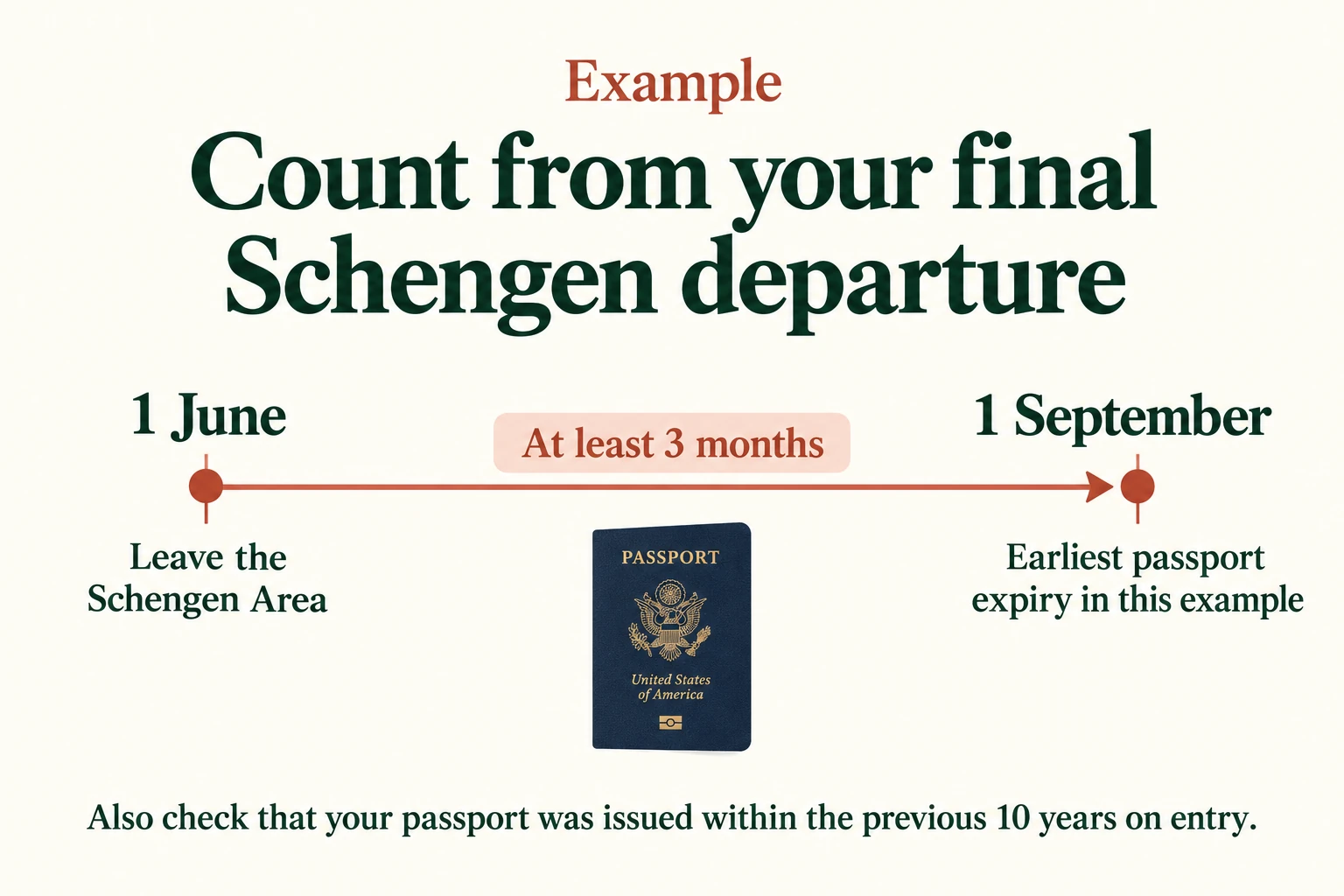
Many travel guides recommend six months of remaining validity instead, and the extra margin works as a practical buffer. Because airlines check passports at check-in, a six-month margin protects you from being turned away at the departure gate even when Germany’s border rule is met. If your passport expires within six months, renew it before you book.
Your passport also needs at least two blank pages for entry and exit stamps, according to Remitly. Passports must be signed. The Germany visa requirements guide for US citizens lists the signature requirement.
The 90-in-180-Day Rule
US citizens may enter Germany for tourism, business meetings, or short visits without a visa, for up to 90 days in any 180-day period. The EU regulation that sets the visa-exempt list applies the same 90-in-180 rule to US nationals. The allowance covers every Schengen country together, so a week in Germany followed by two weeks in France and a few days in Italy counts as 90 days of Schengen time, not 90 days per country.
To check your remaining days on any date, count the Schengen days you spent in the 180 days before that date. A total of 90 or fewer leaves you within the limit, as the rolling-count explanation describes. Border officers do not check this total at every entry, but the EES record described below makes the dates available to them. Overstaying without authorization can lead to fines and future travel restrictions.
Visa-free entry covers short visits only. Work or study requires a national visa for Germany, a separate permit from the visa-free allowance. The overview of US visa rules explains that distinction. If your trip includes a job or a semester, apply for the national visa at a German embassy or consulate before you leave the United States.
ETIAS Status and Fees
ETIAS is a pre-travel authorization for visa-exempt visitors, including US citizens. It is not a visa, residence permit, or work permit. Each traveler needs an authorization of their own, including children, as this ETIAS guide for US citizens explains.
The timeline has moved. In August 2025, the EU said ETIAS would "start operations in the last quarter of 2026" and that "no action is required from travelers at this point." In mid-July 2026, the fourth-quarter 2026 target was reportedly removed from the official page. As of 11 September 2026, Trailandra reported that ETIAS was not operating, and no applications were accepted. A Visagrade guide updated 19 September 2026 estimates 2027 as the likely launch year.
For planning purposes, that means you do not apply for ETIAS for a trip this year. Check the European Commission’s official travel information site before you travel, because the start date will change once the EU announces it.
When ETIAS launches, the fee will be €20 per application. The EU raised the fee from €7 by a Commission decision dated 17 July 2025, so the €7 fee no longer applies. One payment covers the full validity period rather than each trip. You pay the fee by debit or credit card when you apply (ETIAS fee details). Travelers under 18 and over 70 pay no fee but still need an approved authorization.
The authorization lasts up to three years or until the passport linked to it expires, whichever comes first. It does not add days to the 90-in-180 allowance. Your passport also needs at least three months of validity left, counted from your last day in Europe. Visagrade and Schengen Traveler report that approval usually arrives within minutes.
EES Registration at the Border
The EES records non-EU travelers at Europe’s external borders, including German airports, seaports, and land crossings. It has applied in Germany since 12 October 2025. According to the German Interior Ministry’s press release, the rollout window ran through 9 April 2026, when full operation was due at all external borders.
The system covers non-EU nationals on short stays of up to 90 days in any 180-day period. EU citizens, citizens of Iceland, Norway, Switzerland, and Liechtenstein, and holders of German residence permits are exempt. Berlin Brandenburg Airport’s EES page lists these exemptions and describes the process.
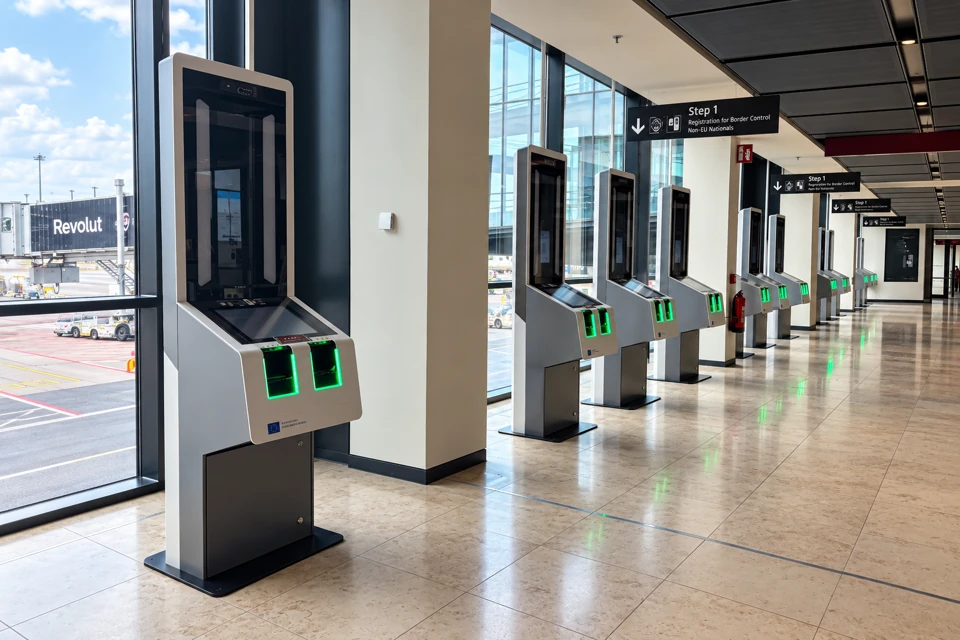
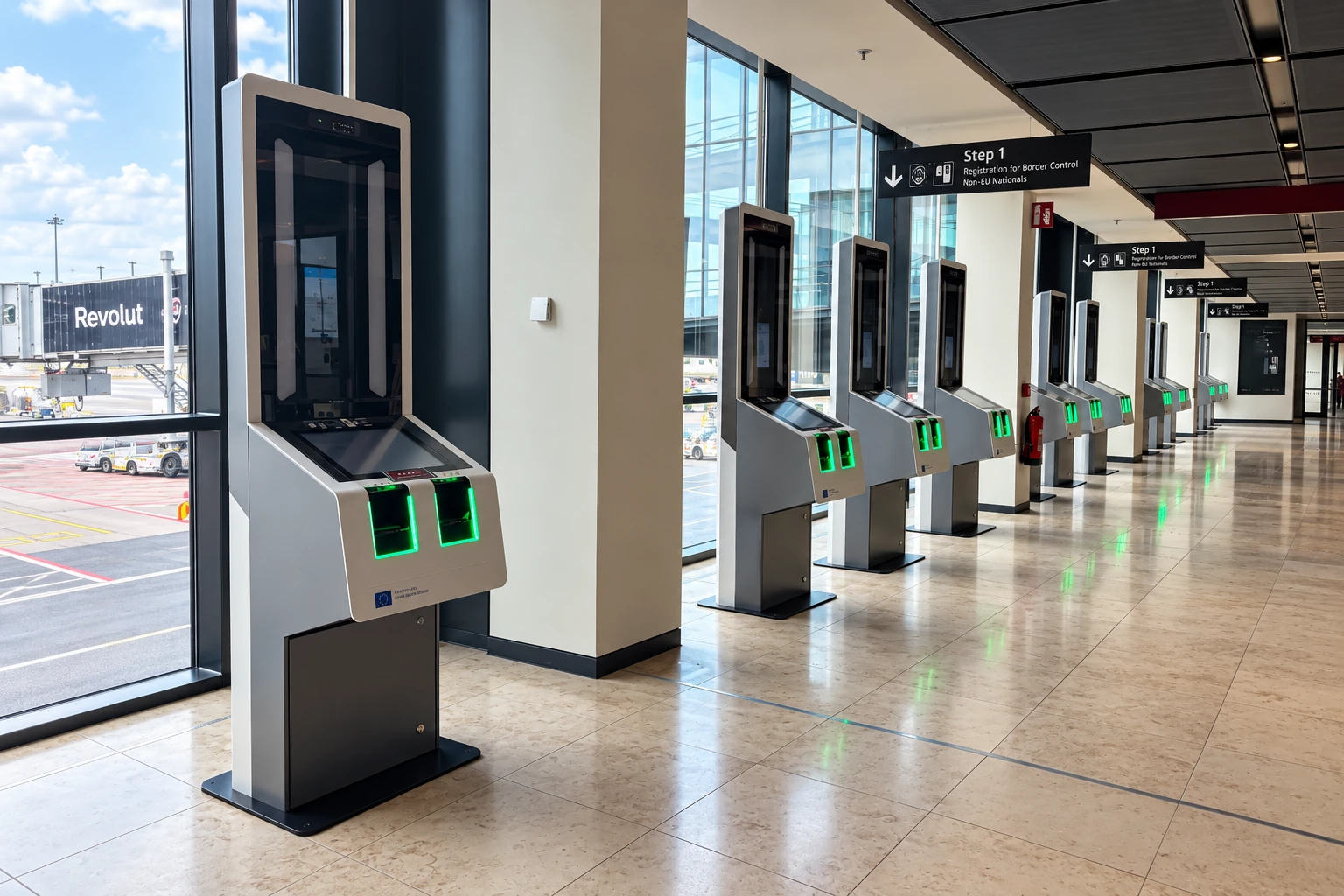
On your first entry, a border officer or a self-service kiosk records your personal data. It also takes a facial image and your fingerprints. Entries and exits are then logged digitally, so your passport no longer receives entry and exit stamps. On later trips, the system matches your passport to the existing record. You do not need to register in advance, as the EES guide explains.
At the kiosks, you scan your passport, have your face photographed, and scan the fingerprints of your right hand, excluding the thumb. Berlin Brandenburg Airport says registration began at border desks in December 2025 and that self-service kiosks were available from January 2026. Plan for longer waits at peak times, because the airport warns that lines may be longer at entry and exit. Schengen Traveler estimates summer 2026 waits of two to five hours at peak times at major airports. Treat that figure as a rough estimate, not a guarantee.
Questions Border Officers Ask
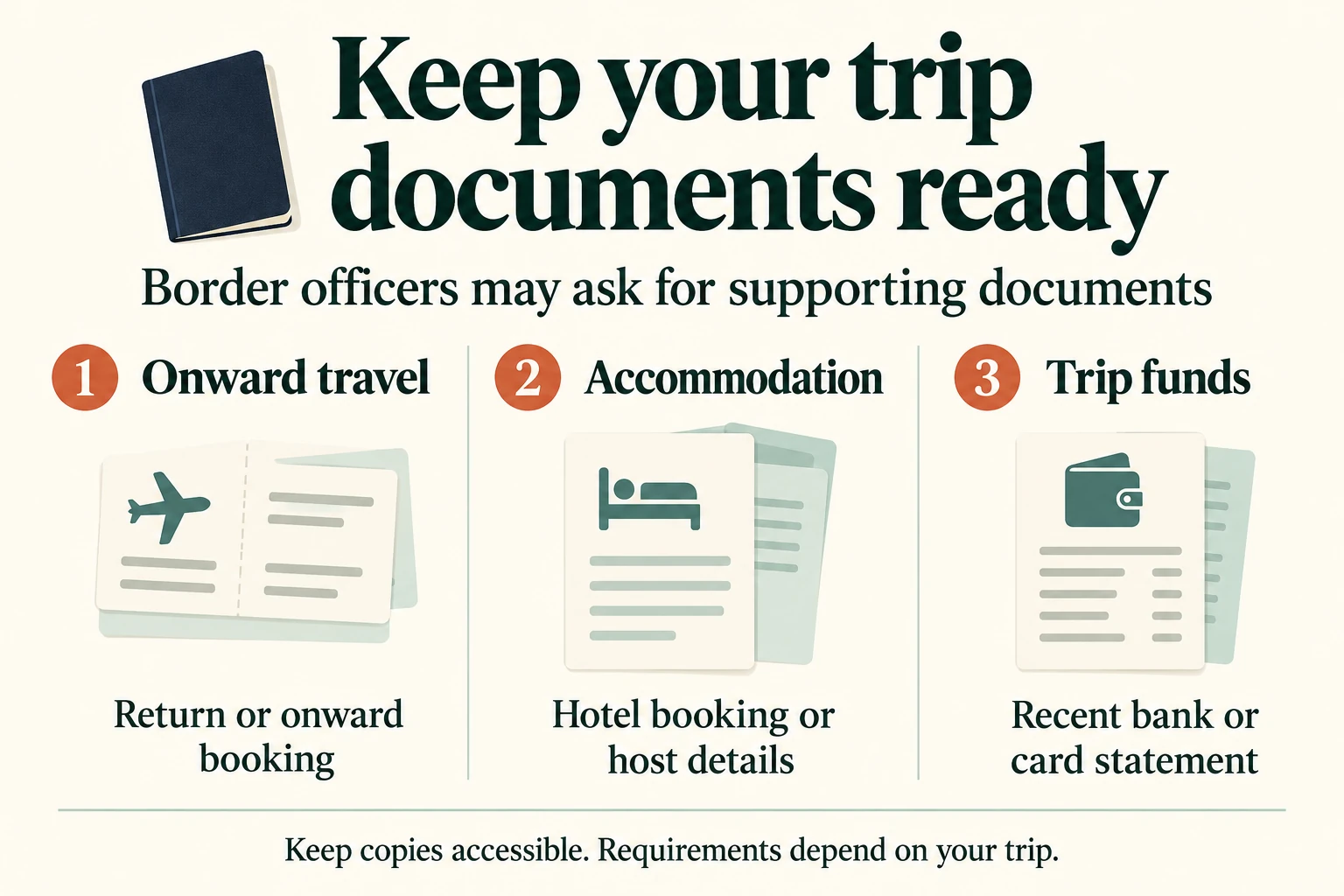
Officers may ask for proof of your return or onward travel. Officers look for a ticket that shows you will leave the Schengen Area within 90 days. Carry a printed or downloaded copy of your return flight, train, or ferry booking.
Officers can also ask about the purpose and conditions of your visit, even though you need no visa. This is among the standard questions. Keep a hotel confirmation or the address of your host, as the entry rules guidance advises, and carry a recent bank statement or card statement that shows you can pay for the trip. Officers do not publish a required amount, so bring enough money to cover your planned days and show that you have it.
Customs Limits for Arrivals From Outside the EU
Customs rules apply to everything you bring into Germany from outside the EU. Germany’s customs administration, Zoll, publishes the current allowances at zoll.de. Check them there before you travel, because allowances can change.
For goods, the allowance for arrivals by air or sea is up to €430 per person, duty- and tax-free, under the long-haul allowance rules. Arrivals by land or inland waterway get up to €300. Travelers under 15 have a €175 allowance. The same limits apply. Tobacco and alcohol do not count toward the goods allowance. Gifts count toward the limit. If the total value exceeds the allowance, you must declare all of your goods, not only the amount over the limit.
Tobacco and alcohol allowances apply to travelers 17 and older. For tobacco, you may bring 200 cigarettes. Other options are 100 cigarillos, 50 cigars, or 250 grams of loose tobacco, as the customs overview describes. For alcohol, you may bring 1 liter of spirits over 22 percent alcohol or 2 liters at 22 percent or below, plus 4 liters of still wine and 16 liters of beer. Choose one tobacco option and one spirit option. Don’t combine allowances from different categories beyond these limits.
Cash works differently. Cash of €10,000 or more must be declared when you enter the EU from outside it. Travelbook and the Verbraucherzentrale consumer organization explain that the threshold also covers cheques, securities, and some precious metals. The cash rule runs separately from the goods allowance.

Customs officers enforce the rules. Ruhr Nachrichten describes a case in which a couple brought gold jewelry from India, valued under €10,000, and thought no declaration was needed. Customs assessed duty with a surcharge and opened a tax-criminal case. If you carry valuables, declare them at arrival, and keep receipts.
Some goods are banned or restricted. Reisen Exklusiv lists protected animal and plant species, meat and dairy products from non-EU countries, and narcotics without a certificate as not permitted in luggage. The Verbraucherzentrale warns that animal-based products such as cheese and leather clothing can cause problems at the border. If you plan to buy local food, leave the cheese and sausage at home.
Passports From Other Countries
The rules above apply to US passports. Visa-free access depends on nationality, and the EU keeps two lists. Annex II of the EU visa regulation names nationals who may enter for up to 90 days in any 180-day period without a visa. The list includes the United States, Australia, Canada, Japan, South Korea, New Zealand, Singapore, Brazil, and the United Kingdom, with an exception for certain British nationals. Annex II also attaches conditions to some passports. For example, holders of passports issued by the former Yugoslav Republic of Macedonia are covered only if their passports are biometric.
Annex I lists nationals who need a visa before they travel. The consolidated 2024 text of the regulation includes Russia, Nigeria, Pakistan, the Philippines, Thailand, Turkey, and South Africa. The regulation also states that the lists can change through case-by-case assessment and legislative amendment, so use the current EUR-Lex text before you book.
If your passport appears on neither list, or you hold passports from more than one country, contact the German embassy or consulate that serves your home country before you buy tickets.
Key Takeaways
- Check the passport first: Confirm that your US passport is valid for at least three months after your last day in the Schengen Area, and consider six months if you can renew it in time.
- Track your days across Schengen: Count every day you spend in any Schengen country, because the 90-in-180 limit applies to the whole Schengen Area.
- Skip ETIAS for now: ETIAS is not operating as of mid-September 2026, so plan for the €20 fee and the approval process only after the EU announces a start date.
- Expect fingerprints and a photo: On your first entry, the EES takes your fingerprints and a photo of your face, so leave extra time at the airport for that first trip.
- Declare cash and valuables: If you carry €10,000 or more in cash or equivalent payment forms, declare it. Keep receipts for jewelry and electronics to avoid a customs case.