Hungary Entry Requirements for US Travelers
Hungary is an EU member and part of the Schengen Area, where travelers cross shared borders without routine passport checks. U.S. citizens do not need a visa for a tourist or business stay of up to 90 days in any 180-day period. The 90-day limit covers all Schengen countries combined, including Hungary. Your passport must be valid on arrival and for three months after your departure date. Since April 10, 2026, border officers take fingerprints and a facial photo at your first entry from a non-EU country. The electronic travel authorization ETIAS is planned but not yet required.
Customs limits apply if you carry cash, alcohol, tobacco, or medicine. Declare cash of EUR 10,000 or more. The duty-free allowance for goods is EUR 430 for arrivals by air and EUR 300 for arrivals by road or rail. Check each rule’s effective date and where to confirm changes before you travel.
How long you can stay without a visa
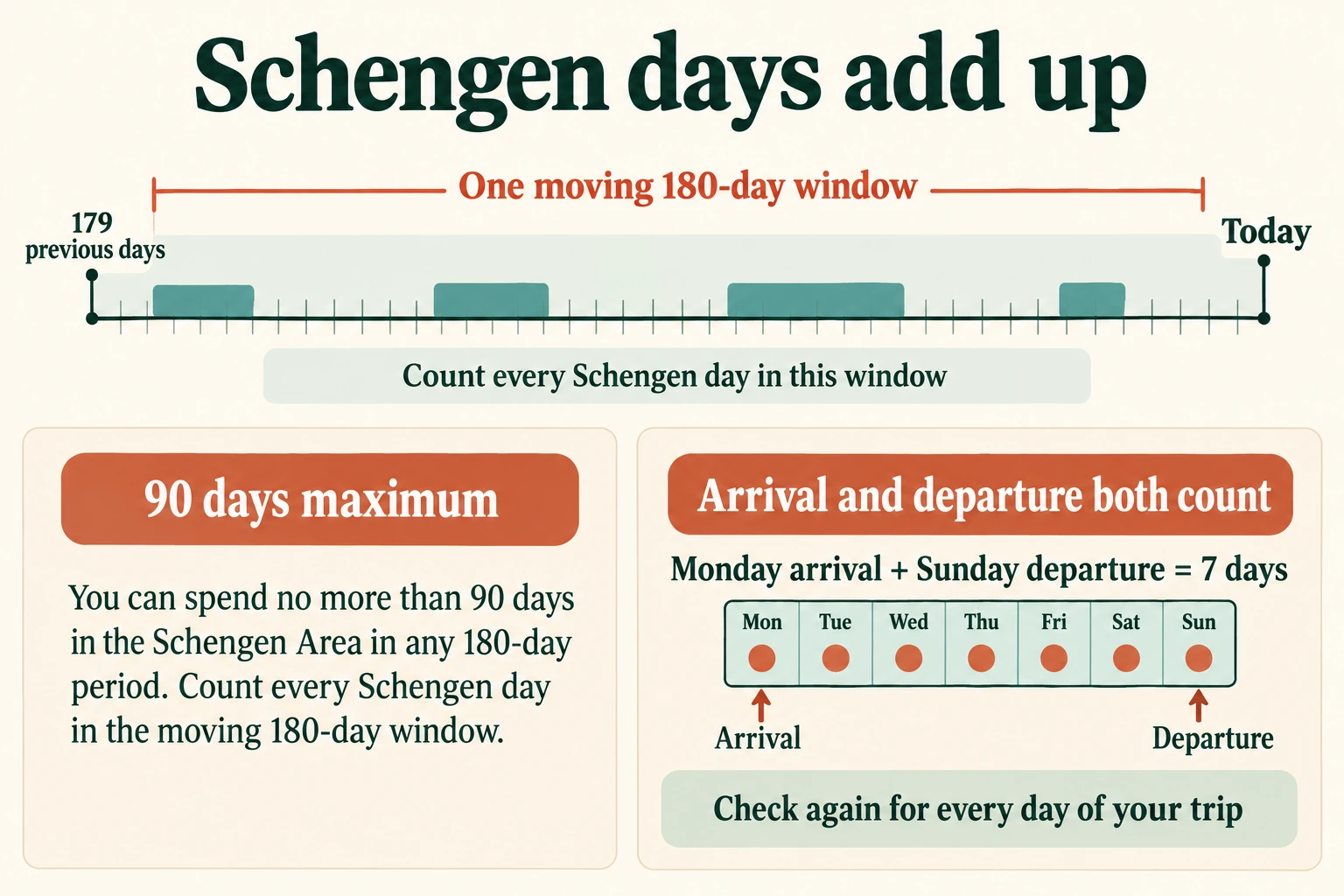
The State Department’s Hungary travel page lays out the basic rule: U.S. citizens do not need a visa for tourist or business stays of up to 90 days in any 180-day period. The count includes every Schengen country you visit. Days in Hungary and days in a neighboring Schengen country add together against the same limit.
The 180-day period moves with each day you spend in the Schengen Area. To check where you stand on a given day, count back 180 days from that date and add up the days you spent in the Schengen Area during that span. Leaving the Schengen Area and coming back does not reset the count. A traveler who spends a long stretch in Hungary in spring and then several weeks in Portugal in summer uses one shared allowance for both trips. Once the early days drop out of the 180-day window, that space becomes available again.
The visa-free allowance covers tourism and business activity, including attending meetings. Employment is not allowed under it.
Staying longer than the visa-free limit
The State Department says U.S. citizens may be able to stay an additional 90 days under a bilateral agreement between the United States and the EU. This option applies only to travelers who did not use their full 90 days of visa-free Schengen stay in the six months before their first Schengen entry. If the extra days are granted, you cannot visit other Schengen countries during them, and you must leave the Schengen Area directly from Hungary on the last day. Plan this option before you enter, because it depends on your travel history in the previous six months.
For longer stays, the State Department says a visa is required to stay more than 180 days or to study. Working in Hungary requires a work and residence permit. Hungary also has a digital nomad visa that allows stays of up to one year. You can extend it by another year, and it runs separately from the 90-day rule. Confirm the current terms with the Hungarian embassy or consulate that serves your area before you apply.
Passport validity rules
The State Department requires your passport to be valid at the time of entry and to have at least three months of validity beyond your departure date. The same page also refers to validity beyond the planned stay. Both wordings set the same deadline when you leave on your return flight, so plan around that departure date.
Check the expiration date before you book the trip. A passport that expires a few months after your return flight meets the rule. One that expires within three months of departure falls short.
The coming ETIAS authorization
ETIAS, the European Travel Information and Authorisation System, is a screening step that visa-exempt travelers complete online before they arrive in Europe. It works in a similar way to the ESTA that visitors to the United States complete. ETIAS is not a visa, and it does not replace the stay limits described above. An ETIAS information site for Hungary states that the system is not yet operational and that no one can apply yet. Skip any intermediary that offers to file an application for you now.
The European Commission announced on 17 July 2025 that ETIAS would start operating in the last quarter of 2026. Travelers do not need to take action yet. The Q4 2026 target has since been dropped, and the ETIAS guide points to 2027 as the more likely launch year. Before you book a trip after late 2026, check the official ETIAS FAQ for the start date.
The application fee is EUR 20. The Commission raised it from EUR 7 to cover the system’s operating costs, and the increase takes effect once ETIAS is operational. The Council and the European Parliament review the increase over two months, and that review can be renewed once. Applying directly through the official site costs EUR 20. Any additional charge comes from an intermediary service that you choose to use. The fee is non-refundable regardless of the outcome.
Travelers under 18 and over 70 pay no fee but still need an authorization. Family members of EU nationals who meet the conditions are exempt from the fee as well. An approved authorization is valid for up to three years and allows stays of up to 90 days in any 180-day period across Hungary and the other participating countries. Anyone who holds a valid Schengen visa does not need ETIAS.
ETIAS checks you before you arrive, while the Entry/Exit System records your entries and exits at the border. ETIAS starts only once the Entry/Exit System is fully operating at all Schengen external borders, and that condition is now met.
Fingerprints and a photo at the border
The EU’s Entry/Exit System (EES) launched on 12 October 2025 and became operational on 10 April 2026. Since then, it runs at every external border crossing point for eligible non-EU travelers with biometric passports. Border officers no longer stamp passports by hand for these travelers. The system records the data from your travel document and the date and place of each entry and exit. It also captures a facial image, your fingerprints, and any entry refusals.
On your first crossing after the system started, officers scan your fingerprints and take a facial photo. Later crossings match your fingerprints or face against the stored record, and the full enrollment is not repeated. The House of Commons Library notes that some crossings use self-service kiosks overseen by officers. The same briefing adds that the Frontex "Travel to Europe" app lets you start registration before you travel, but fingerprints are still collected at the border.
Re-entry rules depend on your last record. The Port of Dover, a ferry operator that summarizes the EES rules for its passengers, says that re-entry within three years of the original record requires only one biometric, such as fingerprints. A full new record is needed after three years without entry, or when you travel on a new passport. Officers may also ask for a new photo if your appearance has changed a lot.
At Budapest Airport, officers check the documents of non-EU passport holders at border booths for both arrivals and departures. Have your passport and boarding pass ready in the queue, along with a residence permit if you hold one. After the document check, the booth captures your fingerprints and a face photo. For non-Schengen flights, the gates come after the border control booths.
What border officers may ask
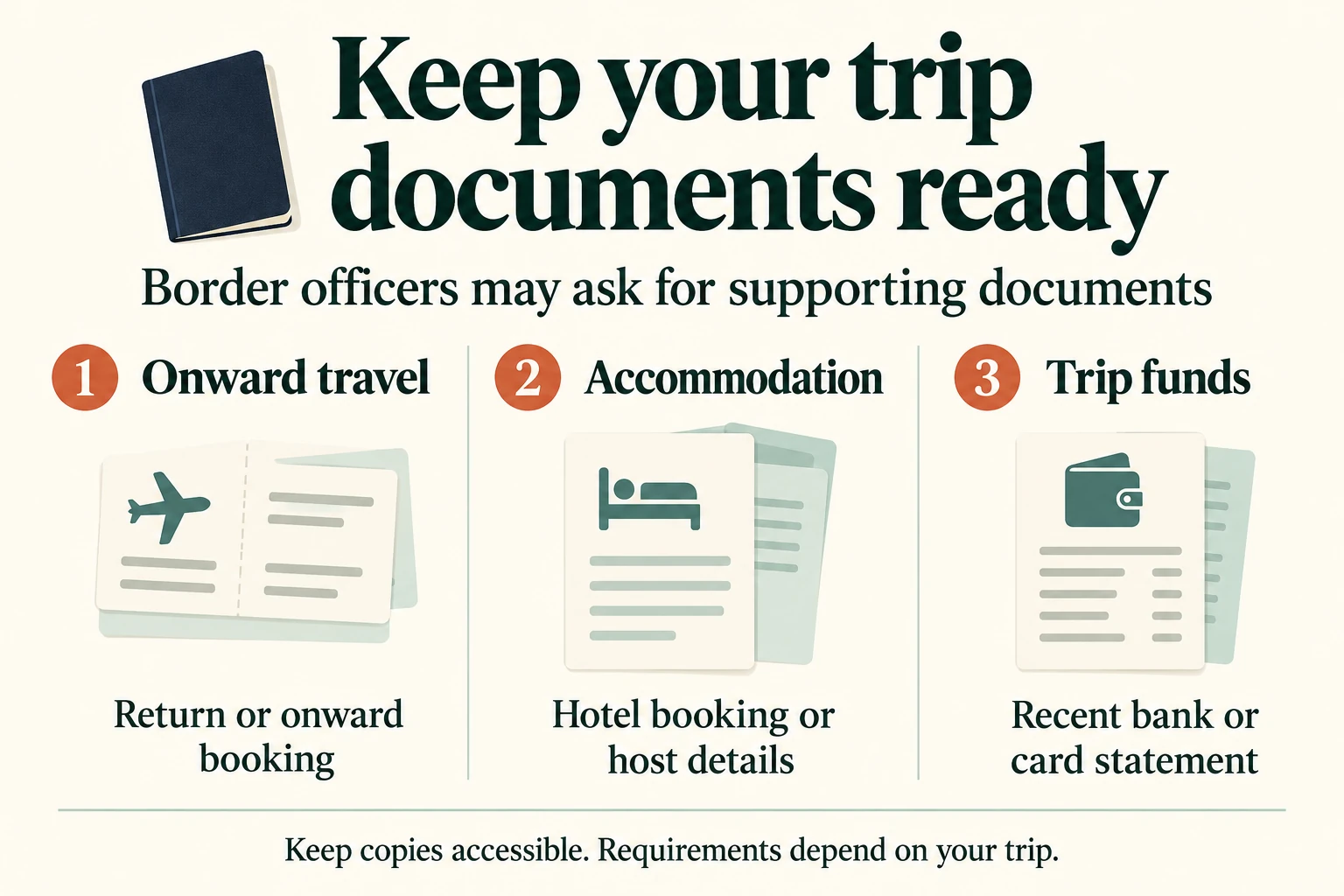
Officers can ask basic questions about your trip. Based on the Schengen Border Code, these questions usually cover the purpose of your visit, where you will stay, how long you plan to stay, and how you are paying for the trip. Answer these questions directly and with the details in your itinerary.
Carry documents that answer these questions before the officer asks. A valid passport comes first. Keep hotel reservations and a return travel confirmation in your bag or on your phone. A business traveler should also carry invitation letters from the host company and the meeting agenda. The State Department notes that U.S. citizens may need to show sufficient funds and a return ticket. A bank statement, a credit card statement, and a printed return booking cover both requests.
If you refuse to give fingerprints or a photo, you can be denied entry.
Cash and duty-free limits
The Hungarian tax and customs authority, NAV, sets the customs rules for travelers. Its press release of 23 June 2026 gives the cash and duty-free figures below. The NAV passenger FAQ, which refers to 2026 figures, covers the other rules.
Anyone who enters or leaves the EU with cash of EUR 10,000 or more, or the equivalent in another currency, must declare it in writing to customs. Any sum of EUR 10,000 or more must be declared. Cash includes banknotes and coins, including expired notes that can still be exchanged, along with cheques, traveler’s cheques, bearer instruments, certain prepaid cards, and gold above set purity thresholds. Securities and bonds count toward the total value. You declare the cash to the customs authority of the country where you enter or leave the EU, which may be a country other than Hungary. NAV may impose a fine and hold the cash if you fail to declare it.

You can bring in goods from outside the EU worth up to EUR 430 duty- and tax-free if you arrive by air, or EUR 300 if you arrive by road or rail. Alcohol and tobacco have separate limits and do not count toward those totals.
Alcohol, tobacco and restricted items
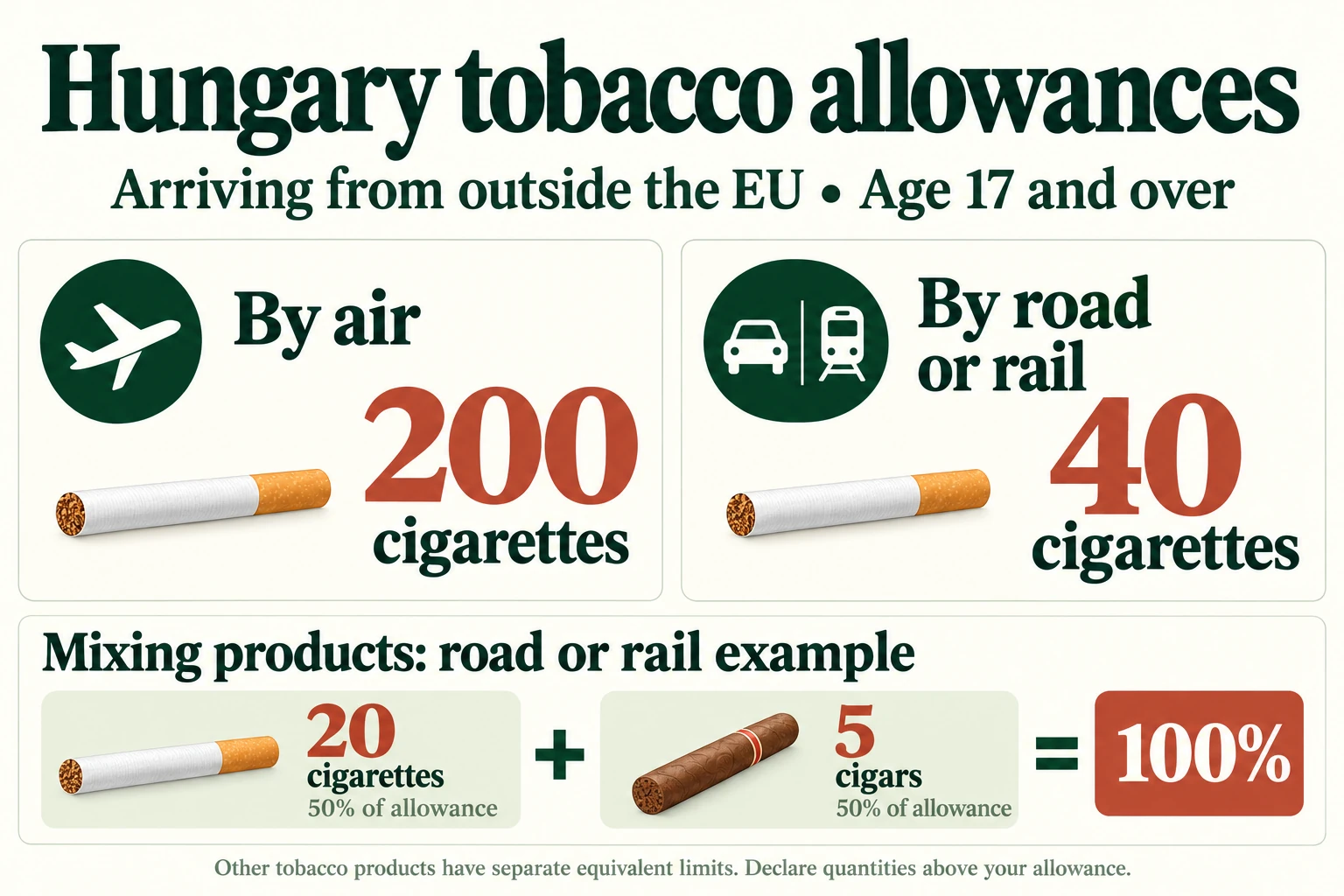
The minimum age for bringing in alcohol and tobacco is 17. For alcohol, you may bring in one litre of spirits above 22% alcohol by volume, or two litres of a product up to 22%. On top of the spirits allowance, you may add four litres of still wine and 16 litres of beer. When you mix products, the allowances apply in proportion. Half a litre of spirits uses half of the spirits allowance. Alcohol you receive as a gift counts toward the allowance.

Tobacco limits depend on how you arrive. The NAV passenger FAQ sets these allowances:
| Product | Air arrivals | Road or rail arrivals |
|---|---|---|
| Cigarettes | 200 (10 packs) | 40 |
| Cigarillos | 100 | 20 |
| Cigars | 50 | 10 |
| Smoking tobacco | 250 g | 50 g |
| Smokeless tobacco | 125 g | 25 g |
| Nicotine substitute | 125 g | 25 g |
| E-liquid | 75 ml | 15 ml |
| Heated-tobacco sticks | 200 | 40 |
Declare any amount above these limits when you enter. You pay duty, VAT and excise on the excess, and undeclared excess can lead to a fine or confiscation.
You may bring medicine only for ongoing treatment and personal use, in a quantity proportionate to your trip. The NAV FAQ says a supply of enough for 90 days is the benchmark. A doctor’s certificate is recommended, and some products require one. Narcotic and psychotropic medicines require an international certificate.
Hunting, sport and self-defense firearms may enter only with the required permits. You must declare firearms and ammunition at the EU border. Use the red channel at airports to declare them. Products made from protected species, such as ivory, coral and exotic leather, are restricted. Smuggling them carries fines and, in criminal cases, up to three years of imprisonment. NAV’s 23 June 2026 press release says small quantities are no longer treated as a criminal offense on NAV’s initiative, but specific rules still apply. Pets from outside the EU need an official veterinary certificate issued in at least two languages, one of them English and one an official language of the entry country.
Non-EU visitors can claim VAT refunds on goods they take out of the EU in personal or hand luggage. The purchase must exceed EUR 175, which NAV states as 68,000 forints for 2026, and the goods must leave the EU within 90 days in new and unused condition. Keep the receipts and the goods unopened until you reach the export check.
Rules for other passport holders
Hungary’s visa-free rule for short stays comes from the Schengen visa list in EU Regulation (EU) 2018/1806. Its consolidated text dated 13 October 2024 sets the 90-in-180 allowance for nationals of listed countries and requires a visa for nationals of countries in Annex I.
About 60 countries share the U.S. allowance, among them the United Kingdom, Canada and Australia. British citizens have been visa-exempt for 90-in-180 stays since Brexit, so they face the same stay limit and the same ETIAS and EES procedures as U.S. travelers. Citizens of EU, EEA and Swiss nationality need no visa and have no time limit. Some countries, including Albania and Bosnia and Herzegovina, are visa-exempt only with a biometric passport. More than 100 countries require a visa in advance.
Travelers with other passports face the same EES fingerprint and photo procedure at the border if they are eligible for it. ETIAS applies only to visa-exempt nationals. Visa-required nationals need a Schengen visa before they travel and do not complete ETIAS.
Key takeaways
- Count the 90 days across all of Schengen: Days in Hungary and other Schengen countries add up within any 180-day window, and leaving the area does not reset the count.
- Check your passport three months past departure: The State Department requires validity on arrival and for three months beyond departure, so renew it before booking if it is close to that date.
- Expect fingerprints and a photo on your first entry: Later crossings check against the stored EES record. At Budapest Airport, booths handle both arrivals and departures.
- Check the ETIAS date before paying the EUR 20 fee: ETIAS is not required yet, its launch timing has moved, and the official ETIAS site lists the current start date.
- Declare cash of EUR 10,000 or more: Keep duty-free goods within EUR 430 for air arrivals or EUR 300 for road and rail arrivals, and declare any tobacco or alcohol above the listed allowances.