Getting Around Switzerland

Swiss Federal Railways (SBB) runs the national train network, and the train is the best choice for most trips between cities, lakes, and mountain towns. Buses cover the gaps, lake steamers serve the waterfronts, and Zurich to Geneva is the only scheduled domestic flight. Each canton (Swiss state) regulates ride-hailing apps and taxis, so the rules differ from canton to canton.
Most visitors choose among three ticket options: point-to-point tickets, the Swiss Travel Pass (a visitor pass for unlimited rides on trains, most buses, and most boats), or the half-fare card (a card that cuts most fares by about half). The best choice depends on your route, the typical prices and journey times, and where you book.
Trains Cover Most Trips
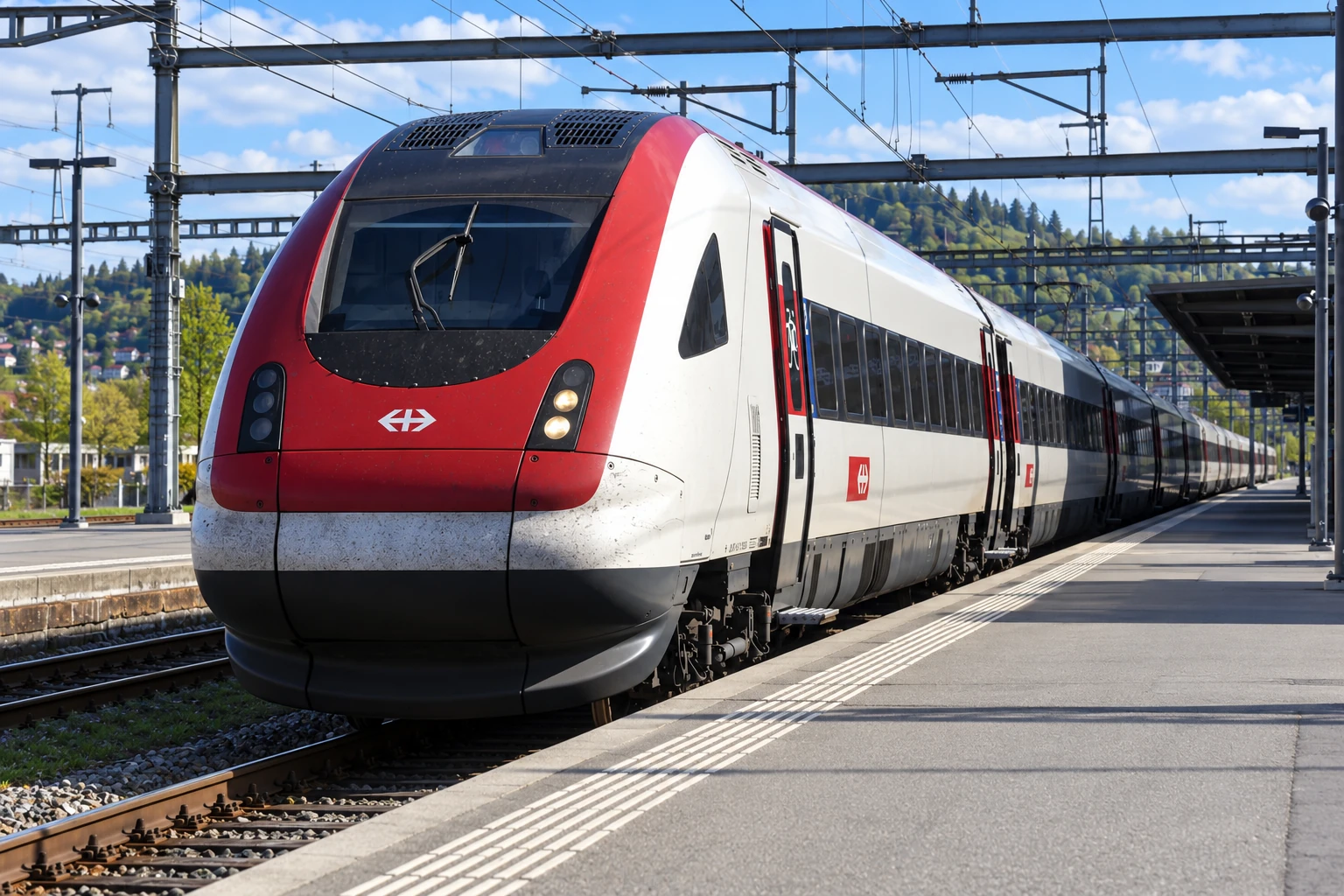
SBB operates the national rail network, and its domestic high-speed trains are the InterCity Neigezug (ICN) tilting trains. Punctuality runs at 92%, with most delays under five minutes. Zurich to Geneva trains run every 15 to 30 minutes, but rush-hour trains between major cities can be crowded. On a travel day with a tight connection, such as a flight home, avoid weekday commuter peaks.
Typical rail journey times between the main hubs are short. Bern to Zurich takes 55 to 56 minutes and Bern to Geneva takes 1 hour 44 to 45 minutes. Zurich to Interlaken takes 1 hour 55 minutes. Zurich to Geneva takes 2 hours 41 minutes on the fastest service and 2 hours 44 minutes by InterCity.
Reservations matter in two places. Panoramic trains such as the Glacier Express and Bernina Express require a seat reservation even if you hold a pass, and the Swiss Travel Pass page lists the reservation as an extra cost. International EuroCity trains, for example from Zurich, Bern or Geneva to Milan, also require a reservation. Ordinary domestic trains need no reservation.
International connections are quick enough to plan around. The TGV Lyria from Paris takes about 3 hours 10 minutes to Geneva and about 4 hours to Zurich. Munich to Zurich takes about 3.5 hours.
Airport links
Swiss airports sit on the rail network, so the train is the normal way into town. Trains from Zurich Airport to Zurich main station take 10 to 12 minutes and run every 5 to 10 minutes. A ticket costs CHF 6.80 in 2nd class. From Geneva Airport, Lausanne is 40 minutes away for CHF 28, Bern is 1 hour 45 minutes away for CHF 51, and Zurich is 2 hours 45 minutes away for CHF 92. Bern Airport is the exception: the trip to Bern main station takes about 40 minutes by bus to Belp, then train.
Zurich to Geneva: Train or Flight
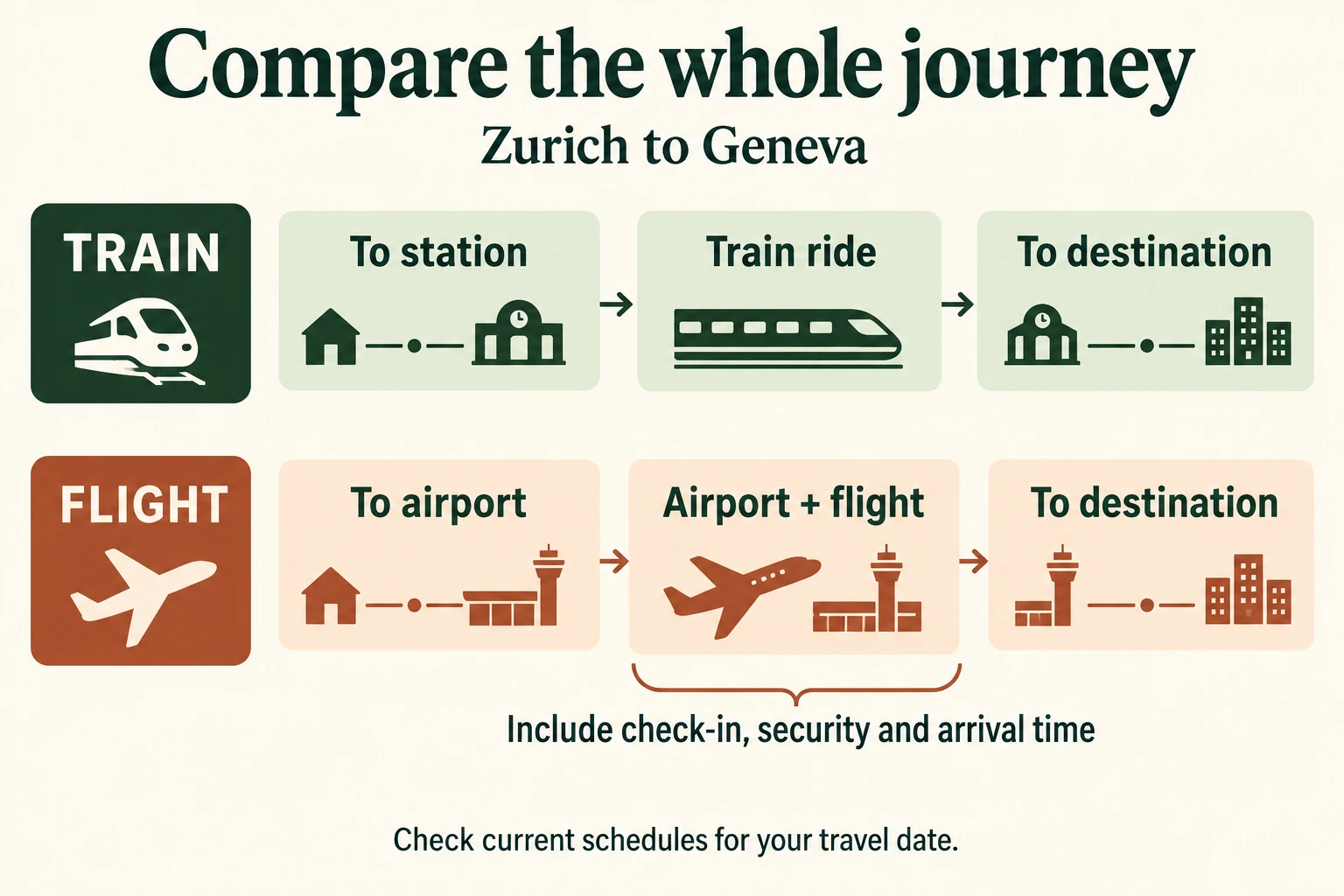
Zurich to Geneva, operated by SWISS, is the only scheduled domestic flight in Switzerland. SWISS runs several flights a day, each about 45 minutes in the air. The train takes under 3 hours between the two main stations. The flight saves air time, but once you add travel to the airport, check-in, security and the trip from the destination airport into town, the train is faster door to door for most travelers, and it needs no airport transfer at either end.
Lugano has no domestic air service. The airport is used only by private planes, and the Geneva to Lugano and Zurich to Lugano flights were discontinued in 2017 for lack of sustained demand. The Council of States approved changes on 16 September 2026 that would let EU or EFTA airlines run domestic flights only in exceptional cases, where no Swiss company wishes to serve the route and the distance is impractical by train. The change has not yet become law, and it will not bring flights back to Lugano in the near term. Plan on the train: Zurich to Lugano takes about 2 hours.
From Milan, the train to Lugano takes about 1.5 hours. A single ticket costs under EUR 20 when bought on the SBB site. A border check at Chiasso can add delay.
Swiss Travel Pass or Half-Fare Card
Only visitors who live outside Switzerland and Liechtenstein can buy the Swiss Travel Pass. Prices start at CHF 254 for 3 days in 2nd class, and the pass runs on consecutive days. It covers trains, buses and boats on the Swiss Travel System network. It also includes city transport in many Swiss cities and free entry to over 500 museums (the museum list is at museumspass.ch). For travel between 1 October 2026 and 15 December 2026, it gives up to 50% off SBB luggage transport. Children up to 16 travel free with a parent under the Swiss Family Card.
The Swiss Travel Pass Flex covers any 3, 4, 6, 8 or 15 days within one month, from CHF 289. It suits a trip with rest days in one place, since you only spend a pass day when you ride. It also allows flexible cancellation if plans change at short notice, with the terms on a separate SBB page. You can buy either pass from the SBB sales page or the Swiss Pass online shop. Both come as a print@home ticket or an eTicket with immediate confirmation.

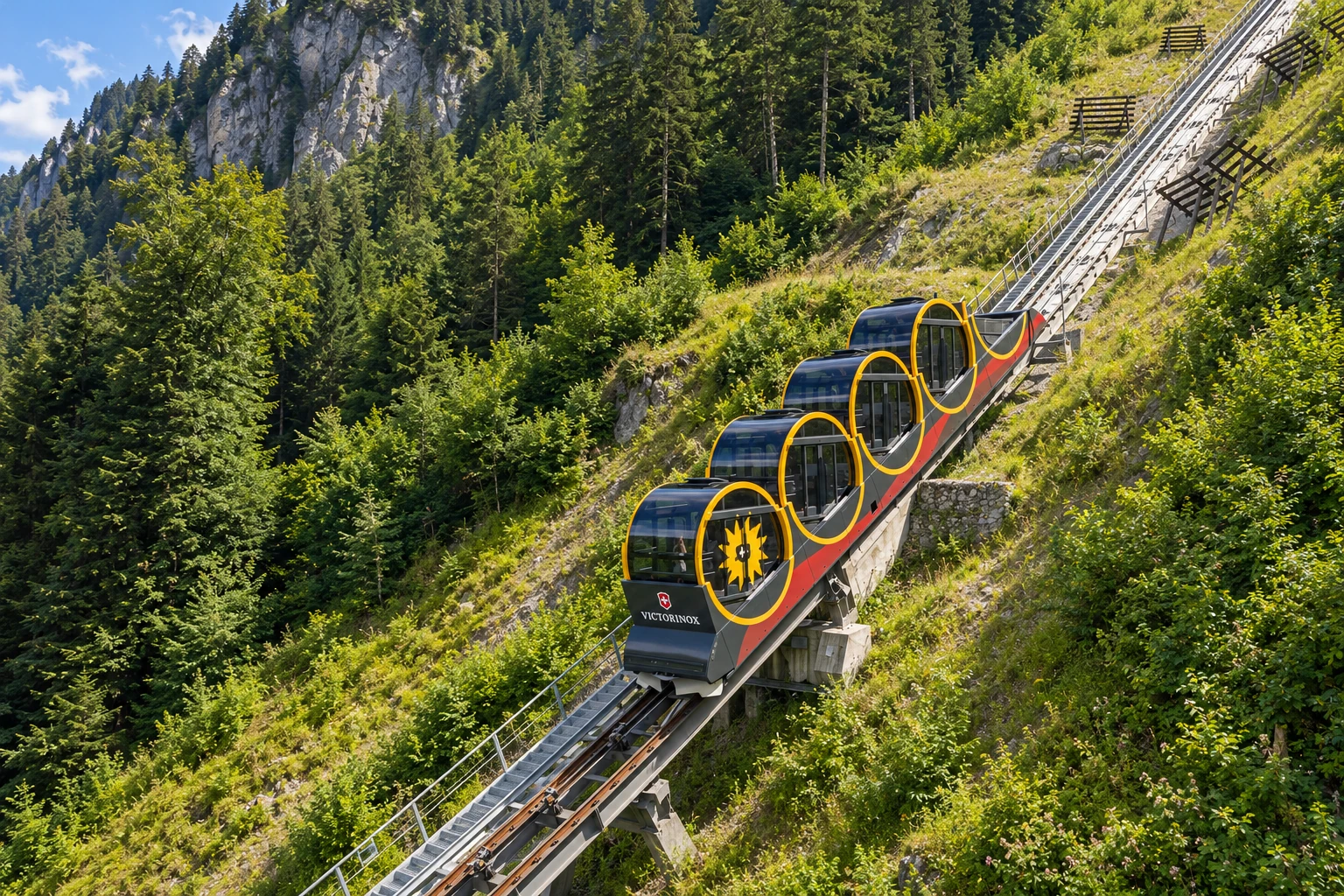
Under the Swiss Pass FAQ, updated 24 July 2026, some mountain railways and private lines are only partly included or give a discount instead of free travel. Rigi, Stoos and Stanserhorn are included, and many other mountain excursions get up to 50% off. Jungfraujoch, Pilatus and Schilthorn are not on the list of included railways, so look up each operator’s current terms before counting them as free. Premium or special lake cruises can carry a surcharge. Seat reservations on panoramic trains are always extra.
A half-fare card discounts each ticket instead of covering rides. Visitors can buy the Swiss Half Fare Card for one month from CHF 150. The Halbtax, the annual Swiss version, costs CHF 190 for the first year and CHF 170 on renewal as of August 2026 (current fares). The Halbtax Jugend for ages 16 to before 25 costs CHF 120 per year. Cards give about 50% off most public transport routes, except very short ones, and the discount covers PostBus routes. At standard fares, the annual break-even is about CHF 380, for example four 2nd-class return trips between Zurich and Geneva. The unlimited annual GA travel card costs CHF 3,995 in 2nd class and CHF 6,520 in 1st class, which suits residents more than visitors.
A simple rule: a multi-region tour of 3 to 15 days with many long rides fits the Swiss Travel Pass or Flex. A stay based in one or two places with a few big excursions often fits a half-fare card plus individual tickets. A trip with only one or two long train rides fits point-to-point tickets alone.
Buses and Mountain Villages
PostBus (the yellow Swiss postal bus network) reaches remote mountain villages, alongside lake steamers, mountain railways, cable cars and funiculars. Under the Swiss Pass FAQ, the yellow PostBus network is generally included within the pass’s validity area, and most passes include city buses, trams and local trains in many Swiss cities. For sections outside the validity area, buy a separate ticket. Halbtax holders get the half-fare discount on PostBus routes.

Use trains for the main legs between towns and PostBus for the last stretch into a village. Without a pass, price those PostBus segments separately, because they are easy to overlook when you budget.
Lake Ferries and Steamers
Each large lake has its own operator, which affects where you buy tickets. Lake Geneva is run by CGN, Lake Lucerne by SGV, Lake Zurich by ZSG, Lakes Thun and Brienz by BLS Schifffahrt, and Lake Lugano by NLL. Geneva’s small Mouettes water taxis (lines M1 to M4) are run by Mouettes genevoises rather than CGN, and cost CHF 2 single, free with the Geneva Transport Card.
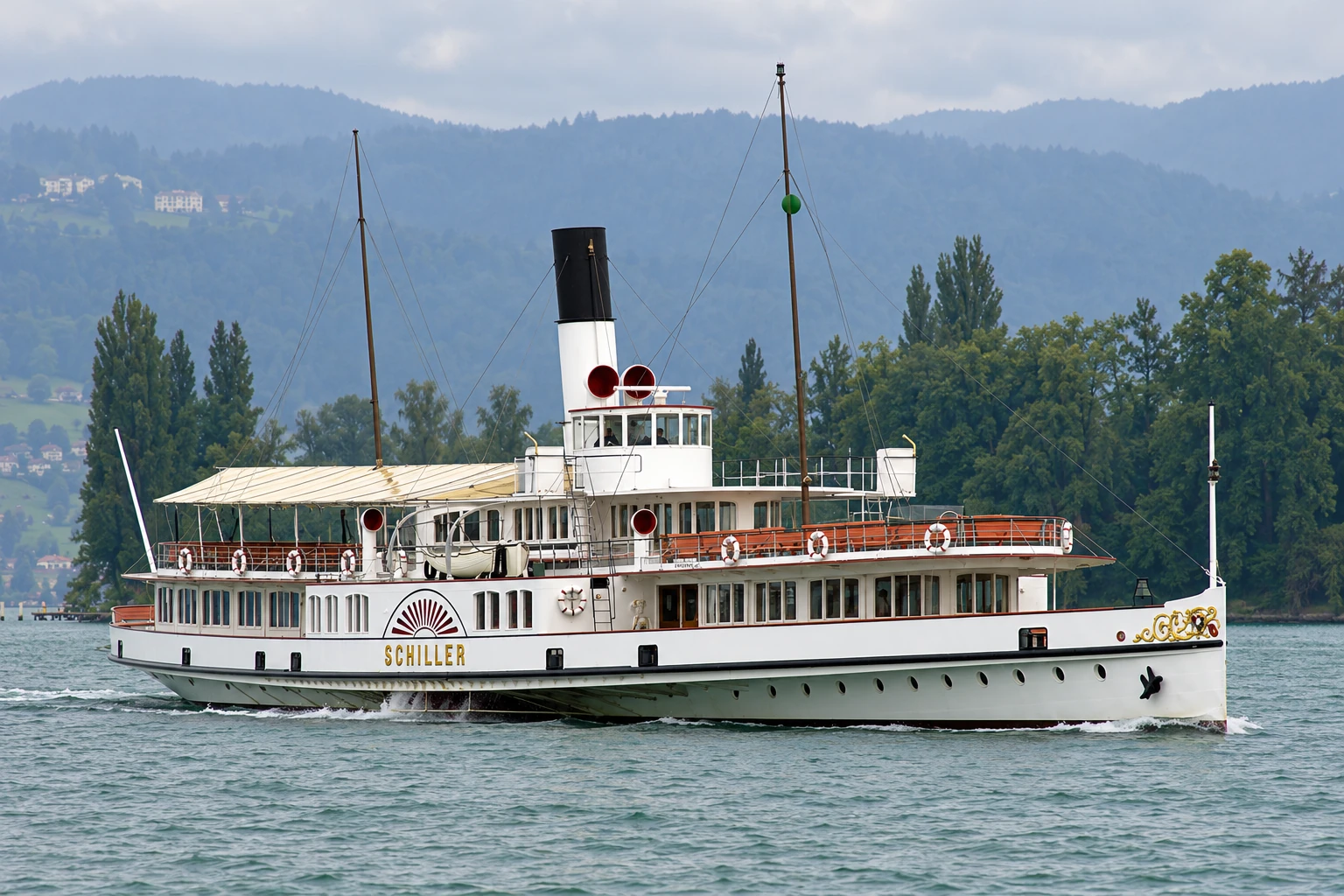
CGN runs four direct lines across Lake Geneva to France. N1 goes from Lausanne-Ouchy to Évian-les-Bains and N2 from Lausanne-Ouchy to Thonon-les-Bains. N3 runs from Nyon to Yvoire, and N4 from Bellevue GE to Corsier GE.
Journey times and fares on Lake Geneva
Geneva Tourism lists these typical outings:
- A steamer from Geneva to Yvoire, with lunch, takes about 2 hours each way.
- The trip from Geneva to Nyon is about 1.5 hours each way.
- The Tour de l’Eau, from Geneva to Lausanne, runs about 4 hours.
- The Petit Lac loop has six daily sailings, lasts about 1 hour and costs from CHF 25.
- The Geneva Grand Tour round trip to Versoix, Coppet and Nyon costs from CHF 48 and lasts about 2.5 hours.
| CGN route or product | Standard (CHF) | First class (CHF) |
|---|---|---|
| Geneva to Nyon | 24 | 34 |
| Geneva to Lausanne-Ouchy | 47 | 67 |
| Geneva to Vevey | 22 | 31 |
| Geneva to Montreux / Château de Chillon | 27 | 38 |
| Geneva 55-minute cruise | 21 | n/a |
| Geneva 2-hour paddle-steamer cruise (food excluded) | 33 | 46 |
| CGN day pass | 64 | 90 |
Return tickets are about 15% cheaper than two one-way tickets, and you can pay in CHF or EUR. On family day tickets, children under 6 travel free and ages 6 to 15 pay half price. Across the country, a one- to two-hour section typically costs CHF 20 to 40. A first-class Lake Lucerne cruise with a three-course lunch is advertised from CHF 89.
Timetable and season
Lake Geneva’s schedule has been cut. CGN runs about half as many crossings as before, with most at commuter hours in early morning and evening. The year has three timetable periods: winter from mid-October to mid-April, summer from mid-June to mid-September, and shoulder periods in between. Winter steamer routes are limited, so a lake outing in winter needs a timetable check first. Check the daily schedule at cgn.ch, and boats also appear in the national timetable at sbb.ch.
Booking and pass coverage
Buy CGN tickets at ticket windows, the Cornavin SBB counter in Geneva, the Mont-Blanc port office, at vending machines, or on board for a small surcharge. Cash and credit cards are accepted, with the same prices on all ships. Buying before departure is recommended. Regular steamer and modern boat services need no reservation, but special theme cruises and dinner packages require one. Paddle steamers are marked "vapeur" or "Belle Époque" in the CGN timetable.

The Swiss Travel Pass covers regular CGN services, including French-shore stops. Dining cruises, charter boats and supplement vessels are not covered. With a pass, a steamer ride to Nyon or Montreux costs nothing extra, which makes it an easy addition to a Geneva or Lausanne stay.
Taxis, Ride-Hailing and Rental Cars
Taxi and app-ride rules are set by each canton, so the right way to get a ride depends on where you are.
In the canton of Zurich, taxi and limousine services have been regulated at the cantonal level since 2024. Before a provider can start commercial taxi rides, it needs a cantonal driver permit (Taxiausweis) and a vehicle permit (Taxifahrzeugbewilligung). Limousine services follow a notification procedure instead of the taxi permit procedure. From 26 November 2026, taxi services in Zurich require a higher identity-verification level.
In Basel-Landschaft, rules in force since 1 October 2020 define a taxi as a service carrying paying passengers without prior booking, such as from a rank or on a hailed ride. Providers that take only pre-booked rides, explicitly including limousines and "Uber usw.," need no permit, but they may not advertise themselves as a taxi. A licensed taxi can take both hailed and pre-booked rides.
St. Gallen applies the same permit requirement to app-based drivers as to classic taxis for trips within the city. A trip that starts outside the city and ends inside needs no permit, and neither does a spontaneous return fare leaving the city. Geneva’s cantonal decision of 30 March 2015 treated Uber’s activity like a taxi dispatch center requiring an operating permit, and the Geneva taxi law governs professional car passenger transport there.
At the federal level, the Federal Council proposed in December 2025 to simplify commercial passenger transport by car, removing the BPT permit for professional passenger transport and the higher medical minimums for professional drivers. The consultation opened in December 2025, and the proposal is not law. Current law still requires both for taxi drivers.
For travelers, this means three habits. Use a taxi rank or a hotel-arranged taxi when you need a ride on the spot. Pre-book app rides where the canton allows them. Do not assume an app that works in one city works the same way in the next canton. Taxis are the practical choice for late arrivals, luggage-heavy transfers and places the train does not reach, since trains and buses cover most other trips.
A rental car suits travelers who want to reach several villages in a day or carry a lot of gear. For city-to-city travel the train is faster and simpler. Rail also gets you from airports to the center of Zurich, Geneva and Basel without a car. For the Swiss Travel Pass, a rental car adds a cost on top of a pass you are already paying for, so choose one or the other for a given stretch.
Matching Mode to Trip
| Trip | Best fit | Why |
|---|---|---|
| Multi-region tour, 3 to 15 days | Swiss Travel Pass or Flex | Covers trains, most buses and regular lake steamers |
| Several separate public transport days, or a long stay | Halbtax or Half Fare Card | Lower fixed cost; about 50% off most routes |
| Zurich to Geneva | Train | Faster door to door than the 45-minute flight |
| Lugano from north of the Alps | Train | Domestic flights ended in 2017 |
| Airport to city center | Rail from airport station | Zurich, Geneva and Basel have rail stations at or near the airport |
| Scenic mountain or lake day | Pass coverage plus reservations | Panoramic trains need seat reservations |
| Lake Geneva crossings | CGN boat, pass or ticket | Regular services covered by the pass |
| Remote mountain village | PostBus | Reaches villages the train does not; included in the pass area |
| Pre-booked city ride | App service where allowed | Rules vary by canton |
Typical Fares on Popular Routes
Check these figures on the SBB site before buying, as fares change.
| Route | Rail time | Standard fare (CHF) | Saver fare (CHF) |
|---|---|---|---|
| Bern to Interlaken | 50 min | 35–44 | 18–23 |
| Zurich to Interlaken | 1 h 55 min | 40–75 | 19–38 |
| Geneva to Interlaken | 2 h 44 min | 47–79 | 42–49 |
Those Interlaken fares show how much the saver price can save, especially from Zurich. Saver fares apply to limited seats on specific trains, so book early for a fixed travel date.
How to Book
Buy the Swiss Travel Pass or Flex from the SBB sales page or swiss-pass.ch. Order Halbtax annual cards through SBB. Buy ordinary point-to-point tickets on the SBB site, and note that Trainline also sells Swiss routes online. Reserve panoramic trains and EuroCity trains in addition to any pass. For lake boats, buy at CGN windows, the Cornavin counter, the port office, vending machines or on board, and book dinner or theme cruises separately. For taxis and app rides, rules depend on the canton, as above.
What to Know Before You Travel
- Take the train for almost every trip: SBB trains run frequently, and Zurich to Geneva takes under 3 hours, which beats the 45-minute flight once airport time is added.
- Price the pass against your actual itinerary: The Swiss Travel Pass starts at CHF 254 for 3 days, while the Halbtax breaks even at about CHF 380 a year in standard fares.
- Reserve seats and check mountain railways: Panoramic trains and EuroCity services need reservations, and Jungfraujoch, Pilatus and Schilthorn need a check of each operator’s pass terms.
- Check the ferry timetable before you go: CGN crossings on Lake Geneva have been cut to about half the former number, mostly at commuter hours, and winter routes are limited.
- Expect ride rules to differ by canton: Zurich requires permits for taxis, Basel-Landschaft exempts pre-booked app rides if they do not advertise as taxis, and St. Gallen treats app drivers like taxis for in-city trips.