Turkey Entry Requirements for US Travelers
Americans with ordinary passports can enter Turkey for tourism without a visa and stay up to 90 days in any 180-day period. You do not apply for permission in advance. At the border, you show your passport, and the officer decides whether to admit you. Your passport must be valid for at least 60 days after your planned departure, so a full 90-day stay needs a passport valid for 150 days from entry. Airlines may apply a stricter six-month rule at check-in, so aim for six months of validity.
Check any figure that affects your trip on the official page linked above before you travel.
How the 90-day limit works
The Turkish Ministry of Foreign Affairs lists US citizens with ordinary passports as visa-exempt for tourist travel for 90 days in any 180-day period, as stated on the Ministry’s visa-regime page. The exemption rests on Presidential Decision No. 7976, published 23 December 2023. The same 90-in-180 rule applies to all foreign nationals entering Turkey.
The count is rolling. It looks back over the previous 180 days from any date you are in the country, so it does not reset on a fixed calendar date. A common example makes the point: 60 days in March and April leaves about 30 days for a return trip in June, because the earlier 60 days still fall inside the 180-day window. Every day in Istanbul counts toward the 90 as well.

The 90-day cap covers every passport you hold. The Ministry’s general information page states that dual nationality does not reset the cap, and a traveler cannot stay 90 days on each of two passports within the same 180 days. If you hold two passports, count your days across both.
Official and diplomatic passport holders need one. Travelers coming to work, study, or do research also need a visa. Documentary filming, scientific research, and archaeological excavation require applying to a Turkish mission and obtaining permits from Turkish authorities before you leave home. Staying beyond the visa-free allowance requires a residence permit, as explained by this immigration guide.
The US Embassy in Türkiye warns that an overstay can bring a fine when you leave and a re-entry ban lasting months or years, according to the visa guide that summarizes its advice. Track your entry and exit dates in your calendar from the first day.
Passport validity and blank pages
Article 7(b) of Turkey’s Law on Foreigners and International Protection, in force since 1 January 2015, requires foreigners to carry a passport valid at least 60 days beyond the end of the permitted stay. The Ministry’s passport validity page gives two examples: a 90-day stay requires a passport valid for 150 days, and a 30-day stay requires one valid for 90 days.
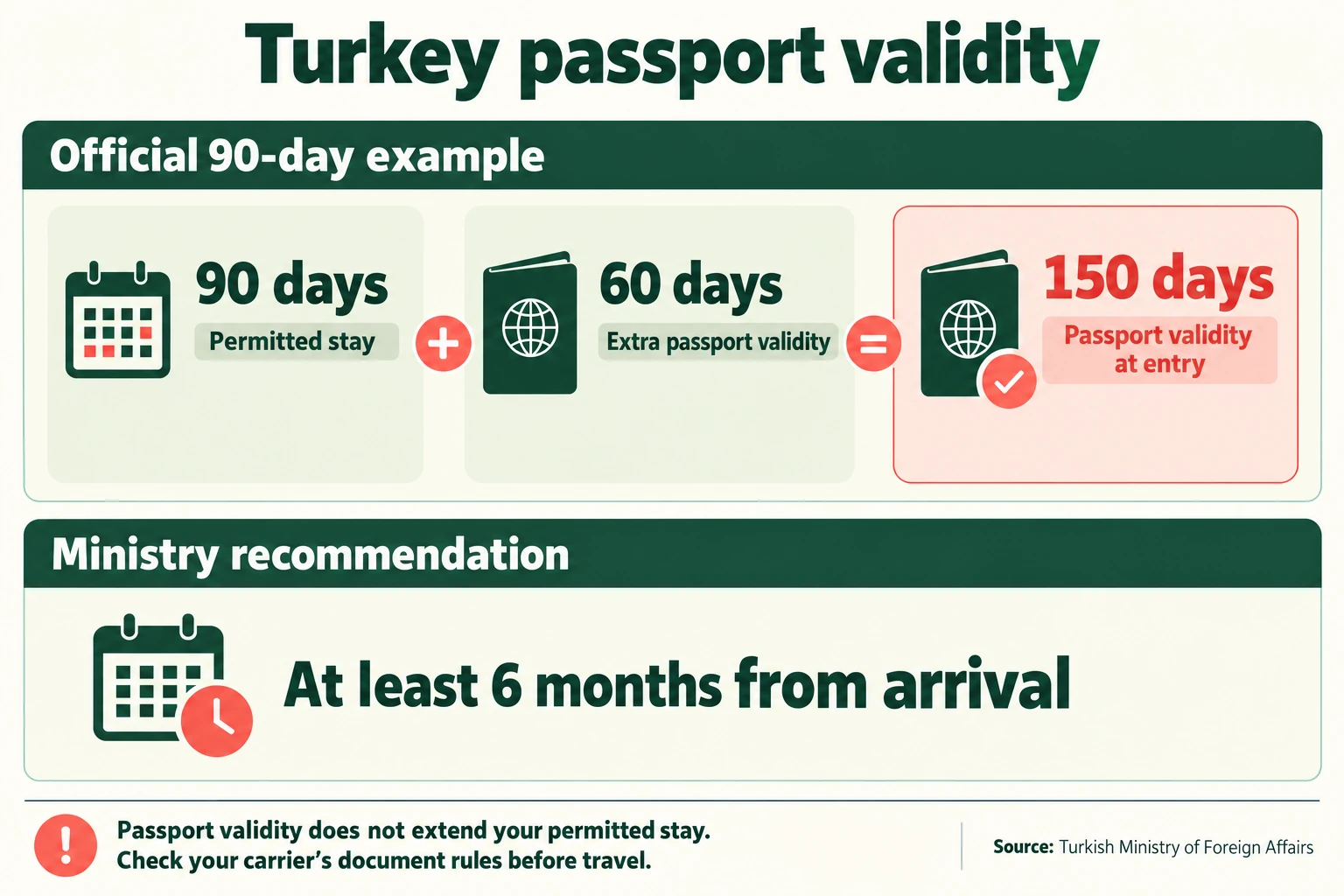
The Ministry also recommends carrying a passport valid for at least six months from the travel date. Follow that recommendation. An airline that checks against the six-month rule can refuse to board a passenger whose passport falls short of it, and the Turkish rule alone would not help you at the check-in counter.
Your passport also needs blank pages. The US Embassy advises that a passport needs enough blank pages for entry and exit stamps, or entry may be refused. Turkish officers stamp passports on arrival, and that entry stamp is needed to take domestic flights within Turkey. A missing exit stamp can lead to a fine on a later visit, so ask the officer to stamp it when you leave.
Whether you need an e-Visa
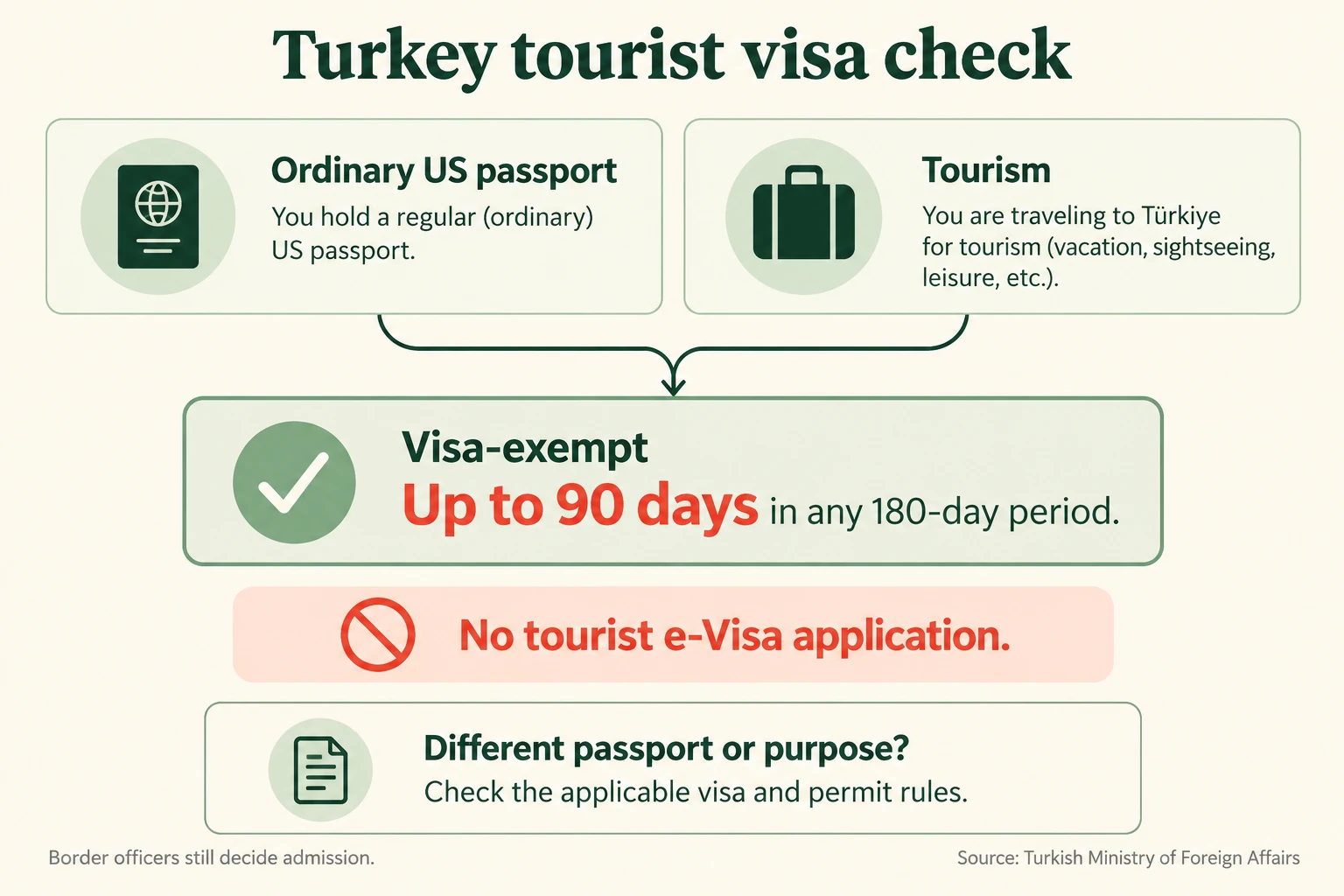
Americans on ordinary passports do not need an e-Visa for tourism. The Ministry’s visa-regime page states that visa-exempt US tourists do not have to hold one. The e-Visa system covers nationalities that need a visa in advance. The Turkish consulate in Essen lists the United States among countries whose citizens are eligible to apply for an e-Visa, but the consulate’s brochure describes the process for travelers who use it, and visa-exempt tourists do not need it.
For travelers who do apply, the official system runs at evisa.gov.tr and has operated since 17 April 2013. It issues an e-Visa for tourism or commerce in about three minutes, according to the visa guide. Applicants pay by credit or debit card. The approved e-Visa arrives by email, and you should print it and show it to airline staff and customs officers. Applicants need a flight or transport reservation and passport validity of at least six months from the travel date, as the brochure states. The Ministry advises applying at least one month before travel. Each traveler needs a separate application, even within one family. The e-Visa covers tourism and trade only. Work or study requires a visa from a Turkish embassy or consulate.
The fee for an e-Visa is set by nationality on a reciprocity basis, and the amount appears on the official site before you pay, according to a fee guide checked on 13 October 2026. Because Americans on ordinary passports do not need an e-Visa, they pay no e-Visa fee. Several commercial sites advertise fees for Americans, and some of those figures refer to visa types that no longer apply to visa-exempt travelers. The Turkish Embassy in New Delhi warns that third-party e-Visa sites charge more than twice the official price, as noted in the embassy announcement. Use only the official site if you apply.
What border officers ask
Officers may ask why you are visiting, where you are staying, and how long you plan to stay. For those answers, have the address of your first hotel or rental and a clear end date ready. Officers may also ask for proof that you will leave the country. A printed or digital return ticket works, and so does a booking for onward travel. Carry hotel bookings and a return ticket for the same reason.
Entry is always at the officer’s discretion. The border officer decides admission even if you hold a Turkish visa. Answer questions directly and keep your answers consistent with your paperwork.
Transit works differently. A passenger who stays airside at Istanbul needs no visa. Americans are visa-exempt even when they leave the airport during a connection.
Customs officers may check and search passengers and their bags. The Ministry of Trade’s customs FAQ covers the searches and the checks at the border.
Customs limits on alcohol, tobacco, and vapes
Allowances apply to travelers 18 and older, and the Ministry of Trade’s passenger-allowance page lists the limits. Travelers may bring 1 liter of spirits above 22 percent alcohol by volume, or 2 liters of spirits at or below 22 percent. Cigarettes are limited to 600, cigarillos to 100 (each weighing no more than 3 grams), and cigars to 50. Cut tobacco is limited to 250 grams with 200 cigarette papers, and pipe tobacco to 250 grams. Under-18 travelers receive no allowance for alcohol or tobacco.
Vape rules are less clear-cut. A customs guide citing a Ministry circular lists one electronic device in use plus one of three options: up to 200 heated-tobacco sticks, up to 30 milliliters of cartridges or liquid, or up to 10 disposable e-cigarettes.
Personal goods, food, and medicine
Each passenger may bring personal items listed in Annex 9 of the Turkish customs rules, plus goods worth up to €430, as long as the goods are not in commercial quantity. The Ministry of Foreign Affairs covers this in its customs information page. Travelers under 15 have a €150 allowance. Keep receipts for anything you buy abroad. Duty-free purchases do not count against these limits.
Passenger baggage is limited to Annex 9 personal goods within their quantity limits, plus goods worth up to €430 (€150 for travelers under 15), according to the customs information page. Examples include clothing, sports equipment, a laptop, a camera, and up to three portable musical instruments. Check the Ministry of Trade page before you fly.
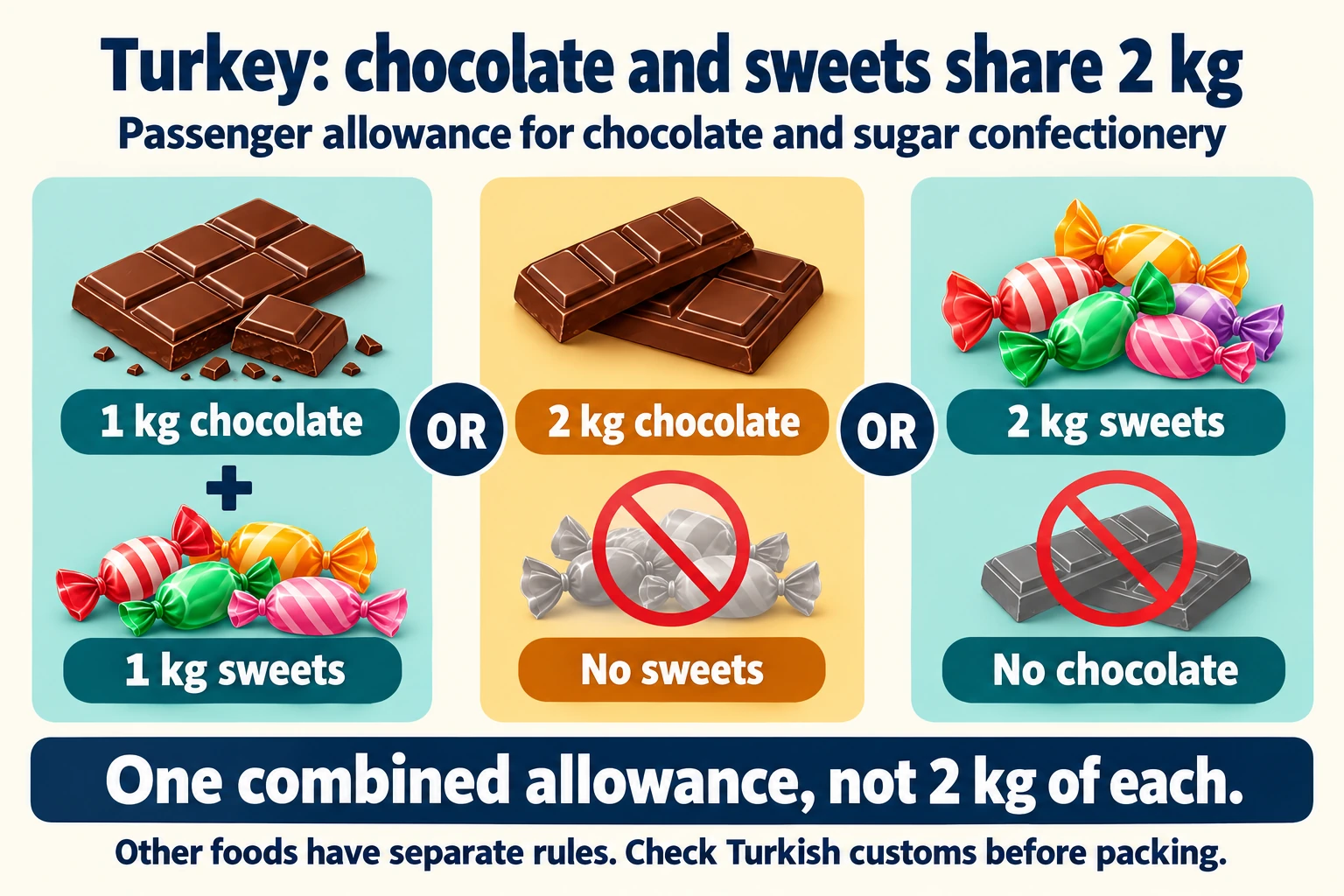
Food faces the tightest limits under the customs rules. Travelers may bring up to 2 kilograms of chocolate and sugar confectionery combined, 1 kilogram each of tea and soluble coffee, and up to 2 kilograms of honey. Baby formula and medically necessary special foods are allowed up to 2 kilograms per person if they need no refrigeration, come in proprietary-brand packaging, and arrive with the packaging intact. Meat and dairy, including sausages and cheese, cannot come in as ordinary personal goods. Fresh fruit, eggs, and packaged food also appear on the prohibited list, according to a customs guide for Turkey. Eat your snacks before you land or leave them at home.
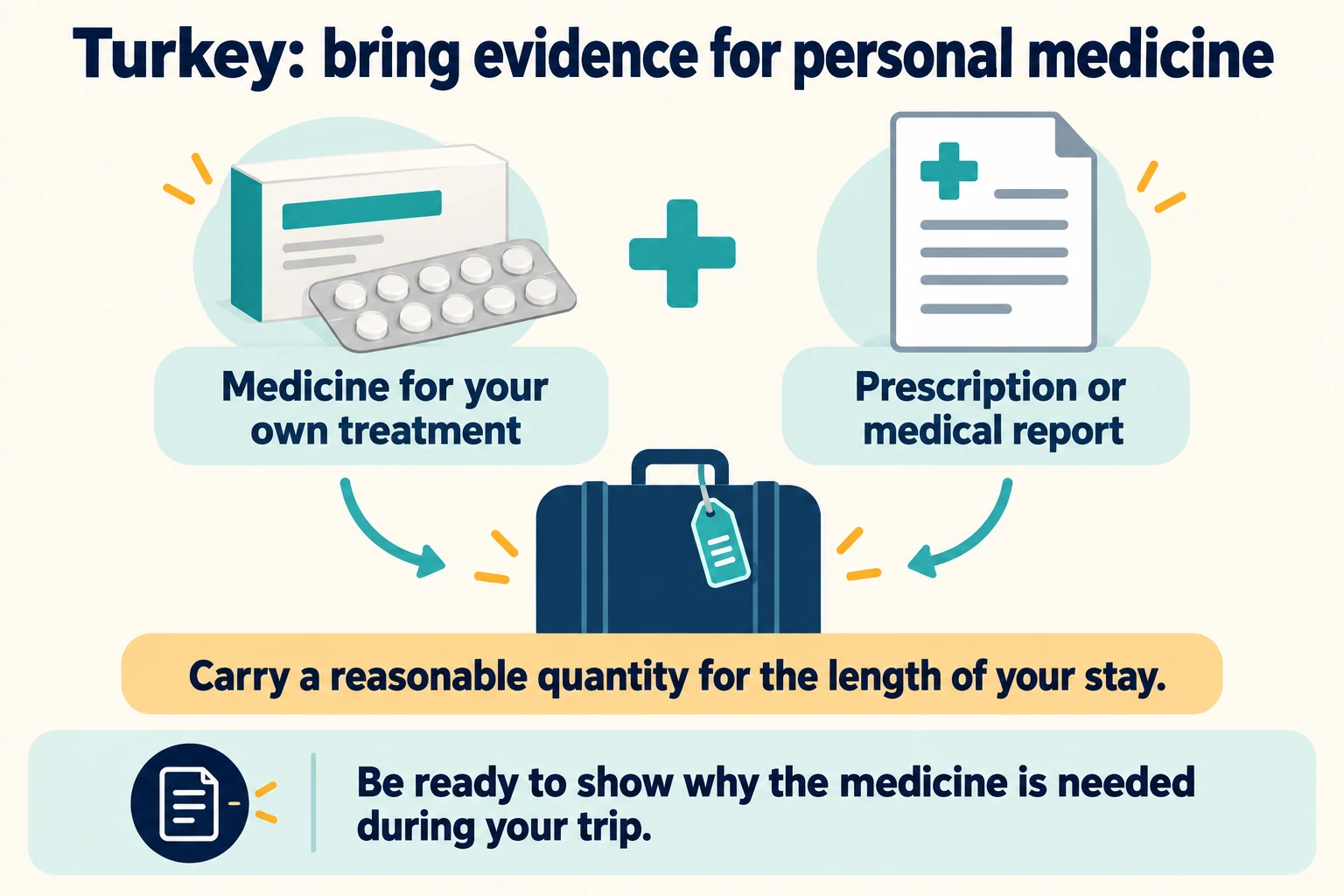
You can bring medicine in an amount that is reasonable for your treatment. Carry the prescription or a medical report.
For cosmetics, a duty-free limits guide lists up to 600 milliliters of cologne or perfume and up to five skin-care or makeup products. Confirm these figures on the Ministry pages if you carry large amounts.
Travelers who exceed the personal-effects exemption can still buy from the border duty-free shops when they enter. The Ministry of Foreign Affairs lists one carton of cigarettes, one bottle of alcohol up to 1 liter, one perfume up to 120 milliliters, one cosmetic item, and up to 1 kilogram of chocolate or sugar-based food as duty-free quantities for drivers and crew members, who are not passengers, at border entry gates, up to 10 times per month for land exits.
Drugs, weapons, firearms, and radioactive substances are banned, and so is exporting cultural artifacts, antiques, or archaeological items without official authorization. Taking objects from historical sites brings penalties, so leave stones, pottery, and coins where you find them.
Cash and currency declarations
For cash arriving in Turkey, as of 27 September 2026, Türkiye has no general automatic declaration threshold for ordinary cash a passenger brings in. Customs officers may still ask how much you carry, where the money came from, and what it is for. Answer fully and truthfully. Gifts, loans, and inheritances must enter through the banking system. If you choose to declare cash, approach customs after passport control and before you leave the customs area, and keep the copy you receive. The lack of a general threshold does not allow bringing any amount for any purpose.
The Ministry of Trade’s FAQ states that cash above 25,000 Turkish lira, or €10,000 or the equivalent in other currencies, must be declared when you leave. Check the threshold on the Ministry page before you carry large sums out of Turkey.
Entry rules for other passports
Passport rules differ by country. The table below summarizes the categories that the research covers. Check the Ministry’s visa-regime page and the Turkish visa-policy overview for your passport before you book.
| Passport | Entry rule for tourism |
|---|---|
| United States (ordinary) | Visa-free for up to 90 days in any 180-day period |
| EU and EFTA citizens | No visa required, except citizens of the Republic of Cyprus |
| Argentina | Visa-exempt for 90 days, for ordinary and official passports |
| Brazil | Official passport holders visa-exempt for 90 days; ordinary passport holders exempt for tourism and business if the total stay within any 180 days does not exceed 90 |
| Antigua and Barbuda | Ordinary passport holders need an e-Visa or visa, with 90-day multiple-entry visas |
| Benin | Ordinary passport holders need a visa; diplomatic passport holders may enter visa-free for up to 90 days |
| Canada, UK, Ireland, Australia | Listed as eligible to apply for an e-Visa |
| India, Pakistan, Bangladesh, Egypt, Nigeria | e-Visa only under certain conditions |
Some European countries accept national ID cards in place of passports for entry. Passports from several countries remain usable for a set period after they expire, according to the Wikipedia overview, but the time limits differ by country, so do not rely on an expired passport without checking the rule for yours. Green Card holders who are not US citizens fall under different rules, so check the requirements for the passport they hold.
Quick rules to remember
- Count the 90 days across both passports: The limit is 90 days in any rolling 180-day period, and every passport you hold draws from the same 90 days.
- Carry a passport valid for six months: Turkish law requires 60 days beyond your stay, but airlines may apply a stricter six-month standard, and blank pages are required for stamps.
- Skip the e-Visa and the fee: Americans on ordinary passports do not need an e-Visa for tourism, so do not pay a third-party site for one.
- Bring a return ticket and hotel booking: Border officers decide admission, and they may ask about your plans, where you stay, and how you will leave.
- Declare cash above 25,000 lira or €10,000 when you leave: Departure rules set the threshold, while entry has no general declaration threshold, so answer every customs question fully.